
A Chinese podcast · Same story, 4 levels
红杉资本撤离伦敦,英国风投追逐AI天才
Sequoia Capital Exits London as UK Venture Capital Chases AI 'Adonises' — Record $26bn Invested but Fewer Deals
About this story
British startups raised over $26 billion this year, but nearly three-quarters went to AI companies, and Sequoia Capital is closing its London office to focus on Silicon Valley. HSK 3 Chinese listening practice.
This is an HSK 3 Chinese listening episode that runs about 3 minutes. The full Mandarin script is shown with tap-for-pinyin and a line-by-line English translation, so you can listen and read at once — comprehensible input in the sense of Stephen Krashen's i+1 theory. It teaches 12 key vocabulary words such as 办公室、公司、钱 and walks through 5 grammar patterns, each explained in English with examples. The same news story is retold at 4 difficulty levels — use the level selector above to find the version that is challenging but still understandable for you.
Read at your level
原文Read the complete story in Chinese. Reveal pinyin and English only when you need them.
English transcript reference
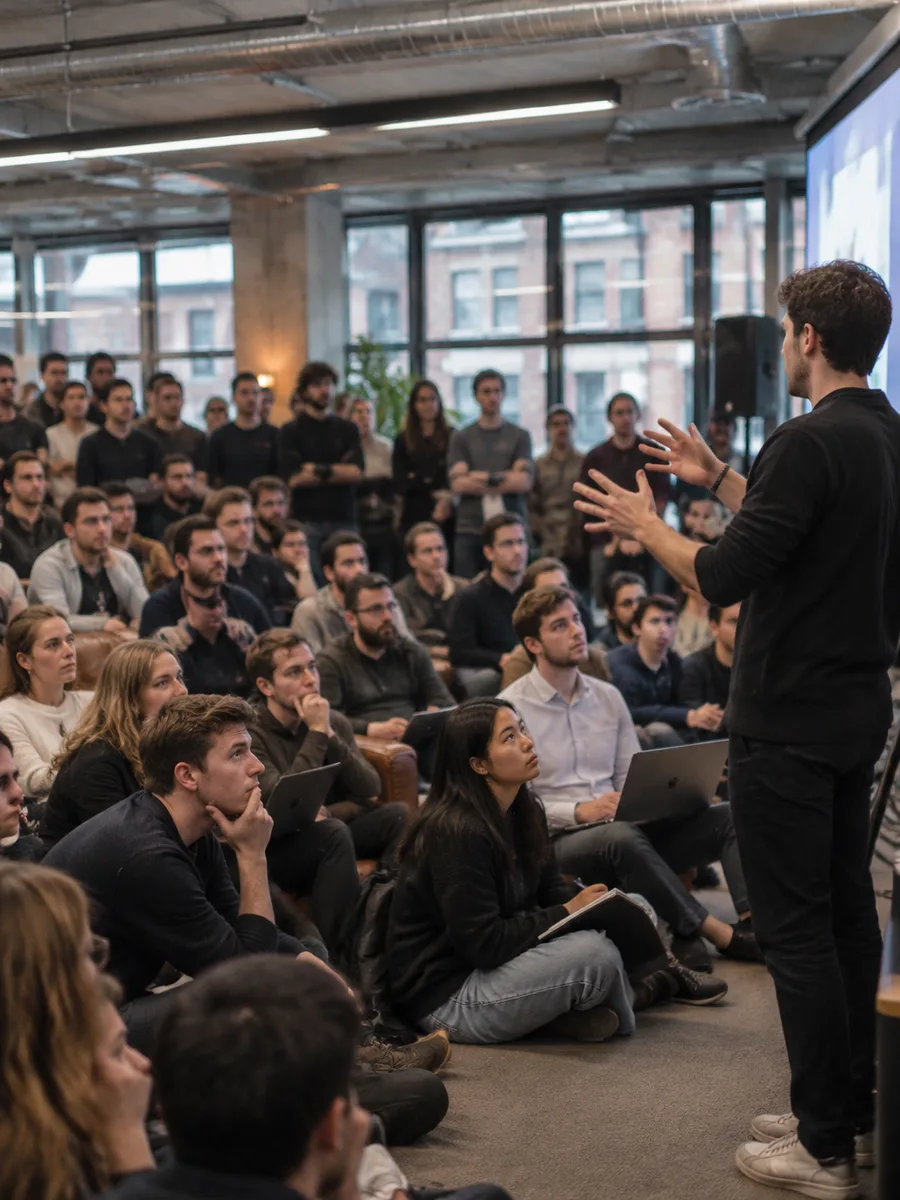
On Monday morning, an office in east London was packed with people.
They came here to meet investors.
The event was called 'Is your dream investor into you?'
The person organizing the event is Sameer Nusrat.
He works at a company.
This company helps people who want to start companies find people willing to give money.
This year, British startups have received a lot of money.
Investors have put in a total of over 26 billion US dollars.
This is more than in any previous year.
Although there is more money, the number of companies receiving money is fewer than before.
Most of the money went to one place: companies working on artificial intelligence.
In the first half of this year, nearly three-quarters of the money went to AI companies.
And this money only landed on a very small number of companies.
There is a new AI company.
This company had just started looking for money when it received 1.1 billion US dollars.
This is the largest early-stage investment of its kind in Europe.
James Wise is an investor.
He says AI has made looking at companies simpler.
What used to take a day to research can now be done in minutes.
So he no longer has to look slowly one by one.
He can first go to the most famous people.
Money is thus becoming more and more concentrated.
But on the other side, new companies coming out of universities are different.
They are finding it increasingly difficult to get their first round of money.
In the first half of this year, this kind of first-round money fell by 68.3 percent.
A large company called Sequoia Capital decided to do something.
It will close its own office in London.
Sequoia Capital also wrote a document.
The document says they don't think they need to have people here.
It wants to put people in Silicon Valley.
That place is closer to the people working on AI.
There are also founders who are not very satisfied with investors.
The boss of a large British financial company said something.
He said many investors nowadays are like cheerleaders.
They only shout from the sidelines and don't really help out.
Later he started his own investment company and invested his own money.
In London, some also say investors need to become more useful.
Otherwise, one day, it will be the investors who are left behind.
Listen again
Try it without the transcript and notice what sounds clearer.
What vocabulary does this episode teach?
词汇HSK 2. Place where people work.
HSK 2. Common noun for business.
HSK 2. Basic word for money.
HSK 1. Used in comparisons like 比...多.
HSK 1. Opposite of 多.
HSK 2. Refers to a location.
HSK 2. Easy to understand or do.
HSK 2. Unit of time.
Beyond HSK 2. 投资 means 'to invest'; 人 means 'person'.
Beyond HSK 2. Often abbreviated as AI.
Beyond HSK 2. 创立 means 'to found'.
Beyond HSK 2. Proper noun for the tech hub in California.
* beyond level超纲词
What grammar patterns appear in this episode?
语法为了 + Verb Phrase
Expresses purpose: 'in order to'.
他们来这里,是为了见投资人。
比 + Noun + 多/少
Comparison: 'more/less than'.
这比过去任何一年都多。
拿到钱的公司却比过去少了。
虽然...却...
Concession: 'although... yet...'.
钱虽然多了,拿到钱的公司却比过去少了。
被 + Verb + 的 + 是 + Noun
Passive construction focusing on the receiver.
被甩下的会是投资人自己。
Proper nouns
专有名词Sources
来源Free account
Keep learning from this story
Create a free account to keep saved words and your preferred level together.
- Keep words with their story context
- Remember your preferred level
- Build your vocabulary over time