
A Chinese podcast · Same story, 4 levels
专利号CN224104011U:一个马桶、一场内卷、和中国电动车的荒诞美学
Seres Patents Toilet for Chinese EV
About this story
Chongqing's Seres files patent CN224104011U for an in-car toilet — the latest absurd front in China's EV feature war. HSK 5-6 Chinese listening practice.
This is an HSK 5-6 Chinese listening episode that runs about 8 minutes. The full Mandarin script is shown with tap-for-pinyin and a line-by-line English translation, so you can listen and read at once — comprehensible input in the sense of Stephen Krashen's i+1 theory. It teaches 12 key vocabulary words such as 经济、市场、品牌 and walks through 3 grammar patterns, each explained in English with examples. The same news story is retold at 4 difficulty levels — use the level selector above to find the version that is challenging but still understandable for you.
Read at your level
原文Read the complete story in Chinese. Reveal pinyin and English only when you need them.
English transcript reference
Speaking of the competitive intensity in China's EV industry, you can look at sales data, patent filing volumes, or the depth of price wars.
But if you want just one image to sum it all up.
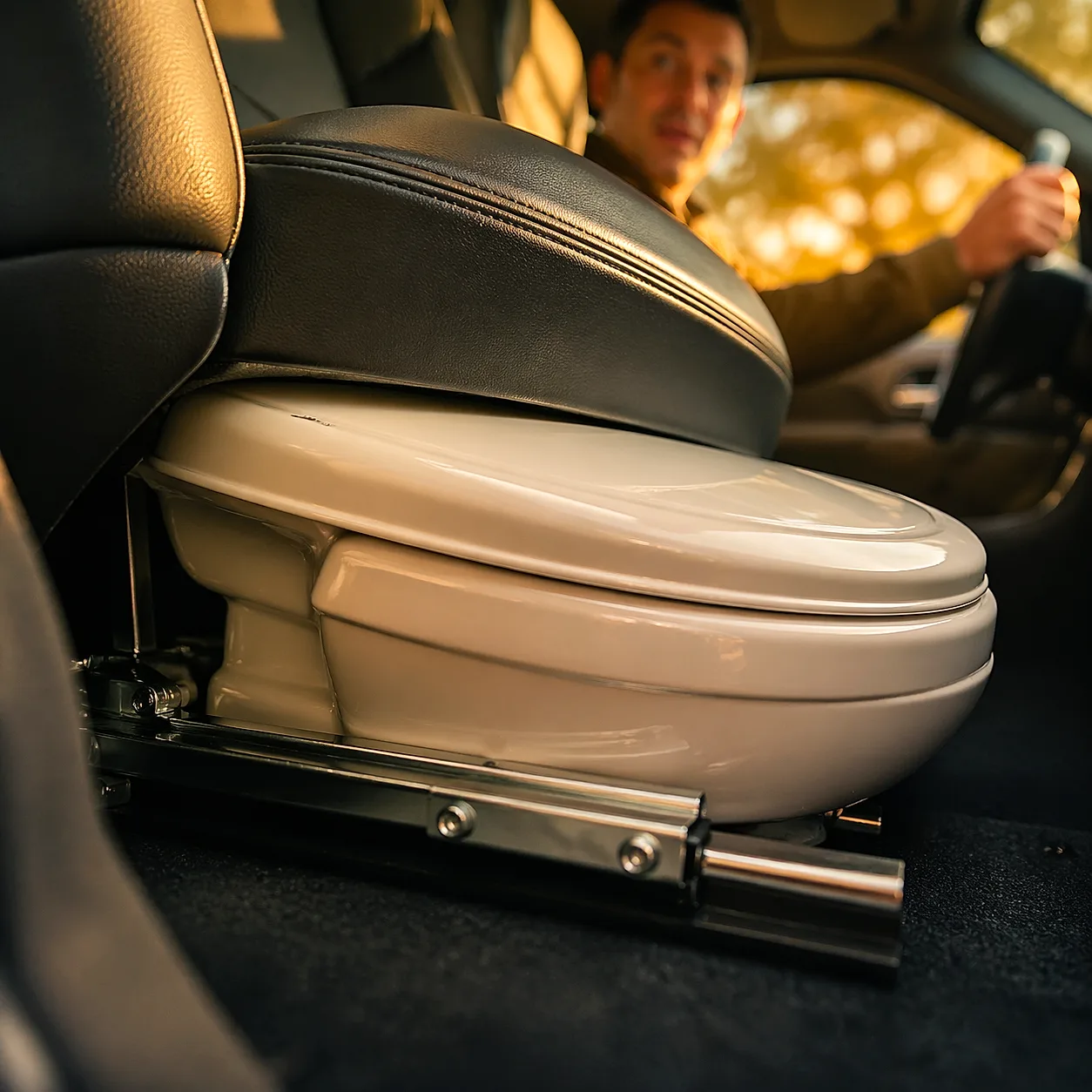
It's this: a toilet sliding out from under your passenger seat.
Chongqing-based EV brand Seres received a national utility model patent last month.
Number CN224104011U.
The content is an "in-vehicle toilet device."
In plain terms, a toilet inside a car.
Voice-controlled.
Hidden under the seat.
Say one sentence and it comes out.
After use it automatically retracts.
Before analyzing this, I need to clarify: this is a real, government-approved Chinese patent.
Not a prank.
Not a concept render.
It's a patent document with a number, technical description, and engineering drawings.
Specifically how does it work?
The toilet is mounted on a set of guide rails under the passenger seat.
The mechanism is similar to a drawer.
When needed, a voice command triggers it.
The toilet slides out along the rails.
The user can relieve themselves without leaving the car.
After use, the toilet slides back under the seat.
No visible trace from the outside.
Regarding waste processing.
The toilet bottom connects to a removable storage tank.
Inside the tank is a rotating heating element.
Urine is evaporated through heating.
Solid waste is dried.
The purpose is to reduce volume and odor.
Simultaneously an exhaust pipe channels odors through an exterior vent.
Theoretically the car interior remains odor-free.
But the final step — cleaning the storage tank — still requires manual operation.
You need to remove the tank, empty it, wash it, and put it back.
This step, honestly, is probably the biggest dealbreaker in the entire design.
The original text in Seres's patent description reads as follows.
This device aims to "satisfy users' toilet needs during long-distance travel, outdoor camping, or overnight car stays."
If you read this statement in isolation, it's actually reasonable.
China's land area is enormous.
Long-distance driving is extremely common.
Beijing to Shanghai is about 1,200 kilometers, roughly ten to twelve hours by car.
Chengdu to Lhasa is over 2,000 kilometers.
Highway rest stops are sometimes spaced 60-70 kilometers apart.
During traffic jams you might be completely immobile for two to three hours.
Camping culture in China has been growing rapidly in recent years.
Many people drive SUVs or MPVs to camp outdoors overnight.
In these scenarios.
"Being able to use a toilet in the car" is a genuine need.
Most people's solution is to hold it, find roadside bushes, or use emergency supplies.
Seres's answer is engineered: install one in the car.
From a technical standpoint this isn't a particularly complex invention.
Its core is a set of guide rails plus a sealed storage tank plus an exhaust system.
No revolutionary technical breakthrough.
What's really interesting isn't the technology itself.
But the market logic it reflects.
How intense is competition in China's EV market right now?
Let me give a few examples.
BYD's cars have fridges, TVs, and big sofas.
This "fridge, TV, big sofa" has become a Chinese internet meme.
Li Auto's MPV rear seats fold completely flat into a double bed.
Xpeng's cars have in-car karaoke.
NIO's cars can control almost everything through the NOMI voice assistant.
Zeekr's rear seats have zero-gravity massage chairs.
Huawei-Seres's Aito models run HarmonyOS car system, with interaction approaching tablet quality.
In this competitive environment.
How do you differentiate?
Everyone has fridges now.
Everyone has big screens now.
Everyone can lie flat and sleep now.
So what's next?
Seres's answer is: a toilet.
Is this answer absurd?
To some degree, yes.
But it's also the natural extension of this competitive logic.
When all "normal" differentiation has been exhausted.
The only thing that can generate news is something even more abnormal.
From a marketing perspective.
This patent might be the highest-ROI marketing event of the year for Seres.
A patent application doesn't cost much.
But it appeared on Top Gear, Carscoops, BBC, CNN.
Car media worldwide reported it.
The whole world laughed.
But after laughing, many people remembered a name: Seres.
Before this, most European and American consumers didn't know who Seres was.
Now they do.
Even though the reason they know it is a toilet.
But they know.
In the attention economy.
Being known is itself value.
Regardless of why you're known.
Of course this patent will most likely never become a production car feature.
Millions of patents are filed worldwide every year.
The vast majority never reach a production line.
Many companies file patents just to protect ideas.
To prevent competitors from getting there first.
Or like this case.
Maybe just to see how the market reacts.
What was the market's reaction?
Laughter.
Lots of laughter.
Then some serious discussion.
Then more laughter.
But I think beyond the laughter.
This is actually worth thinking about.
China's EV industry is evolving with a logic completely unlike anywhere else in the world.
In Europe and America.
A car is a car.
It takes you from A to B.
Safe, efficient, comfortable.
These are the core demands.
But in China.
A car is becoming a living space.
A mobile room.
You can work, entertain, sleep, eat inside.
Now, following Seres's logic.
You can also use the toilet inside.
This way of thinking is completely different from Europe and America.
It's not asking "how can the car drive better."
It's asking "what else can humans do inside a car."
Where's the boundary of this question?
Maybe there is no boundary.
Maybe one day Chinese EVs really will become small apartments.
Four wheels.
A kitchen.
A toilet.
A bed.
An office.
A KTV.
A massage chair.
You won't need a house.
You'll just need a car and a charging station.
This is obviously an exaggeration.
But look at the current trend.
Maybe it's not as exaggerated as you think.
Patent number CN224104011U.
A toilet.
An invention that made the whole world laugh.
But also a mirror.
Reflecting the competition, creativity, absurdity, and ambition of China's EV industry.
All packed under a single seat.
And this is perhaps the most precise metaphor of this patent.
All the qualities of China's EV industry — innovation, involution, absurdity, and seriousness — compressed into the space under one seat.
You laughed.
The whole world laughed.
But after laughing you might think.
Next time you're stuck on the highway for three hours.
Would you wish there really was that thing under the seat?
If the answer is "maybe."
Then Seres wins.
Listen again
Try it without the transcript and notice what sounds clearer.
What vocabulary does this episode teach?
词汇HSK 1-4. economy.
HSK 1-4. market.
HSK 1-4. brand.
HSK 1-4. price.
HSK 1-4. theory.
HSK 1-4. data.
The fixture you sit on in the bathroom.
Legal protection for an invention or idea.
Operated by speaking commands.
A track that lets something slide in and out.
Pushing air or smells out of a space.
When liquid turns into gas and disappears.
* beyond level超纲词
What grammar patterns appear in this episode?
语法Proper nouns
专有名词Sources
来源Free account
Keep learning from this story
Create a free account to keep saved words and your preferred level together.
- Keep words with their story context
- Remember your preferred level
- Build your vocabulary over time