
A Chinese podcast · Same story, 4 levels
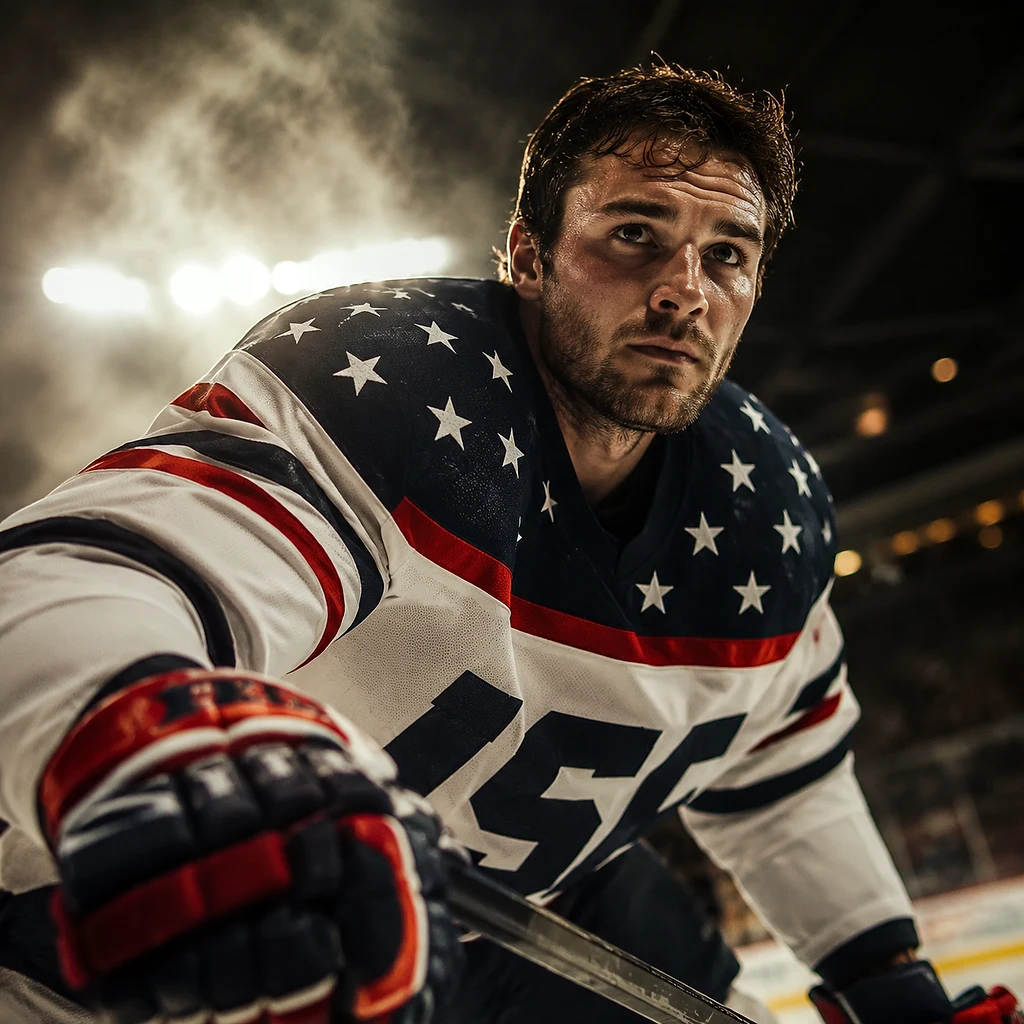
跨越半个世纪的冰上追梦:美国男子冰球冲击冬奥历史
Team USA Seeks Hockey Gold at Milan Olympics
About this story
NHL star Zach Werenski leads Team USA into Milan, chasing the first Olympic hockey gold since 1980's Miracle on Ice. HSK 5-6 Chinese listening practice.
This is an HSK 5-6 Chinese listening episode that runs about 9 minutes. The full Mandarin script is shown with tap-for-pinyin and a line-by-line English translation, so you can listen and read at once — comprehensible input in the sense of Stephen Krashen's i+1 theory. It teaches 14 key vocabulary words such as 即将、巅峰、期待 and walks through 5 grammar patterns, each explained in English with examples. The same news story is retold at 4 difficulty levels — use the level selector above to find the version that is challenging but still understandable for you.
Read at your level
原文Read the complete story in Chinese. Reveal pinyin and English only when you need them.
English transcript reference
Speaking of the upcoming Milan Cortina Winter Olympics men's ice hockey final, this is not just a sports competition, but more like a historical echo spanning half a century.
When we turn our gaze to Columbus Blue Jackets defenseman Zach Werenski, you will find that by any secular standard, he already stands at the pinnacle of success.
This famous hockey player from Michigan is not only a ten-year veteran of the NHL, but also signed a six-year contract extension worth $57.5 million in 2021,
instantly becoming one of the highest-paid defensemen in professional hockey.
His personal life is equally fulfilling; he entered the palace of marriage last summer and is currently looking forward with his wife, Odette, to the birth of their first child.
However, even with such an enviable career and a happy family, and even with a packed schedule during the NHL season, Werenski still keeps a piece of unfilled puzzle deep in his heart.
Just before flying with the team to Italy for the Winter Olympics, he made a point to find time to watch a Netflix documentary called "Miracle: Boys of the 80s".
Werenski admitted that compared to the well-known Disney movie "Miracle," he prefers this non-fiction work because he needs to draw strength from real history.
The reason for all this traces back to that famous "Miracle on Ice"—that was 1980, when the US team defeated the arrogant Soviet team in Lake Placid, New York, winning that legendary gold medal.
Werenski is very clear that since then, for a full 46 years, the US men's ice hockey team has never touched a Winter Olympic gold medal again.
That longing for historical glory drives him to revisit that brilliant memory, trying to find some spiritual totem from it to help the US team write a new chapter on the Apennine Peninsula.
"It definitely gave me more motivation," Werenski said. "We know the weight of this game, and we know what we are facing."
The special thing about this Winter Olympics is that this is the return of top NHL players to the Olympic arena after a twelve-year absence.
This means we are witnessing a true "best of the best" duel, and its competitive level and watchability can be fully compared to the Olympic basketball final or the World Cup soccer final.
In the semi-final held in Milan, the US team showed amazing dominance, sweeping the Slovak team with a large score of 6 to 2, and proudly advanced to the final.
This victory is not just a ticket to the podium, but also a charge for that historic gold medal.
When the US players skated off the ice after the semi-final, there wasn't much ecstasy on their faces because everyone knew the real test was yet to come.
It can even be said that they had almost no mind to review this seemingly easy victory because everyone's thoughts had already drifted to Sunday.
There, waiting for them is their old rival, Team Canada, and a "North American Derby" destined to spark is about to be staged.
This is not just a contest between neighbors, but a battle for revenge.
Just in the final of the "Four Nations Face-Off" a year ago, it was a goal by Canadian superstar Connor McDavid in overtime that ruthlessly shattered the US team's dream of winning the championship.
And in the previous Montreal group stage, the US team had defeated Canada 3 to 1; this entanglement of mutual victories and defeats fills the upcoming final with a tension like fate.
It can be said that this is the dream matchup that all hockey fans most desire to see before the game.
If history is some kind of foreshadowing of the future, then this game, as the grand finale of this Winter Olympics, is very likely to become a new legend.
For the US team, the significance of winning the championship this time also lies in the fact that it could become the first gold medal in the history of US men's ice hockey obtained outside of home soil.
You have to know, whether it was the 1960 Squaw Valley Winter Olympics or the 1980 Lake Placid Winter Olympics, the US team's coronation was on their own home field.
This temptation to create history in a foreign land makes these professional stars worth tens of millions feel as if they have returned to their innocent childhood days.
Brady Tkachuk, who plays for the Ottawa Senators, sighed: "To have the opportunity to realize a childhood dream, this will be a truly special moment, nothing is more wonderful than this."
The two teams are too familiar with each other, not only because of that fierce confrontation last year, but also because these players are opponents or teammates who see each other constantly in the NHL arena.
When we look back at history, the last time the US and Canada met in the Winter Olympic final traces back to Vancouver in 2010.
That was the highlight moment for Canadians; Sidney Crosby's golden goal in overtime immersed the host in a sea of carnival, and that game even set a viewing record in Canadian television history.
Team Canada seems to always have some magic at Winter Olympics where top players participate; they not only won in 2010 but also took the gold medal at the 2014 Sochi Winter Olympics.
Coupled with McDavid's buzzer-beater in the Four Nations tournament, Team Canada, as the defending champion, carries extremely high expectations from that country which regards ice hockey as its national sport.
In comparison, the US team's mentality seems more weightless.
Tkachuk appeared quite relaxed when talking about preparation: "I just eat some pasta, hang around, and relax my mind as usual. If you think too much, you will lose the fun of the game."
However, no one can deny that this is no longer 1980.
Today's US team is no longer a "ragtag army" composed of a group of college students going against the powerful Soviet "Red Army."
Even if the US team wins on Sunday, it will not shock the entire universe like half a century ago, because they are already full of stars today.
But this does not mean that this gold medal lacks value; on the contrary, it will evoke people's memories of that special era, that era when the whole country shared a bitter hatred of the enemy and advocated the spirit of the "underdog winning."
Can the US team capture that spiritual core again?
The answer will be revealed at 2:10 PM Milan time on Sunday.
US team forward Dylan Larkin used only one word to describe it when looking forward to this duel: "Chills."
He said: "Maybe we haven't even realized how much impact this will have, the process of this tournament, and the US-Canada showdown everyone expects. I hope this can create a sense of tension so the audience is as full of expectation for Sunday as we are."
Looking back at the road to promotion, compared to Canada's stumbling, the US team's performance can be said to be a leisurely walk.
On the same day the US team easily defeated Slovakia, the Canadian team had to go through a thrilling hard fight to reverse Finland at the last moment and pass through danger.
And in the quarterfinals, Canada was even dragged into overtime by the Czech team.
McDavid also admitted after defeating Finland: "This really scared the fans at home. Many mornings were stressful, but that is where the fun is."
In contrast, the US team established an advantage early in that 6-2 victory over Slovakia.
Just 4 minutes and 19 seconds into the game, Dylan Larkin opened the scoring for the US team.
Subsequently, under a heavy cannon shot from Buffalo Sabres star Tage Thompson, the score was rewritten. Although the Slovak goalkeeper had performed bravely before, he appeared helpless in the face of the US team's tide-like offensive.
By the second period, the game completely evolved into an offensive drill.
Jack Hughes' exquisite left-handed shot expanded the lead to 3-0, and just 19 seconds later, Jack Eichel scored another city with the assist of the Tkachuk brothers.
The Slovak team had to change the goalkeeper, but this still could not stop the US team's firepower. Hughes then scored twice, making the game completely lose suspense.
Although the Slovak team pulled back two goals in the final stage, this seemed more like adding a touch of tragic color to this one-sided game.
Now, the stage is set, and all the spotlights are in place.
The US team against the Canadian team, this is undoubtedly the most perfect curtain call script for the Milan Cortina Winter Olympics.
On one side is the US team eager to break the 46-year curse and create history in a foreign land, and on the other is the Canadian team with a deep foundation, swearing to defend its hegemony.
For the sport of ice hockey, you really can't ask for a more blood-pumping ending than this.
Those professional stars with high net worths have now all turned back into those teenagers with dreams, standing just one step away from legend.
Listen again
Try it without the transcript and notice what sounds clearer.
What vocabulary does this episode teach?
词汇Used to indicate an event that is going to happen very soon.
Metaphorically used to describe the highest point of success or a career.
Common verb expressing anticipation.
Used when observing a significant event or history in the making.
Refers to a difficult situation that tests someone's ability or endurance.
A very common noun used to discuss the importance of an event.
HSK 1-4. income.
Literally an echo, but often used metaphorically for historical resonance.
Literally 'to dip one's finger in'. Historically meant to covet food, now often means to encroach upon or, in sports contexts, to win a title (sometimes with a connotation of it being a rare feat).
Used to say two things are of equal beauty or quality.
Idiom describing someone who handles difficult tasks with ease and grace.
Idiom meaning to unite against a common enemy.
Idiom describing a calm, relaxed, and confident demeanor.
Idiom describing a state of extreme excitement or agitation.
* beyond level超纲词
What grammar patterns appear in this episode?
语法不仅仅是……更(像)是……
A structure meaning 'not only is it A, but it is even more so B', used to emphasize the second part.
这不仅仅是一场体育竞技,更像是一次穿越半个世纪的历史回响。
这场胜利不仅仅是一张通往领奖台的门票,更是他们冲击那枚历史性金牌的冲锋号。
无论……还是……
A pattern meaning 'no matter if it is A or B', indicating that the result or situation is the same regardless of the condition.
无论是1960年的斯阔谷冬奥会,还是1980年的普莱西德湖冬奥会,美国队的加冕都是在自己的主场。
相比之下
A phrase used to introduce a comparison or contrast, meaning 'by comparison' or 'in contrast'.
相比之下,美国队的心态似乎更加举重若轻。
相比之下,美国队在那场6比2大胜斯洛伐克的比赛中,早早就确立了优势。
即使……也……
A conjunction pattern meaning 'even if... [still]...', used to introduce a concession.
即使美国队在周日获胜,也不会像半个世纪前那样震惊整个宇宙。
之所以……是因为…… / ……的缘由,都要追溯到……
Structures used to explain the cause or reason for something. The script uses a variation 'The reason for... traces back to...'.
这一切的缘由,都要追溯到那个著名的“冰上奇迹”。
Proper nouns
专有名词Sources
来源Free account
Keep learning from this story
Create a free account to keep saved words and your preferred level together.
- Keep words with their story context
- Remember your preferred level
- Build your vocabulary over time