
A Chinese podcast · Same story, 4 levels
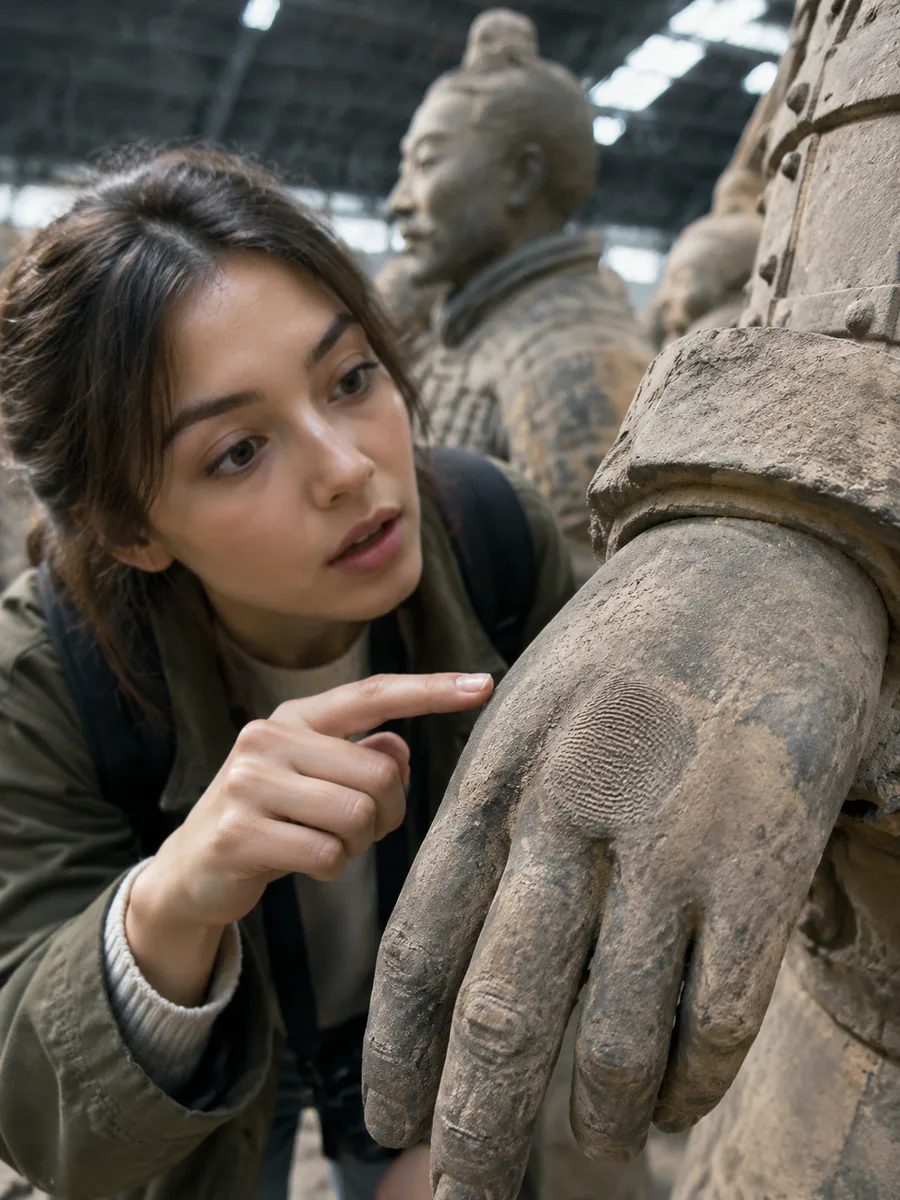
兵马俑上有女人和少年留下的指纹
Fingerprints on the Terracotta Army Suggest Women and Teenagers Helped Make It
About this story
Fingerprints on 23 Terracotta Army figures suggest that women and children under 15 may have helped make them. HSK 3 Chinese listening practice.
This is an HSK 3 Chinese listening episode that runs about 5 minutes. The full Mandarin script is shown with tap-for-pinyin and a line-by-line English translation, so you can listen and read at once — comprehensible input in the sense of Stephen Krashen's i+1 theory. It teaches 12 key vocabulary words such as 人、手、女人 and walks through 5 grammar patterns, each explained in English with examples. The same news story is retold at 4 difficulty levels — use the level selector above to find the version that is challenging but still understandable for you.
Read at your level
原文Read the complete story in Chinese. Reveal pinyin and English only when you need them.
English transcript reference
Have you ever seen many figures made of clay?
They are called the Terracotta Army.
They have faces, eyes, and hands.
Their faces, hands, and clothes are all made of clay.
Their bodies are all clay.
There are fingerprints on their hands.
Your hands are like their hands.
Fingerprints are on your hands.
If you look at your hand, you can see fingerprints.
Your fingerprints and mine are different.
The people in your home have fingerprints too.
Your friends have fingerprints too.
Everyone's fingerprints are different.
So a fingerprint can tell us who a person is.
The people who made the Terracotta Army used their hands to make clay figures.
Their fingerprints ended up on the clay figures.
The things you make have your fingerprints on them too.
These fingerprints have been on the Terracotta Army for many years.
For many years, nobody looked at these fingerprints.
Why did nobody look?
Because fingerprints are small, and many people cannot see them.
Fingerprints cannot speak.
But fingerprints can tell us a lot.
Now someone has looked.
Teachers from the Emperor Qinshihuang's Mausoleum Site Museum and Shandong University studied 23 terracotta figures together.
These 23 figures are all in one small area.
They looked at the clay figures' heads and hands very slowly.
They looked very carefully.
On these 23 figures, they found 79 fingerprints.
The 79 fingerprints are all different.
Of the 79 fingerprints, 73 were left when the makers shaped the wet clay with their hands.
The other 6 were left when they used their hands to attach other clay pieces.
These 79 fingerprints come from many people.
For the first time, someone has seen these fingerprints.
In recent days, this news has been on many people's phones.
Long ago, many people believed the makers were men.
Everyone believed that many men made the Terracotta Army together.
Many books said the same thing.
What about women?
What about children?
Nobody thought about women.
Nobody thought about children either.
From one fingerprint, we cannot tell if the person was a man or a woman.
Many fingerprints together can show us many people.
Now computers have also examined these 79 fingerprints.
Computers look faster than people do.
The computer looked many times and then answered a question.
Were the makers men, women, or children?
The computer said there were men, women, and children.
Among the makers, 45.0% were men.
32.7% were women.
Another 22.3% were children under 15.
Men were the most numerous.
But women and children were not few.
Among the men's fingerprints, those of 20-year-olds were the most common.
A journal is a publication where many people write.
This research was published in the Journal of Cultural Heritage.
But what the computer said is a likely estimate.
It describes a group of people, not one person.
We cannot tell which figure was made by one person.
We do not know which figure was made by a woman.
Nor which one was made by a child.
What they studied was one small area.
This small area is a tiny part of the whole Terracotta Army.
Other places have many figures too, and they did not study those.
So there is a lot more to study.
This is a beginning.
Among the makers there were men, women, and children.
Together, they made these figures.
Women and children may have worked on them too.
Many people had not thought of this new idea.
This idea is not in many books.
There is still much we do not know.
When you look at the Terracotta Army, you can look at their hands.
When you look at their hands, think about the people who made them.
When you are doing something, does your family come to help you?
Listen again
Try it without the transcript and notice what sounds clearer.
What vocabulary does this episode teach?
词汇HSK 1. What moves the story: the people who made the figures, and the people they left behind in the clay.
HSK 1-2. 手上 = on the hand; 用手 = with the hand. The fingerprints were left by hands.
HSK 1-2. 女 = female, 人 = person. 女人也做 = women made them too.
HSK 1-2. 男 = male, 人 = person. The old view was that only men made the figures.
HSK 1-2. Young people. The study says children under 15 left some fingerprints.
HSK 1-2. 一起做 = make something together. 一起做了兵马俑 = made the Terracotta Army together.
指 = finger, 纹 = pattern or lines. A fingerprint is the mark a finger leaves on wet clay.
The clay army buried with Qin Shi Huang. 兵 = soldier, 马 = horse, 俑 = burial figure.
Wet earth. 泥人 = a figure made of clay. The figures are made of 泥.
The museum at the mausoleum site. One of the two institutions that did the study.
A university in Shandong province. Its researchers worked on the study with the museum.
文化遗产 = cultural heritage; 杂志 = journal or magazine. The paper appeared in this journal.
* beyond level超纲词
What grammar patterns appear in this episode?
语法都 + Verb
都 means 'all' and comes before the verb: it says every one of them does or is something.
他们的身体,都是泥。
79个指纹,都是不一样的指纹。
因为……
因为 gives the reason for what was just said or asked. 'Because…'
因为指纹很小,很多人看不见。
……的时候
The phrase before 的时候 sets the time: 'when…' or 'while…'.
79个指纹里,73个是做的人用手做泥人的时候留下的。
你做事情的时候,家里的人会来帮助你吗?
能 + Verb
能 means 'can' or 'be able to'. It says what something is able to do.
一个指纹,能告诉我们一个人是谁。
但是,指纹能告诉我们很多。
Proper nouns
专有名词Sources
来源Free account
Keep learning from this story
Create a free account to keep saved words and your preferred level together.
- Keep words with their story context
- Remember your preferred level
- Build your vocabulary over time