
A Chinese podcast · Same story, 4 levels
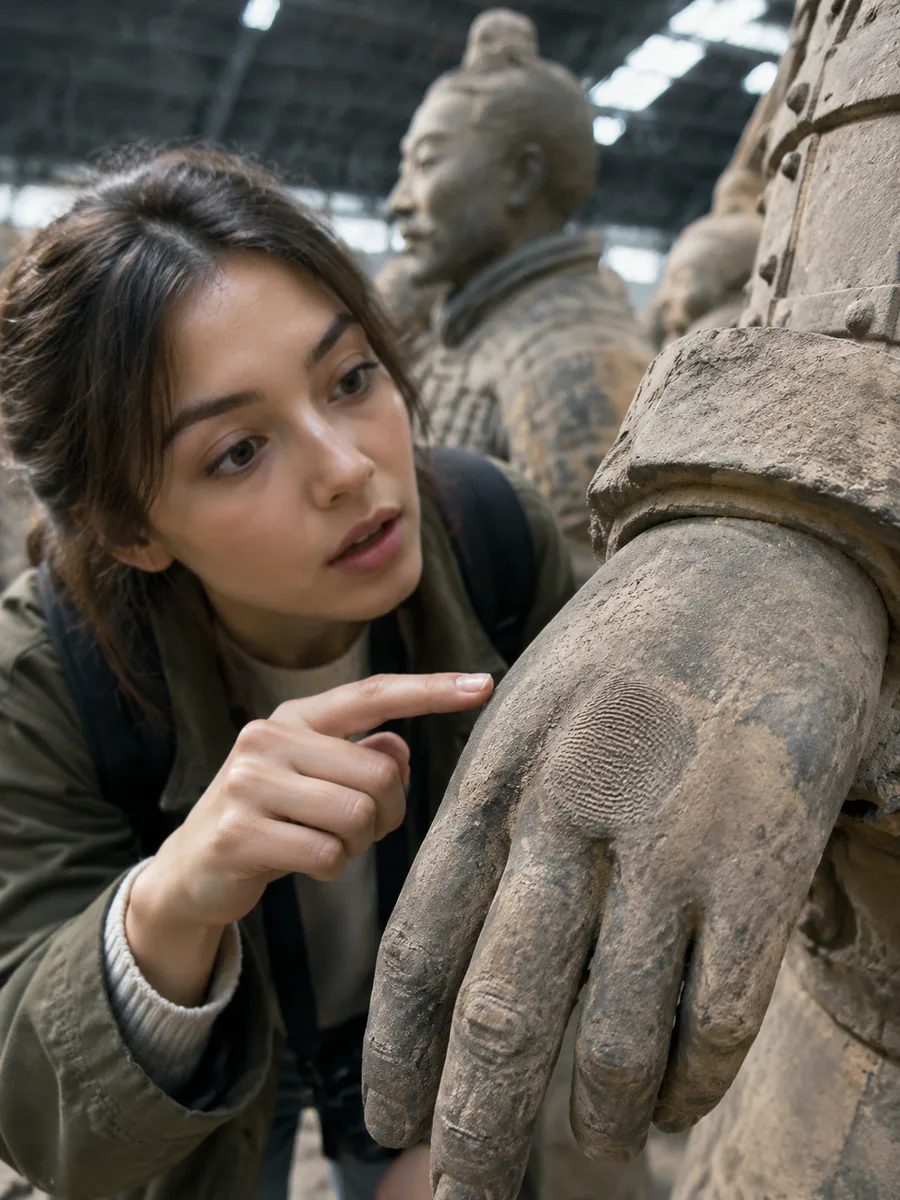
兵马俑上有女人和少年留下的指纹
Fingerprints on the Terracotta Army Suggest Women and Teenagers Helped Make It
About this story
A simple story about fingerprints found on the Terracotta Army, and what they suggest about the women and children who helped make it. HSK 2 Chinese listening practice.
This is an HSK 2 Chinese listening episode that runs about 4 minutes. The full Mandarin script is shown with tap-for-pinyin and a line-by-line English translation, so you can listen and read at once — comprehensible input in the sense of Stephen Krashen's i+1 theory. It teaches 12 key vocabulary words such as 人、东西、时候 and walks through 4 grammar patterns, each explained in English with examples. The same news story is retold at 4 difficulty levels — use the level selector above to find the version that is challenging but still understandable for you.
Read at your level
原文Read the complete story in Chinese. Reveal pinyin and English only when you need them.
English transcript reference
Look at your hand.
You have fingerprints on your hand.
A fingerprint is something on your hand.
Look at your hand, and it is right there.
Your hands can make many things.
You make a cup of tea.
Your fingerprint is on the cup.
In the cup there is water and tea.
The tea is hot.
Your friend comes to your home and drinks a cup of tea.
Your friend's fingerprint is now on this cup.
Everything you make has your fingerprint on it.
There is a famous thing in China called the Terracotta Army.
The Terracotta Army is many, many people.
They stand and look ahead.
They were made by people.
The people who made them lived very long ago.
Those people made many, many terracotta figures.
When they worked, their hands had fingerprints.
The things their hands made have fingerprints on them.
Their fingerprints are on the Terracotta Army.
Those people from long ago are all gone.
The Terracotta Army is still here.
They stayed underground for many years.
Today, we can see them.
We do not know the people who made them.
We do not know their names.
Their fingerprints are on the Terracotta Army.
Today, some people work at the Terracotta Army.
They have looked at the Terracotta Army for many years.
They look at the heads and the hands of the figures.
On 23 figures, they found 79 fingerprints.
Each figure has several fingerprints.
There are 28 fingerprints on the heads.
There are 4 fingerprints on the hands.
These fingerprints belong to people.
Some are from men, some from women, and some from children.
Listen.
Men's fingerprints are the most common, at 45.0%.
Among the men, those aged 20 are the most common.
Women's fingerprints are fewer, at 32.7%.
Another 22.3% of the fingerprints are from children.
These children are under 15.
People under 15 are children.
Children are little people.
Your sons and daughters are children too.
Children's hands are small.
Children's hands have fingerprints too.
When you were little, you were a child too.
When you were little, your hands had fingerprints too.
The things you made had your fingerprints on them too.
Long ago, people who studied the Terracotta Army said that all the makers were men.
Men are grown-ups.
Your father is a man.
Women are grown-ups.
Your mother is a woman.
Your father makes things, and your mother makes things too.
Long ago, people said women did not make the Terracotta Army.
Now the people working there say women made them too.
Children made them too.
Their hands are on the Terracotta Army too.
Children's fingerprints are small, and men's are large.
These fingerprints come from many people.
45.0% refers to many men.
32.7% refers to many women.
22.3% refers to many children.
We do not know how much any one person made.
What we see is many people working together.
Many people worked together to make the Terracotta Army.
Think about this: when you were little, who did you make things with at home?
Listen again
Try it without the transcript and notice what sounds clearer.
What vocabulary does this episode teach?
词汇HSK 1. Used after a number or 很多: 很多人 = many people. Here it names the people who made the figures.
HSK 1. 一个东西 = one thing; 做的东西 = the things one makes. Used throughout for the figures and the objects people make.
HSK 1. The pattern ……的时候 means 'when…': 你小的时候 = when you were little.
HSK 1. Measure word 个: 一个杯子. 杯子上 = on the cup.
HSK 1. Result compound of 看 (look) + 见 (see): 他们看见了79个指纹 = they saw 79 fingerprints.
HSK 1. Used after a number for age: 20岁 = 20 years old.
指 = finger, 纹 = pattern or lines. 一个指纹 = one fingerprint. The whole story is about the fingerprints left in the clay.
The clay army buried with Qin Shi Huang. 兵 = soldier, 马 = horse, 俑 = burial figure.
A male adult. 男 = male, 人 = person. 男人的指纹 = men's fingerprints.
A female adult. 女 = female, 人 = person. 女人也做了 = women made them too.
A young person. 你的孩子 = your child. The story says children under 15 left some fingerprints.
A body part. 头上的指纹 = the fingerprints on the heads. 28 fingerprints were on the heads.
* beyond level超纲词
What grammar patterns appear in this episode?
语法Place + 上 + 有 + Noun
Says what is on a surface. 上 means 'on', and 有 means 'there is/are'.
你手上有指纹。
杯子上,有你的指纹。
……的时候
Means 'when…' or 'at the time of…'. The phrase before 的时候 sets the time.
他们做的时候,手上有指纹。
你小的时候,也是孩子。
A + 也 + Verb
也 means 'also' or 'too'. It adds the same action or state to another person or thing.
孩子也做了。
你小的时候,手上也有指纹。
A common pattern that states what something is or how it was made. Here it identifies the makers and the origin of the fingerprints.
他们是人做的。
这些指纹,是人的。
Proper nouns
专有名词Sources
来源Free account
Keep learning from this story
Create a free account to keep saved words and your preferred level together.
- Keep words with their story context
- Remember your preferred level
- Build your vocabulary over time