
A Chinese podcast · Same story, 4 levels
尼安德特人:为什么只剩下我们?
What Happened to the Neanderthals? Why Homo Sapiens Is the Only Human Species Left
About this story
New evidence that Neanderthals made stone circles, art and fire — and the DNA that shows they interbred with us, leaving only Homo sapiens. HSK 4 Chinese listening practice.
This is an HSK 4 Chinese listening episode that runs about 5 minutes. The full Mandarin script is shown with tap-for-pinyin and a line-by-line English translation, so you can listen and read at once — comprehensible input in the sense of Stephen Krashen's i+1 theory. It teaches 12 key vocabulary words such as 发现、聪明、同意 and walks through 8 grammar patterns, each explained in English with examples. The same news story is retold at 4 difficulty levels — use the level selector above to find the version that is challenging but still understandable for you.
Read at your level
原文Read the complete story in Chinese. Reveal pinyin and English only when you need them.
English transcript reference
If a Neanderthal sat in today's subway, would people look at him?
Some scientists say: no.
People wouldn't give him a second glance.
He wears our clothes, rides our trains, and goes to work with us.
This idea is very interesting.
It shows that today's scientists increasingly feel that Neanderthals are a lot like us.
But many years ago, the story wasn't like this.
A hundred thousand years ago, several kinds of humans lived in the world.
Back then, humans were climbing a ladder step by step.
We were at the very top.
The others were at the bottom.
They weren't smart, so they didn't survive.
In the 19th century, people saw Neanderthal bones for the first time.
In the 1980s, many scientists thought this way.
Later, new discoveries came one after another.
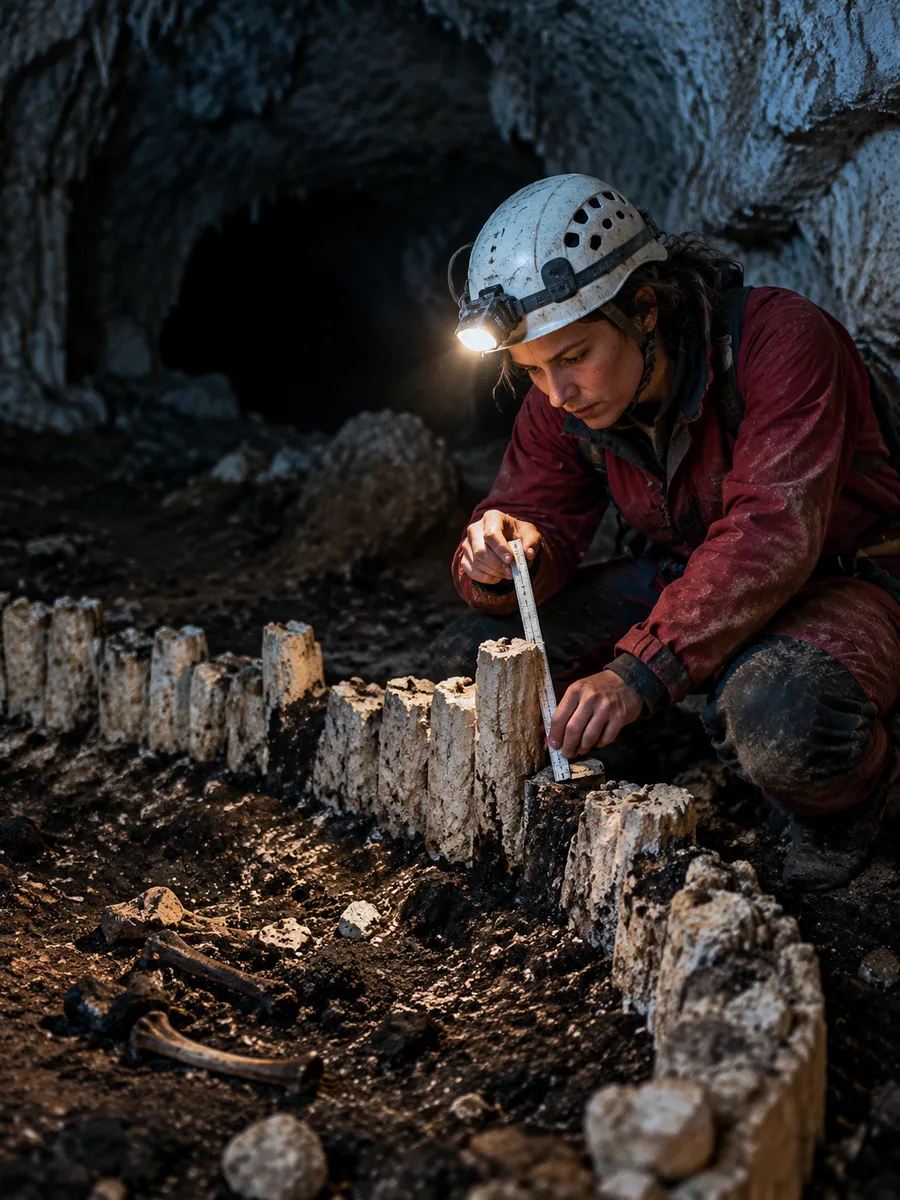
In France, there is a cave called Bruniquel Cave.
One hundred seventy-six thousand five hundred years ago, Neanderthals walked into this cave.
They broke the stone pillars in the cave.
They used these stone pillars to make a circle.
Inside the circle there were also things that had been burned by fire.
Doing these things required planning, talking, and working together.
A scientist in London said: this shows they could think about very complex things.
Besides this cave, there is other evidence.
They could draw.
They cared for sick people.
They also used fire.
So some people started saying: they are just like us.
But others disagreed.
They said: this claim goes too far.
Maybe the Neanderthals learned things from us.
Maybe it was us who learned things from them.
It's hard for us to know who learned from whom.
In 2010, Neanderthal genes came out.
These genes tell us something important.
Neanderthals didn't directly turn into us.
They also didn't completely disappear.
Our ancestors had children with them.
Today, people outside Africa have about two percent Neanderthal genes in their bodies.
Neanderthal genes stayed on in this way.
Scientists also calculated a time span.
This interbreeding lasted about seven thousand years.
It started more than fifty thousand years ago.
But there are still many things we don't know.
How many times did this interbreeding happen?
Was it willing on their part?
Or was there violence?
A scientist who studies genes said: there is far too much we still don't know.
The first question people ask him is always: how many times were there between them and us?
This answer matters a lot.
If it was only a few times, then it's just a small event in history.
If it was thousands of times, then it's tied to who we are.
Besides genes, there are other reasons.
Back then, there were very few people.
The weather was very cold, and it changed a lot.
Sometimes the Neanderthals did well.
Sometimes we did well.
Sometimes the small groups on both sides died out.
Some say this was luck.
We came from Africa.
We had a larger population.
The places they lived had colder weather and were harder.
So maybe we were just a little luckier.
Others say it wasn't about luck.
Maybe our society was larger, with more friends.
Maybe we found it easier to cooperate.
Maybe we were better able to face new diseases.
None of these answers has been proven.
Now, scientists are still searching.
They put Neanderthal genes into mice.
They want to know what these genes do.
What we know now is: these genes are related to immunity, sleep time, and body shape.
But genes are only part of the story.
How people lived, how the weather changed, how many people there were — all of these matter.
Maybe the Neanderthals did nothing wrong.
They just didn't have the kind of luck we had.
They were in the world for four hundred thousand years.
We Homo sapiens, only three hundred thousand.
For a million years, there were many kinds of humans.
Human evolution spans seven million years.
Today, there are eight billion people in the world, all one kind of human.
They are gone.
We should think about it: will we be next?
Listen again
Try it without the transcript and notice what sounds clearer.
What vocabulary does this episode teach?
词汇HSK 3. Used as both noun and verb: 新的发现一个接一个.
HSK 3. 他们不聪明,所以他们没有活下来.
HSK 3. 也有人不同意 — others disagree.
HSK 3. 这个答案很重要 — this answer matters a lot.
HSK 3. 历史里的一件小事 — a small event in history.
HSK 3. 我们更容易合作 — we found it easier to cooperate.
HSK 3. 科学家 + 说/觉得/认为 to report research findings.
HSK 3. 照顾病人 — care for the sick.
HSK 3. Used repeatedly to list hypotheses: 也许,是……
HSK 3. 我们的祖先 — our ancestors.
HSK 3. 他们也没有完全消失 — they didn't completely disappear.
HSK 3. 天气很冷,变化也很大 — the weather was cold and changed a lot.
* beyond level超纲词
What grammar patterns appear in this episode?
语法如果……,会……吗?
Conditional question: 'If X, would Y happen?' 如果 introduces the hypothetical, 会 marks the likely outcome, 吗 asks the question.
如果一个尼安德特人坐在今天的地铁里,人们会看他吗?
越来越 + Adjective/Verb
Expresses a gradually increasing degree: 'more and more…'.
它说明,今天的科学家越来越觉得,尼安德特人和我们差不多。
把 + Object + Verb + Complement
The 把 construction moves the object before the verb to show what is done to it; the verb takes a result complement.
他们把山洞里的石柱打断。
他们把尼安德特人的基因放进老鼠的身体里。
被 + Verb (passive)
Marks the passive voice: the subject receives the action. Often used without an agent.
这些答案,都没有被证明。
如果……,那(就)……
Conditional sentence: 'If…, then…'. 那/那就 introduces the consequence.
如果只有几次,那只是历史里的一件小事。
如果有几千次,那就和我们是谁有关。
和……有关
Means 'is related to / has to do with'.
这些基因和免疫、睡觉的时间、身体的样子有关。
如果有几千次,那就和我们是谁有关。
有时候……,有时候……
Parallel structure listing alternating situations: 'sometimes…, sometimes…'.
有时候,尼安德特人过得很好。
有时候,我们过得很好。
有时候,两边的小群体都没有了。
从……开始
Marks the starting point in time or space: 'starting from…'.
它从五万多年以前开始。
Proper nouns
专有名词Sources
来源Free account
Keep learning from this story
Create a free account to keep saved words and your preferred level together.
- Keep words with their story context
- Remember your preferred level
- Build your vocabulary over time