
A Chinese podcast · Same story, 4 levels
西安:为什么不挖
Xi'an City Wall and Its 2,000-Year History
About this story
Why Xi'an's wall is Ming not Tang, how 8,000 figures were found looking for water in 1974, and why China deliberately stopped digging. HSK 3 Chinese listening practice.
This is an HSK 3-4 Chinese listening episode that runs about 5 minutes. The full Mandarin script is shown with tap-for-pinyin and a line-by-line English translation, so you can listen and read at once — comprehensible input in the sense of Stephen Krashen's i+1 theory. It teaches 12 key vocabulary words such as 城墙、唐代、明代 and walks through 3 grammar patterns, each explained in English with examples. The same news story is retold at 4 difficulty levels — use the level selector above to find the version that is challenging but still understandable for you.
Read at your level
原文Read the complete story in Chinese. Reveal pinyin and English only when you need them.
English transcript reference
Xi'an's most famous thing is outside the city, but the best place to understand the city is inside it.
Most visitors get off the plane and head straight for the Terracotta Army.
I put the Terracotta Army off until the second day and went up on the city wall first.
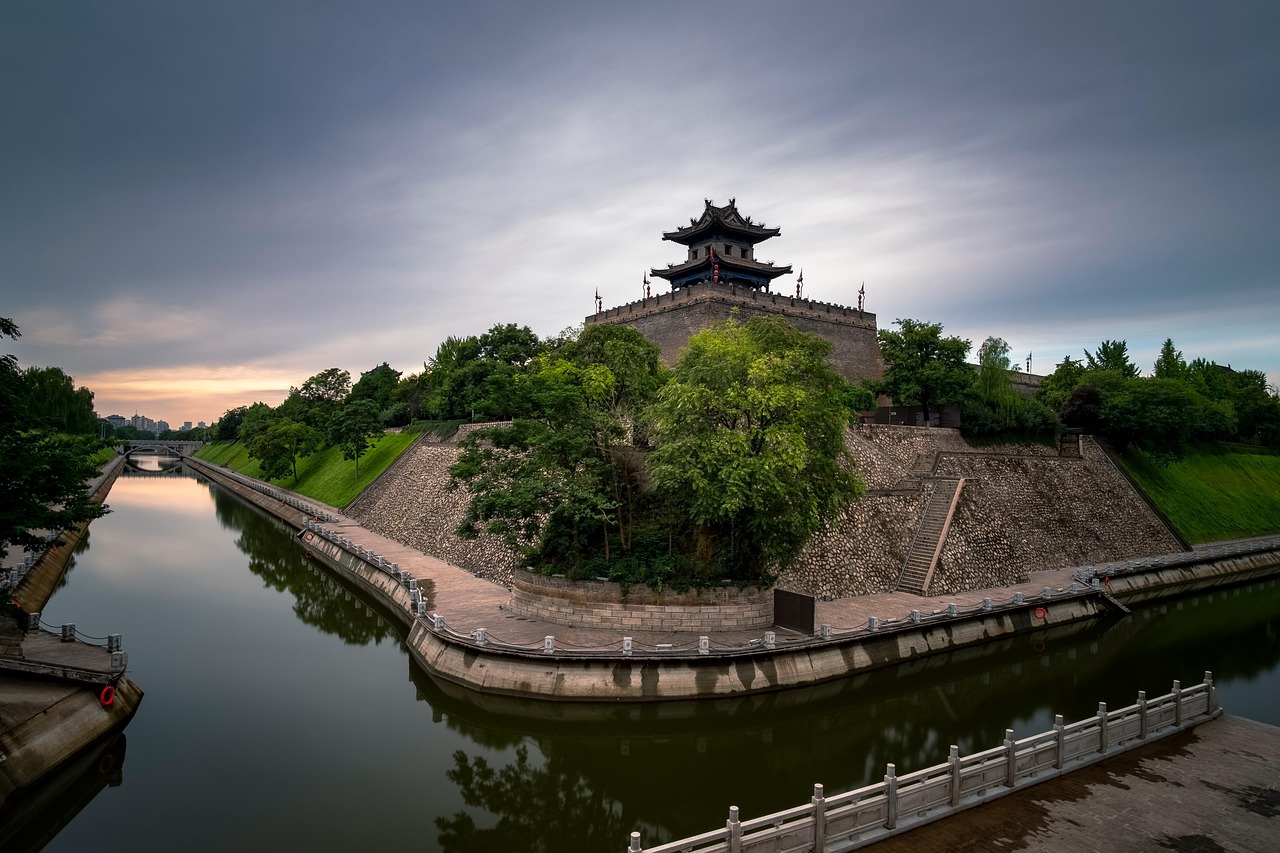
The Xi'an wall runs thirteen point seven kilometres, twelve to fourteen metres wide on top and fifteen to eighteen metres thick at the base.
That width lets you ride two abreast; a full circuit takes a bit over an hour.
Riding along it, left and right are two different worlds.
Inside the wall is the old city: narrow streets, low houses.
Outside the wall are wide roads and tall towers.
A single wall separating two kinds of city is something you rarely see in China now.
That said, this wall isn't as old as many people assume.
The wall you see today was built in the Ming dynasty: begun in 1370, completed in 1378, so a bit over six hundred years old.
Its real significance is that it preserves the outline of a much earlier city — it stands on the foundations of the Sui and Tang imperial city.
More than a thousand years ago, this place was called Chang'an, the capital of the Tang dynasty.
Tang Chang'an was several times larger than the area the wall encloses today.
In the world at that time, Chang'an was one of the largest cities there was.
In other words, the circuit you ride on the wall is only a small piece of Tang Chang'an.
Chang'an was also the eastern starting point of the Silk Road.
Heading west from Chang'an, caravans had to cross the Hexi Corridor, desert, and the oases of Central Asia.
What they brought back was more than goods.
Foreign music, religion, dance and food all entered this city as well.
The streets of Tang Chang'an held large numbers of foreigners, doing business, studying, settling in.
So Xi'an's connection to the outside world is not something from the last few decades.
The next day I went to the Terracotta Army.
The pits are east of Xi'an, part of the tomb complex of the first Qin emperor.
Standing at the edge of Pit One looking down, the most immediate impression is quantity.
More than eight thousand figures stand in formation, and every face is different.
They were made more than two thousand two hundred years ago.
The way they were discovered had no drama at all.
On 29 March 1974, some villagers digging a well here for water turned up pottery fragments and a clay head.
One of China's most famous archaeological finds came out of a search for water.
While visiting, I noticed something that often gets overlooked.
These figures originally had colour: red, green and white were all used.
The method was to brush a layer of raw lacquer onto the surface of the figure, and paint the pigment on top of the lacquer.
That lacquer sat underground for over two thousand years, saturated with moisture.
The moment it comes out and meets the air, the lacquer loses water fast, curls, cracks, and the pigment flakes off with it.
At the fastest, the colour begins changing fifteen seconds after the figure is unearthed.
Two thousand two hundred years in the ground; fifteen seconds out.
The grey army we see today isn't what they originally looked like.
Once you know that, the museum's other decision makes sense.
Painted figures that come out now are immediately sprayed with a moisture retainer, treated with a consolidant, and wrapped in film to control the humidity.
More importantly, a lot of areas simply aren't being dug.
The main tomb of the first Qin emperor has still never been excavated.
When the technology isn't adequate, leaving things in the ground is the more responsible choice.
That often runs opposite to what the tourism industry wants.
In the afternoon I went to the Muslim Quarter.
A lot of people write it up as a street-food street; that isn't wrong, but it's shallow.
This area is the core of Xi'an's Hui community, and the mosque beside it has a long history.
Among the Hui's ancestors were merchants who came along the Silk Road and soldiers who moved here later.
They've lived here for over a thousand years and formed their own food and their own streets.
Today's Muslim Quarter is very commercial, crowded, and not cheap.
But walk into one of the small lanes beside it and you see a different rhythm.
At dusk I went back to the foot of the wall.
The lights came on and the outline of the wall grew clear.
I thought about that circuit on the bike in the daytime.
In one day I passed a six-hundred-year-old wall, a Chang'an over a thousand years old, a Hui community a thousand years old, and an army from twenty-two centuries ago still waiting underground.
They don't sit in the same span of time, yet they are crowded onto the same piece of ground.
If you only had one day, would you go and see that army first, or ride around the city once and work out how big it is?
Listen again
Try it without the transcript and notice what sounds clearer.
What vocabulary does this episode teach?
词汇What the wall really preserves.
HSK 3. The reason for not digging.
HSK 4. Leaving artefacts buried is the responsible call.
HSK 4. The first thing you feel at the edge of Pit One.
Ming-built, on Sui-Tang foundations.
When Chang'an was one of the largest cities on earth.
When the wall you actually ride on was built.
More than eight thousand, no two faces alike.
The layer whose failure destroyed the colour.
Painted onto the lacquer, and lost with it.
The moment the fifteen-second clock starts.
Deliberately not being done, over large areas.
* beyond level超纲词
What grammar patterns appear in this episode?
语法并没有 … 那么 …
Denies an assumed degree.
不过这道墙并没有很多人以为的那么老。
换句话说
Restates the point more plainly.
换句话说,你在城墙上骑的这一圈,只是唐长安的一小块。
在 … 的时候,… 是更 … 的选择
Frames a judgement as conditional on circumstances.
把东西继续留在地下,在技术不够的时候,是更负责的选择。
Proper nouns
专有名词Free account
Keep learning from this story
Create a free account to keep saved words and your preferred level together.
- Keep words with their story context
- Remember your preferred level
- Build your vocabulary over time