
A Chinese podcast · Same story, 4 levels
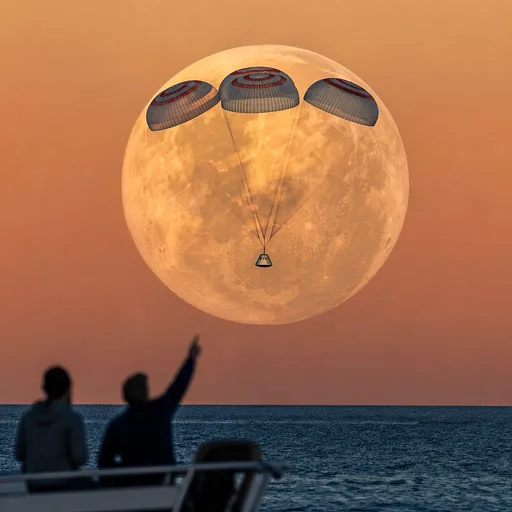
阿尔忒弥斯二号:四个人绕着月亮飞
Artemis 2 Returns from First Lunar Trip in 54 Years
About this story
A simple story about four astronauts from the US and Canada who flew to the Moon and came home to the sea near San Diego. HSK 1 Chinese listening practice.
This is an HSK 1 Chinese listening episode that runs about 6 minutes. The full Mandarin script is shown with tap-for-pinyin and a line-by-line English translation, so you can listen and read at once — comprehensible input in the sense of Stephen Krashen's i+1 theory. It teaches 12 key vocabulary words such as 月亮、天、火箭 and walks through 4 grammar patterns, each explained in English with examples. The same news story is retold at 4 difficulty levels — use the level selector above to find the version that is challenging but still understandable for you.
Read at your level
原文Read the complete story in Chinese. Reveal pinyin and English only when you need them.
English transcript reference
Speaking of the moon, let me tell you a good story.
You look at the sky at night.
Do you see the moon?
The moon is big.
The moon is bright.
The moon is far.
The moon is very very far from us.
But there are four people.
They went to see the moon.
They really went.
They went on a very big thing.
This thing is called a rocket.
What is a rocket?
A rocket is a very very big machine.
It can fly.
Fly very high.
Fly up into the sky.
Fly to where the moon is.
These four people are Americans.
No wait, one of them is Canadian.
What kind of people are they?
They are called "astronauts."
Astronauts are people who go to space.
Space is the highest place above the sky.
Higher than airplanes.
Higher than clouds.
Higher than anything you can see.
They went for ten days.
Ten days.
Not long, but not short either.
They went in a rocket.
Flying and flying.
Flying to where the moon is.
Then they circled around the moon.
After going around.
They went home.
Their "home" is Earth.
We all live on Earth.
Yes, the way home is long.
But they didn't oversleep.
Today they arrived home.
They came back today.
They didn't land on the ground.
They landed in the sea.
Yes, in the sea.
Why land in the sea?
Because the sea is softer.
Softer than the ground.
When their "car" came down from the sky.
The speed was very fast.
Very very fast.
Forty thousand kilometers an hour.
That's a big number, right?
So they needed a soft place to stop.
Sea water is soft.
Their car landed in the sea near California.
California is in America.
There was a big ship waiting for them on the sea.
The big ship picked them up.
All four people were fine.
All very happy.
They said: "We're back.
They said: "We saw the moon.
They said: "The moon is beautiful.
Do you know something very important?
Many many years ago, people also went to the moon.
That was fifty-four years ago.
Fifty-four years.
A very long time ago.
Your mom and dad may not have been born yet then.
After that, nobody went.
All these years, nobody went to the moon.
Until this time.
This is the first time in fifty-four years.
So this story is very important.
People are starting to go to the moon again.
Why go to the moon?
Because people want to know many things.
People want to know what the moon is like.
People want to know what's on the moon.
People want to know if one day we can live on the moon.
This sounds like a dream.
But dreams sometimes come true.
These four people are just the beginning.
Next time, other people will go.
Next time, people will really stand on the moon.
Not just look at the moon.
But stand on the moon.
Stand with their feet.
Just like you standing at home.
That time hasn't come yet.
But it's coming soon.
Maybe in a few more years.
Think about it.
Walking on the moon.
Seeing the Earth like a small blue ball.
This is the dream of many people.
Now this dream is starting again.
Starting from these four people coming home today.
Welcome home.
You did a great job.
By the way, let me say where they landed.
They landed in the sea near California.
California is a place in America.
On the west side of America.
San Diego is a city.
By the sea near San Diego.
When they came down.
There was a big ship waiting.
This ship is a U.S. Navy ship.
The people on the ship picked them up from the sea.
They walked out of the spacecraft.
One by one they walked out.
All walked out on their own.
Nobody had to carry them.
This shows their bodies are very healthy.
A doctor looked at them.
The doctor said they are all very healthy.
Very happy.
Then they were taken to the ship's medical room.
To rest well.
They ate food.
They drank water.
They called their families.
"I'm back," they said.
The families all cried.
Because they were so happy.
Who wouldn't worry about their own family?
Going to space is a very dangerous thing.
Them coming back is the best news.
Listen again
Try it without the transcript and notice what sounds clearer.
What vocabulary does this episode teach?
词汇The moon in the sky at night.
The sky above or one calendar day.
回 (return) + 家 (home).
A large body of salt water.
大 (big) + 船 (ship/boat).
In good physical condition.
To feel anxious about something.
火 (fire) + 箭 (arrow). A rocket that goes to space.
A person who travels into space for work.
The area beyond Earth's atmosphere.
Our planet. 地 (ground) + 球 (ball).
Something that could cause harm.
* beyond level超纲词
What grammar patterns appear in this episode?
语法Proper nouns
专有名词Sources
来源Free account
Keep learning from this story
Create a free account to keep saved words and your preferred level together.
- Keep words with their story context
- Remember your preferred level
- Build your vocabulary over time