
A Chinese podcast · Same story, 4 levels
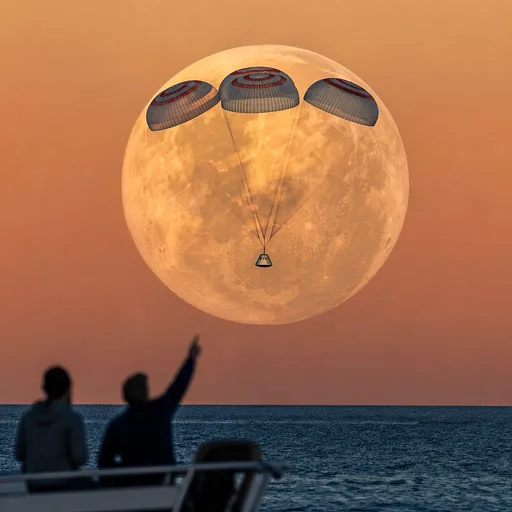
五十四年后,人又去了月亮
Artemis 2 Returns from First Lunar Trip in 54 Years
About this story
Commander Reid Wiseman and the Artemis 2 crew fly to the Moon in Orion capsule Integrity — first trip since Apollo. HSK 2 Chinese listening practice.
This is an HSK 2 Chinese listening episode that runs about 6 minutes. The full Mandarin script is shown with tap-for-pinyin and a line-by-line English translation, so you can listen and read at once — comprehensible input in the sense of Stephen Krashen's i+1 theory. It teaches 12 key vocabulary words such as 为什么、旁边、意思 and walks through 4 grammar patterns, each explained in English with examples. The same news story is retold at 4 difficulty levels — use the level selector above to find the version that is challenging but still understandable for you.
Read at your level
原文Read the complete story in Chinese. Reveal pinyin and English only when you need them.
English transcript reference
Speaking of humans going to the moon, today is a special day.
Four astronauts just came back from the moon.
They returned to Earth tonight.
This is a very big deal.
Why is it so big?
Because it's been fifty-four years.
No one has gone as far as the moon for fifty-four years.
The last time was 1972.
That was Apollo 17.
My parents weren't even born then.
Since then, humans have gone to space.
But not this far.
They were all in places not far from Earth.
You could call it "next to Earth."
But this time is different.
This time they really flew to the moon.
Circled around the moon.
And then came home.
This mission is called Artemis 2.
Artemis is a goddess in Greek mythology.
She is the moon goddess.
She is the younger sister of the sun god Apollo.
The mission fifty-four years ago was called Apollo.
Now this new mission is called Artemis.
It's the younger sister coming to finish what her older brother didn't.
Who are these four astronauts?
Their commander is named Reid Wiseman.
There's also Victor Glover and Christina Koch.
And there's a Canadian named Jeremy Hansen.
Three Americans plus one Canadian.
This is the first time someone from outside America has flown this far to the moon.
The Canadians are very proud.
The spacecraft they rode is called Orion.
This spacecraft also has a name — Integrity.
Integrity means honesty and uprightness.
They spent ten days in total.
They did many things in those ten days.
They took many photos.
They tested all the systems of the spacecraft.
They circled around the moon.
Then started flying home.
The trip home is dangerous.
Why?
Because when the spacecraft enters Earth's atmosphere.
The speed is very very fast.
About forty thousand kilometers per hour.
At that fast a speed.
The outside of the spacecraft becomes very hot.
How hot?
As hot as five thousand degrees.
Your oven at home only goes up to a few hundred degrees.
The outside of the spacecraft is five thousand degrees.
Five thousand degrees can melt steel.
But the people inside the spacecraft need to stay alive.
So there's a special layer outside the spacecraft.
Designed to block all this heat.
Today this system worked.
The spacecraft safely passed through the atmosphere.
Then a big parachute opened.
The spacecraft slowly landed in the Pacific Ocean.
It landed near San Diego, California.
About forty miles from the coast.
The U.S. Navy had a big ship waiting there.
Sailors used small boats to bring the four astronauts onto the big ship.
All four of them were fine.
All smiling.
The doctor said they "feel great and are happy to be home."
This story isn't over yet.
This is just the beginning.
Artemis 2 only flew to the moon and took a look.
It didn't actually land on the moon.
The real landing is the next mission.
That mission is called Artemis 3.
Artemis 3 will let people actually stand on the moon.
Stand with their feet.
The last time someone walked on the moon was 1972.
That's already more than fifty years ago.
Now we're starting again.
Why go back to the moon?
Because humans want to go further.
The ultimate goal is Mars.
But before going to Mars.
We have to first learn how to go to the moon.
The moon is like a practice place.
Practicing how to live on the moon.
How to build houses.
How to find water.
After learning, we can go to Mars.
This is the meaning of Artemis 2.
It's not the last step.
It's the first step.
Welcome home, four astronauts.
What you did is very important.
By the way, there's one more thing I want to say.
Do you know who Christina Koch is?
She is one of the female astronauts on this mission.
She already has many records in space.
She once spent 328 consecutive days at the International Space Station.
Almost a year.
This is the world record for a female astronaut's continuous time in space.
Now she is also one of the first women to return to lunar space.
Her story tells little girls.
Space is yours too.
Not just for men.
Anyone can become an astronaut if they work hard.
The U.S. president watched the live broadcast tonight.
He congratulated the four astronauts.
He said the next goal is Mars.
People all over the world watched this broadcast.
Many children saw it.
They might think: one day I want to go to space too.
This is the most important meaning of this kind of mission.
Not just scientific discoveries.
But making people believe it's possible.
Making children believe dreams can come true.
As long as you work hard.
Listen again
Try it without the transcript and notice what sounds clearer.
What vocabulary does this episode teach?
词汇HSK 1-2. why.
HSK 1-2. side / beside.
HSK 1-2. meaning / interest.
HSK 1-2. matter/thing.
HSK 1-2. hour.
HSK 1-2. place.
A specific job or assignment to accomplish.
A person who travels in space.
希腊 (Greece) + 神话 (mythology).
女 (female) + 神 (god).
太阳 (sun) + 神 (god).
Feeling pride in an achievement.
* beyond level超纲词
What grammar patterns appear in this episode?
语法Proper nouns
专有名词Sources
来源Free account
Keep learning from this story
Create a free account to keep saved words and your preferred level together.
- Keep words with their story context
- Remember your preferred level
- Build your vocabulary over time