
A Chinese podcast · Same story, 4 levels
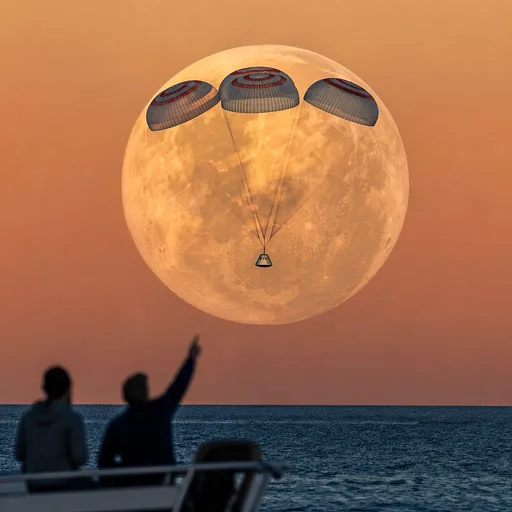
Integrity号归来:五十四年的等待结束了
Artemis 2 Returns from First Lunar Trip in 54 Years
About this story
NASA's Artemis 2 brings Orion capsule Integrity home, ending humanity's 54-year absence from the Moon since Apollo. HSK 5-6 Chinese listening practice.
This is an HSK 5-6 Chinese listening episode that runs about 7 minutes. The full Mandarin script is shown with tap-for-pinyin and a line-by-line English translation, so you can listen and read at once — comprehensible input in the sense of Stephen Krashen's i+1 theory. It teaches 12 key vocabulary words such as 象征、经济、政治 and walks through 5 grammar patterns, each explained in English with examples. The same news story is retold at 4 difficulty levels — use the level selector above to find the version that is challenging but still understandable for you.
Read at your level
原文Read the complete story in Chinese. Reveal pinyin and English only when you need them.
English transcript reference
When it comes to this generation's space memories, most of them are the International Space Station, SpaceX, or imagination from movies.
But what happened tonight is a little different.
At 8:07 PM Eastern Time on April 10th, a spacecraft named Integrity fell from the sky and landed in the Pacific Ocean about forty miles west of San Diego, California.
Inside the spacecraft were four astronauts.
They had just completed humanity's first lunar flyby in fifty-four years.
That sentence is worth repeating.
The first time in fifty-four years.
The last time any humans had been near the Moon was Apollo 17 in December 1972.
After that, humanity stopped.
Stopped for half a century.
Two full generations were born, grew up, and grew old without anyone leaving low Earth orbit.
Tonight, that record was finally broken.
This mission is called Artemis 2, the first crewed flight of NASA's Artemis program.
Artemis in Greek mythology is the goddess of the Moon, and the twin sister of the sun god Apollo.
The name itself is both a tribute and a declaration: we're back.
The entire mission lasted ten days.
The spacecraft's official designation is Orion, and this particular one was named Integrity by the crew — meaning uprightness and honesty.
The four astronauts are Commander Reid Wiseman, Victor Glover, Christina Koch, and Canadian astronaut Jeremy Hansen.
Jeremy Hansen's identity deserves special mention.
He is the first non-American astronaut in history to fly to lunar space.
For Canada's space community, this is a milestone moment.
Let's look at what happened during those ten days.
After launching from the Kennedy Space Center, the spacecraft first spent some time in Earth orbit doing system checks.
Then the main engine ignited, sending the spacecraft onto the transfer orbit toward the Moon.
About three days later, they arrived near the Moon.
The mission's farthest point from Earth was about 230,000 miles, roughly behind the far side of the Moon.
They didn't land — they just performed a free return flyby, looping around the Moon and being pushed back to Earth naturally by the Moon's gravity.
This orbital strategy is called a "free return trajectory," and the Apollo 13 accident used the same path.
Next came going home.
The trip home is the most dangerous part of the entire mission.
Not the launch, not the flight — it's reentry into the atmosphere.
At 7:53 PM tonight, the spacecraft began reentry.
The speed at the time was about 24,661 miles per hour.
This speed is only about 130 miles per hour below the crewed spaceflight speed record held by Apollo 10.
Entering the atmosphere at this speed, the friction produces temperatures reaching 5,000 degrees Fahrenheit.
That's about 2,700 degrees Celsius.
This temperature is enough to instantly vaporize most metals.
So what about the people inside?
They're protected by the heat shield on the bottom of the spacecraft.
This heat shield is made of special carbon-based composite materials that absorb heat and then peel off in layers.
It doesn't resist heat — it slowly sacrifices itself to protect the spacecraft.
During reentry there's also about a six-minute communications blackout.
Because the extreme temperature forms a layer of plasma around the spacecraft that radio waves can't penetrate.
During those six minutes, Mission Control has no idea what's happening inside the spacecraft.
They can only wait.
Any aerospace engineer who has lived through it will tell you those six minutes are the longest six minutes in the world.
Then the signal came back.
The spacecraft had emerged from the blackout zone.
The gravity the astronauts endured during reentry reached about 3.9 G's.
What does four G's mean?
It means you feel your body weight has suddenly become three and a half times normal.
You can barely lift your hand.
After getting through this phase, the parachutes began to deploy in sequence.
First the drogue chutes, then the main chutes.
The spacecraft finally touched the water at about 20 miles per hour.
Mission Control's response was one sentence:
"A perfect bullseye splashdown."
Translated, that means "perfect bullseye water landing."
About ninety minutes later, the four astronauts walked out of the side hatch one by one, and walked onto the recovery boat on their own.
The medical officer's report was that they "felt great and were happy to be home."
All of them were able to walk to the recovery ship's medical bay on their own.
Artemis 2 was a perfect mission from start to finish.
No major failures.
No surprises.
All design parameters met or exceeded expectations.
This is very important.
Because it's a stepping stone to Artemis 3.
Artemis 3 is the real crewed lunar landing mission.
The astronauts will ride the Orion spacecraft to lunar orbit.
Then transfer to SpaceX's Starship lander to touch down near the lunar south pole.
NASA has already committed that the first woman and the first non-white astronaut to walk on the Moon will come from the Artemis 3 mission.
This will be the first time in half a century that humans truly leave footprints on the Moon.
So why go back?
For fifty-four years they didn't go, so why suddenly go again?
The answer has several layers.
First, the Moon is now being redefined.
No longer a Cold War geopolitical symbol.
But a stepping stone for deep space exploration.
In the future, all missions to Mars, asteroids, and the outer solar system may launch from lunar orbit.
Because the Moon has low gravity and low escape velocity, making it a much more economical transfer station than Earth.
Second, water ice has been discovered at the Moon's south pole.
Water can become oxygen for people to breathe.
It can also be electrolyzed into hydrogen and oxygen as rocket fuel.
This means the Moon could become a gas station in space.
This fundamentally changes the economics of space exploration.
Third, America faces competition from China.
China's space program has accelerated over the past decade.
China has already achieved a soft landing on the far side of the Moon, and has its own lunar sample return missions.
China also has its own crewed lunar landing program, targeted for around 2030.
So Artemis is in some sense a restart of the space race.
What's different is that this time the race isn't just between two superpowers.
SpaceX, Blue Origin, and many other private companies are also major participants.
Tonight, when Integrity splashed down in the Pacific.
Applause broke out in Mission Control.
The White House issued a statement.
The astronauts' families were waiting for them at the scene.
But what's most worth remembering may not be these ceremonial images.
It's the ordinary people who watched the live broadcast.
It's the children who saw humans come home from the Moon for the first time in their lives.
To them, space is no longer an old story in history books.
Space is something that is happening right now.
Tonight, these four people proved one thing:
That road never disappeared.
It was just waiting for us for fifty-four years.
Listen again
Try it without the transcript and notice what sounds clearer.
What vocabulary does this episode teach?
词汇Something that represents or stands for a concept.
HSK 1-4. economy.
HSK 1-4. politics.
HSK 1-4. international.
HSK 1-4. to prove.
HSK 1-4. concept.
To announce something formally.
Orbital space close to Earth.
An orbital path that naturally returns to Earth.
A protective layer that absorbs reentry heat.
When radio signals are blocked by plasma during reentry.
The spacecraft returning through Earth's atmosphere.
* beyond level超纲词
What grammar patterns appear in this episode?
语法Proper nouns
专有名词Sources
来源Free account
Keep learning from this story
Create a free account to keep saved words and your preferred level together.
- Keep words with their story context
- Remember your preferred level
- Build your vocabulary over time