
A Chinese podcast · Same story, 4 levels
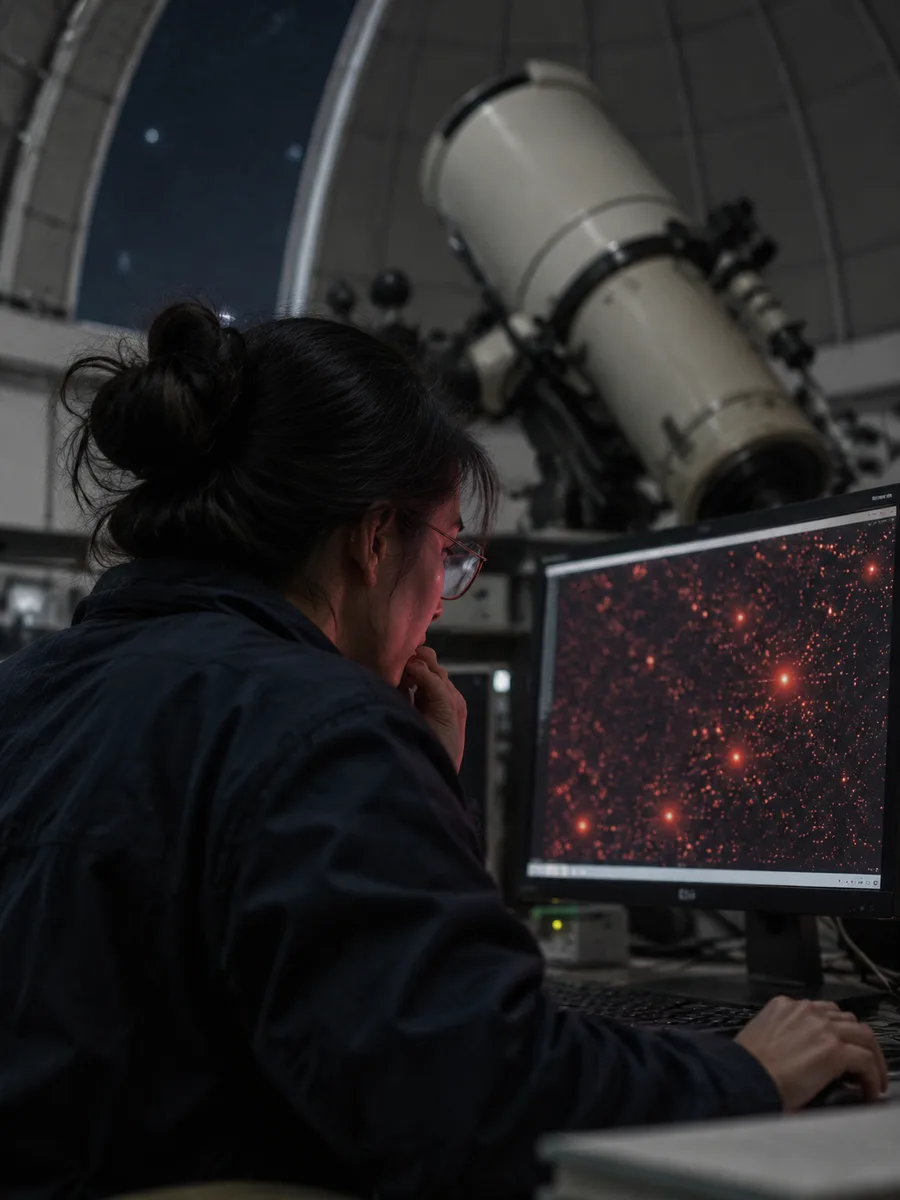
韦布望远镜拍到的小红点:是黑洞,还是黑洞星?
James Webb Telescope's Little Red Dots: Black Holes or Black-Hole Stars?
About this story
Astronomers debate whether the James Webb Space Telescope's little red dots are accreting black holes or a new kind of object called black-hole stars. HSK 5+ Chinese listening practice.
This is an HSK 5+ Chinese listening episode that runs about 3 minutes. The full Mandarin script is shown with tap-for-pinyin and a line-by-line English translation, so you can listen and read at once — comprehensible input in the sense of Stephen Krashen's i+1 theory. It teaches 12 key vocabulary words such as 质量、解释、模型 and walks through 5 grammar patterns, each explained in English with examples. The same news story is retold at 4 difficulty levels — use the level selector above to find the version that is challenging but still understandable for you.
Read at your level
原文Read the complete story in Chinese. Reveal pinyin and English only when you need them.
English transcript reference
In the deep-space images sent back by the James Webb Space Telescope, more than five hundred small, red points of light are scattered.
Astronomers call them "little red dots," and to this day they cannot say exactly what these points of light are.
They are absurdly small—typically less than 0.5% of the Milky Way's width—yet their color is strikingly red.
The earliest ones were born 13.4 billion years ago, when the universe was only about 500 million years old.
When first discovered, astronomers thought they were distant objects packed with mature galaxies; some simply called them "universe breakers."
The trouble is, the universe was only 500 million years old—those galaxies simply wouldn't have had enough time to grow into that form.
In early 2023, Dale Kocevski of Colby College and his colleagues identified a recurring pattern in the spectra of several red dots.
This pattern can only come from a dense, rapidly moving cloud of hydrogen gas, and to maintain such speeds, an enormous mass must be packed into a tiny volume.
Packing so much mass into such a small space—the most natural explanation is a black hole.
Kocevski's camp therefore believes the red dots are ordinary accreting black holes, that is, active galactic nuclei, just wrapped in something different.
In the classic picture, an active galactic nucleus is surrounded by a doughnut of dust; in the red dots, it is replaced by layers of gas that redden the light along the way.
The difficulty is that such black holes should radiate copious X-rays, yet almost no trace of X-rays is detected from the red dots.
The same camp's explanation is that matter falls in so fast that it seals the X-rays inside.
Rohan Naidu of the University of Hawaii and his colleagues offer another scheme, which they name "black-hole stars."
Imagine a black hole wrapped in a shell of gas far denser than ordinary gas, with the outermost layer glowing red and bright like the surface of a star.
It looks like a star, but inside is a black hole.
Critics point out that in a few of the dots, light clearly leaks out from the gas shell—something the black-hole star model cannot account for.
Criticism of the black hole model is equally sharp: to justify itself, it requires a series of independent assumptions.
Kocevski himself says he has rarely seen a debate this fierce.
In May of this year, Ignas Juodžbalis, then at the University of Cambridge, led the publication of the first mass measurement for a red dot.
The measured mass is about 50 million solar masses; the black hole camp regards it as strong support.
Jenny Greene of Princeton University questions precisely this measurement method.
She points out that this method applies to systems with clear boundaries, such as a pair of stars orbiting each other, not to the motions within a messy blob of gas.
In her words, people often see what they want to see.
Juodžbalis responds that this is just one data point.
The two models' mass estimates differ by several orders of magnitude: black-hole stars are much lighter, while AGN-like objects can be much heavier.
Naidu's attitude is direct: "We just have to concede that this is a fundamentally new kind of object."
As long as the identity of the red dots remains unsettled, there is no answer to how the first supermassive black holes grew so large so quickly.
How they in turn shaped the surrounding galaxies also remains hanging in the balance.
Listen again
Try it without the transcript and notice what sounds clearer.
What vocabulary does this episode teach?
词汇HSK 5. In astronomy, refers to the amount of matter; 质量测量 means 'mass measurement'.
HSK 4. Common verb/noun; 最自然的解释 means 'the most natural explanation'.
HSK 5. Used for scientific models; 黑洞星模型 means 'black-hole star model'.
HSK 4. Common verb/noun; 批评者 means 'critics'.
HSK 5. Common in science; 质量测量结果 means 'mass measurement results'.
HSK 5. Common in academic contexts; 一个数据点 means 'one data point'.
HSK 5. Often used for digital or telescopic images; 传回的图像 means 'images sent back'.
HSK 5. Scientific term for the range of light wavelengths; 光谱里 means 'in the spectrum'.
HSK 5. Used for emission of energy; 大量辐射X射线 means 'radiate copious X-rays'.
HSK 5. Often used in scientific contexts; 探测不到 means 'cannot detect'.
HSK 5. Used in scientific reasoning; 一连串彼此独立的假设 means 'a series of independent assumptions'.
HSK 5. Stronger than 怀疑; 质疑的正是这套测量方法 means 'questions precisely this measurement method'.
* beyond level超纲词
What grammar patterns appear in this episode?
语法把 + Object + Verb + 作/为 + Complement
The 把 construction with 作/为 means 'to regard/take something as'. It emphasizes the object and the result.
黑洞派把它当成一个有力的支撑。
被 + Agent + Verb + ...
The passive voice with 被 indicates that the subject is acted upon. The agent may be omitted.
把光一路染红。
是...的 (emphasis construction)
The 是...的 structure emphasizes a detail (time, place, manner) about a past event.
他们把它命名为“黑洞星”。
越来越 + Adjective/Verb
Expresses a gradual increase: 'more and more' or 'increasingly'.
红得扎眼。
为了 + Verb Phrase, Subject + Verb Phrase
Expresses purpose: 'in order to...'. The purpose clause comes first.
为了自圆其说,它需要一连串彼此独立的假设。
Proper nouns
专有名词Sources
来源Free account
Keep learning from this story
Create a free account to keep saved words and your preferred level together.
- Keep words with their story context
- Remember your preferred level
- Build your vocabulary over time