
A Chinese podcast · Same story, 4 levels
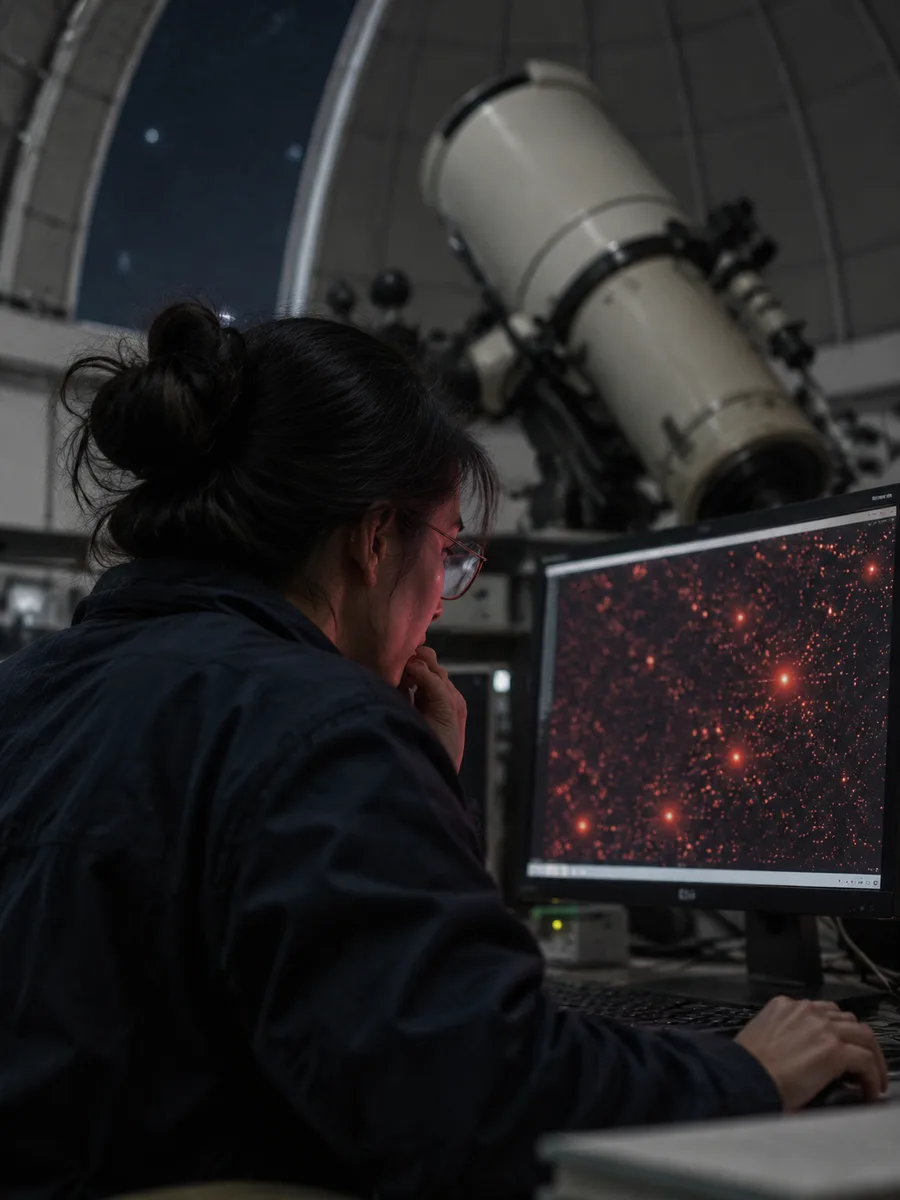
韦布望远镜拍到的小红点:是黑洞,还是黑洞星?
James Webb Telescope's Little Red Dots: Black Holes or Black-Hole Stars?
About this story
Astronomers debate whether the James Webb Space Telescope's little red dots are growing black holes or a new object called black-hole stars, 13.4 billion years old. HSK 2 Chinese listening practice.
This is an HSK 2 Chinese listening episode that runs about 2 minutes. The full Mandarin script is shown with tap-for-pinyin and a line-by-line English translation, so you can listen and read at once — comprehensible input in the sense of Stephen Krashen's i+1 theory. It teaches 12 key vocabulary words such as 照片、地球、看见 and walks through 6 grammar patterns, each explained in English with examples. The same news story is retold at 4 difficulty levels — use the level selector above to find the version that is challenging but still understandable for you.
Read at your level
原文Read the complete story in Chinese. Reveal pinyin and English only when you need them.
English transcript reference
There are many very small red dots in the sky.
People used telescopes to see these red dots.
The telescope is in the sky and can see very far places.
In 2022, it started sending photos to Earth.
The photos have these red dots on them.
Until now, people have found several hundred.
These red dots are very small.
They are very far from us.
The light we see was emitted many years ago.
13.4 billion years ago, these red dots were born.
At that time, stars and everything together were only 500 million years old.
At first, people thought it was many stars crowded together.
Later, people felt that was not right.
In 2023, Kocevski carefully looked at this light.
There is a special pattern in the light.
This light told him that there is a very heavy thing there.
This thing is very small, but very heavy.
Even light cannot escape.
This kind of thing is called a black hole.
He said: The red dots are black holes.
The black hole is eating the gas around it.
The gas is very thick and wraps around the black hole, so the light is red.
But this kind of black hole emits very strong light.
We cannot see this kind of light.
The red dots have almost none of this light.
Another person who studies stars is named Naidu. He said: That's not how it is.
He said: The black hole is inside a very thick gas.
The outside of the gas is very hot and is red.
It looks like a star.
So people call it a black-hole star.
In May of this year, someone measured the weight of a red dot for the first time.
Such a small dot is as heavy as tens of millions of suns.
Some people also say this measurement method is wrong; only one was measured, which is too few.
He said: I have never seen anything like this.
Listen again
Try it without the transcript and notice what sounds clearer.
What vocabulary does this episode teach?
词汇HSK 1. Measure word: 张 (zhāng).
HSK 1. 地 (ground) + 球 (ball).
HSK 1. Result complement 见 indicates success.
HSK 1. Reduplicated noun.
HSK 1. Opposite: 大 (big).
HSK 1. Opposite: 近 (near).
HSK 1. Used in dates and ages.
Beyond HSK 1. Used in large numbers: 一百三十四亿 (13.4 billion).
HSK 1. 红 (red) + 点 (dot). Appears throughout the script.
HSK 1. 望 (look far) + 远 (far) + 镜 (lens).
HSK 1. Appears in 发光 (emit light).
Beyond HSK 1. 黑 (black) + 洞 (hole).
* beyond level超纲词
What grammar patterns appear in this episode?
语法有 + Noun
Indicates existence: 'there is/are'.
天上有很多很小的红点。
光里有一个特别的样子。
用 + Noun + Verb
Expresses 'use something to do something'.
人们用望远镜看见了这些红点。
叫 + Noun
Means 'be called' or 'call'.
这种东西叫黑洞。
所以人们叫它黑洞星。
像 + Noun
Expresses similarity: 'looks like'.
它看起来像一颗星星。
比 + Noun + Adj
Comparative: 'compared to'.
这么小的点,有几千万个太阳那么重。
Proper nouns
专有名词Sources
来源Free account
Keep learning from this story
Create a free account to keep saved words and your preferred level together.
- Keep words with their story context
- Remember your preferred level
- Build your vocabulary over time