
A Chinese podcast · Same story, 4 levels
《新生儿》:内克尔医院里的六个月
Inside Paris's Necker Hospital NICU: Clémentine Goldszal's Six Months with Premature Newborns
About this story
HSK 1: A French journalist spends six months in a Paris hospital's neonatal unit to understand what newborns feel, and writes a 272-page book called Newborn.
This is an HSK 2 Chinese listening episode that runs about 2 minutes. The full Mandarin script is shown with tap-for-pinyin and a line-by-line English translation, so you can listen and read at once — comprehensible input in the sense of Stephen Krashen's i+1 theory. It teaches 12 key vocabulary words such as 孩子、睡、小 and walks through 6 grammar patterns, each explained in English with examples. The same news story is retold at 4 difficulty levels — use the level selector above to find the version that is challenging but still understandable for you.
Read at your level
原文Read the complete story in Chinese. Reveal pinyin and English only when you need them.
English transcript reference
A newborn baby weighs only 900 grams.
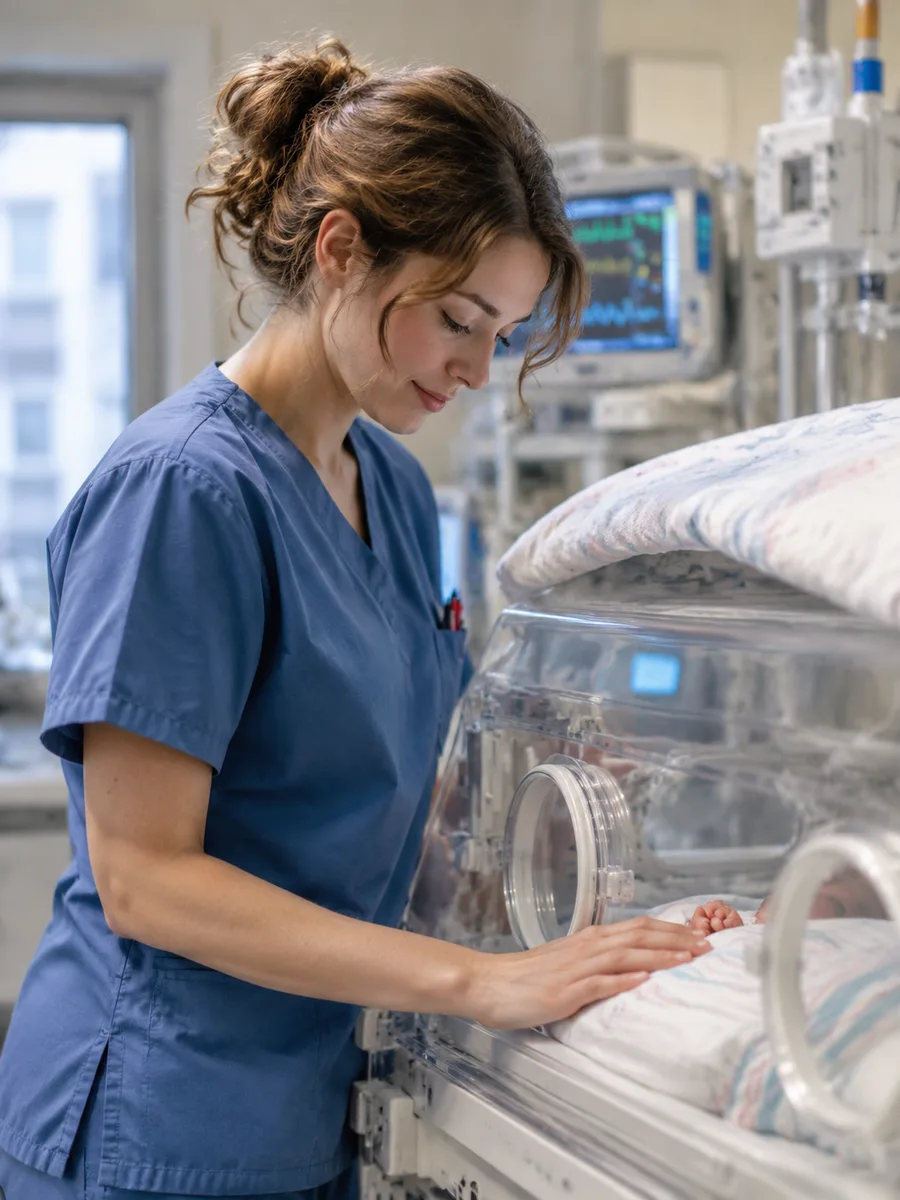
He sleeps in a warm little box.
His skin is very thin; you can see the things inside.
Nurses cannot stick things on his body.
If they stick something on, his skin will tear.
There is a French woman; she writes news.
When her son was born, she heard some sounds.
She thought those sounds were very nice.
The doctor said the baby had difficulty breathing in and out; it was very dangerous.
She wanted to know one thing.
What does a baby feel in its heart when it is just born?
She went to a hospital in Paris.
This hospital is called Necker Hospital.
In the hospital there is a room.
Inside are all babies who got sick right after birth.
She stayed in that room for six months.
She watched what the nurses and doctors did.
The nurses do not call numbers; they call each baby's name.
When nurses care for the babies, they cover the little boxes with a cloth.
This way, others cannot see the baby.
These babies also need injections.
They have a small tube in their noses.
Doctors use the small tube to help the baby breathe out.
Next to them are many machines, very loud.
The babies cannot say no.
Many of these babies survived.
Some babies were born too early and did not survive.
This woman used these things to write a book.
The book is called Newborn.
This book has 272 pages.
Later, this book got an English edition.
The book also includes words from a writer.
He said his newborn daughter first looked very old.
After a while, she looked very young again.
Listen again
Try it without the transcript and notice what sounds clearer.
What vocabulary does this episode teach?
词汇HSK 1. Common noun for child; appears throughout the script.
HSK 1. Verb; used in '他睡在一个暖和的小箱子里'.
HSK 1. Adjective; appears in '小箱子', '小管'.
HSK 1. Noun/position word; used in '箱子里', '医院里'.
HSK 1. Resultative verb; used in '能看见里面的东西'.
HSK 1. Noun; used in '里面的东西'.
HSK 1. Noun; appears multiple times.
HSK 1. Noun; used in '巴黎的一家医院'.
HSK 3. Noun; used in '他的皮肤很薄'.
HSK 3. Noun; appears multiple times.
HSK 3. Adjective; used in '很危险'.
HSK 3. Noun; used in '很多机器'.
* beyond level超纲词
What grammar patterns appear in this episode?
语法只有 + Number + Measure Word
Expresses 'only' a small amount.
一个刚出生的孩子,只有九百克重。
能 + Verb
Expresses ability or possibility.
他的皮肤很薄,能看见里面的东西。
孩子不能说不。
一 + Verb + 就 + Verb
Expresses 'as soon as... then...'.
一贴,皮肤就会破。
用 + Noun + 盖住
Expresses 'use something to cover'.
护士照顾孩子的时候,会用一块布盖住小箱子。
Proper nouns
专有名词Sources
来源Free account
Keep learning from this story
Create a free account to keep saved words and your preferred level together.
- Keep words with their story context
- Remember your preferred level
- Build your vocabulary over time