
A Chinese podcast · Same story, 4 levels
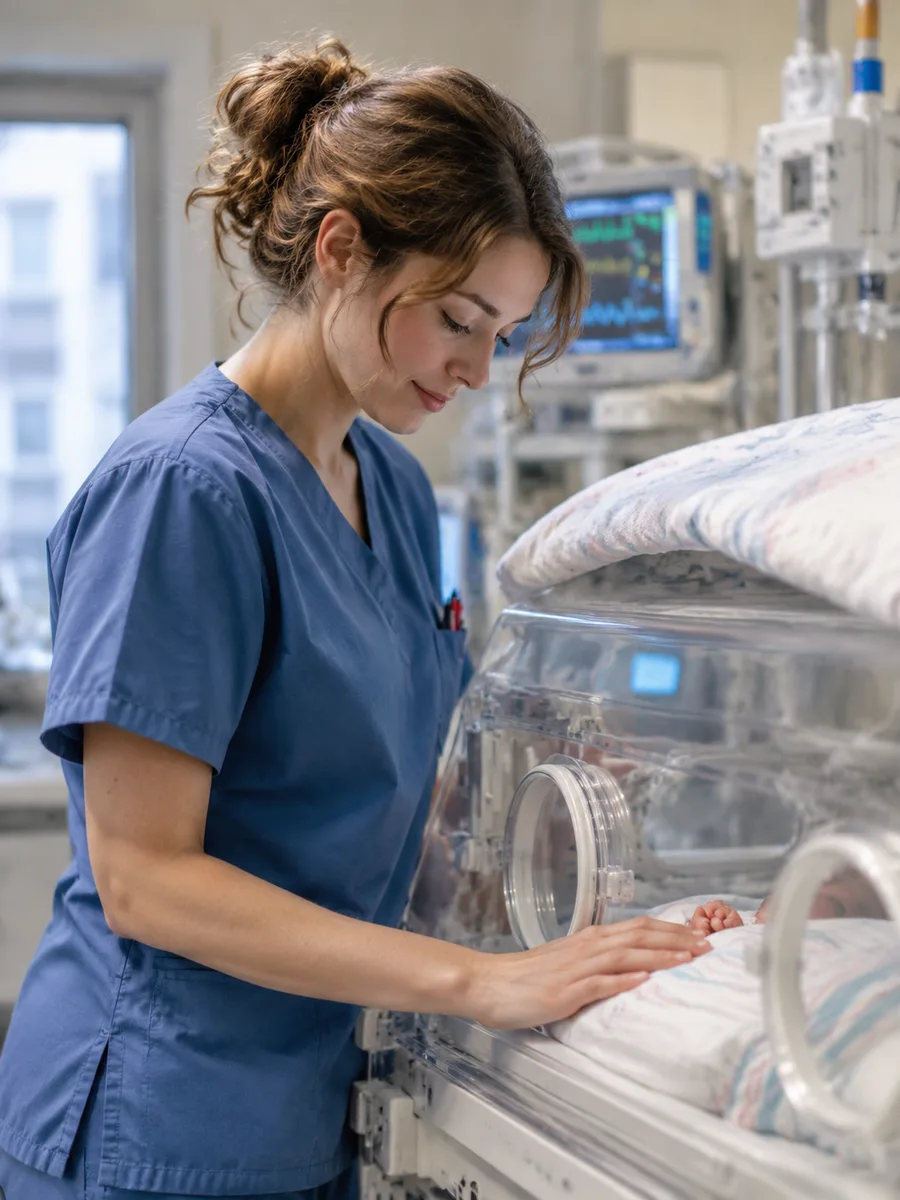
《新生儿》:内克尔医院里的六个月
Inside Paris's Necker Hospital NICU: Clémentine Goldszal's Six Months with Premature Newborns
About this story
HSK 3: French journalist Clémentine Goldszal spent six months in the Necker neonatal unit to ask what birth feels like for premature babies.
This is an HSK 4 Chinese listening episode that runs about 2 minutes. The full Mandarin script is shown with tap-for-pinyin and a line-by-line English translation, so you can listen and read at once — comprehensible input in the sense of Stephen Krashen's i+1 theory. It teaches 12 key vocabulary words such as 体重、记者、声音 and walks through 7 grammar patterns, each explained in English with examples. The same news story is retold at 4 difficulty levels — use the level selector above to find the version that is challenging but still understandable for you.
Read at your level
原文Read the complete story in Chinese. Reveal pinyin and English only when you need them.
English transcript reference
The babies in the incubators weigh only about nine hundred grams and are no more than fifty centimetres long.
Their skin is almost transparent; even a piece of tape could tear it.
The French journalist Clémentine Goldszal saw these children in a hospital ward in Paris.
She went there because of her own son, Lucien.
When Lucien was born, she heard some very gentle sounds and even thought they were pleasant.
Only later did she learn that those sounds were actually signs of acute respiratory distress.
As a journalist, Goldszal wanted to understand one thing.
What does birth actually feel like for a child who has just come into this world?
She also wanted to know what these babies actually experience when doctors give them injections and insert tubes.
So she observed for six months in the neonatal ward of the Necker Hospital in Paris.
An independent assessment said this is the busiest neonatal ward in France, and seriously ill babies from all over the country are sent here.
The ward has a very detailed set of rules.
Every child is called by name, not by bed number.
When changing nappies, the nurses cover the incubator with a blanket so that no one can see.
But the same child is also injected and intubated, surrounded by roaring machines and harsh lights.
No one ever asked them whether they agreed to these things.
We often discuss whether a premature baby can survive, but we rarely ask what he actually goes through.
There are a few figures in the book that may illustrate the point.
Of babies born between twenty-seven and thirty-one weeks of pregnancy, ninety-four percent left hospital alive.
Of babies born at twenty-five weeks, fifty-nine percent survived.
And of the babies who survived, eighty-one percent were left without serious after-effects.
These observations eventually became a book, titled simply Newborn, two hundred and seventy-two pages long.
The English edition was translated by Natasha Lehrer and published by Pushkin Press.
The book also quotes a line from the writer Ballard.
He said that in the first few seconds after his daughter was born, she looked extremely old, and then suddenly became very young.
What a newborn actually feels, we still cannot really say even now.
The book says that new life appears in a place where originally there was nothing.
What medicine can do is its utmost to keep it from returning to that place where there was nothing.
Listen again
Try it without the transcript and notice what sounds clearer.
What vocabulary does this episode teach?
词汇HSK 3. 体重只有九百克左右 — 'weighs only about 900 grams'.
HSK 3. 法国记者 — 'a French journalist'.
HSK 3. 很温柔的声音 — 'very gentle sounds'.
HSK 3. 吕西安出生的时候 — 'when Lucien was born'.
HSK 3. 医生给他们扎针 — 'the doctors give them injections'.
HSK 3. 每个孩子都叫名字 — 'every child is called by name'.
HSK 3. 护士会用毯子把保温箱盖上 — 'the nurses cover the incubator with a blanket'.
HSK 3. 我们常常讨论 — 'we often discuss'.
HSK 3. Used here with 透明: 皮肤几乎是透明的.
HSK 3. 新生儿病房 — 'neonatal ward'.
HSK 3. 一套很细的规矩 — 'a very detailed set of rules'.
HSK 3. 怀孕二十七到三十一周 — 'twenty-seven to thirty-one weeks of pregnancy'.
* beyond level超纲词
What grammar patterns appear in this episode?
语法只有 + number + 左右 / 不过 + number
只有 emphasises how small a quantity is; 左右 means 'approximately' and 不过 means 'no more than'.
体重只有九百克左右,身长不过五十厘米。
是……的 (emphatic 是…的 construction)
Used to highlight or explain a fact, often with a reason or cause in focus.
那些声音其实是急性呼吸困难的信号。
对……来说
'For (someone)' — marks the person from whose perspective something is judged.
出生对一个刚来到这个世界的孩子来说,到底是一种什么感觉。
被 + verb (passive)
Marks the receiver of an action; the agent can be omitted.
全国各地的重病婴儿都会被送到这里。
……的时候
'When…' — a time clause formed with 的时候 after a verb phrase.
医生给他们扎针、插管的时候,他们经历的究竟是什么。
百分之 + number
The standard way to express percentages in Chinese.
百分之九十四活着出了院。
百分之五十九活了下来。
百分之八十一没有留下严重的后遗症。
究竟 / 到底 + question
Both add emphasis to a question, meaning 'after all / actually what'.
出生对一个刚来到这个世界的孩子来说,到底是一种什么感觉。
他们经历的究竟是什么。
Proper nouns
专有名词Sources
来源Free account
Keep learning from this story
Create a free account to keep saved words and your preferred level together.
- Keep words with their story context
- Remember your preferred level
- Build your vocabulary over time