
A Chinese podcast · Same story, 4 levels
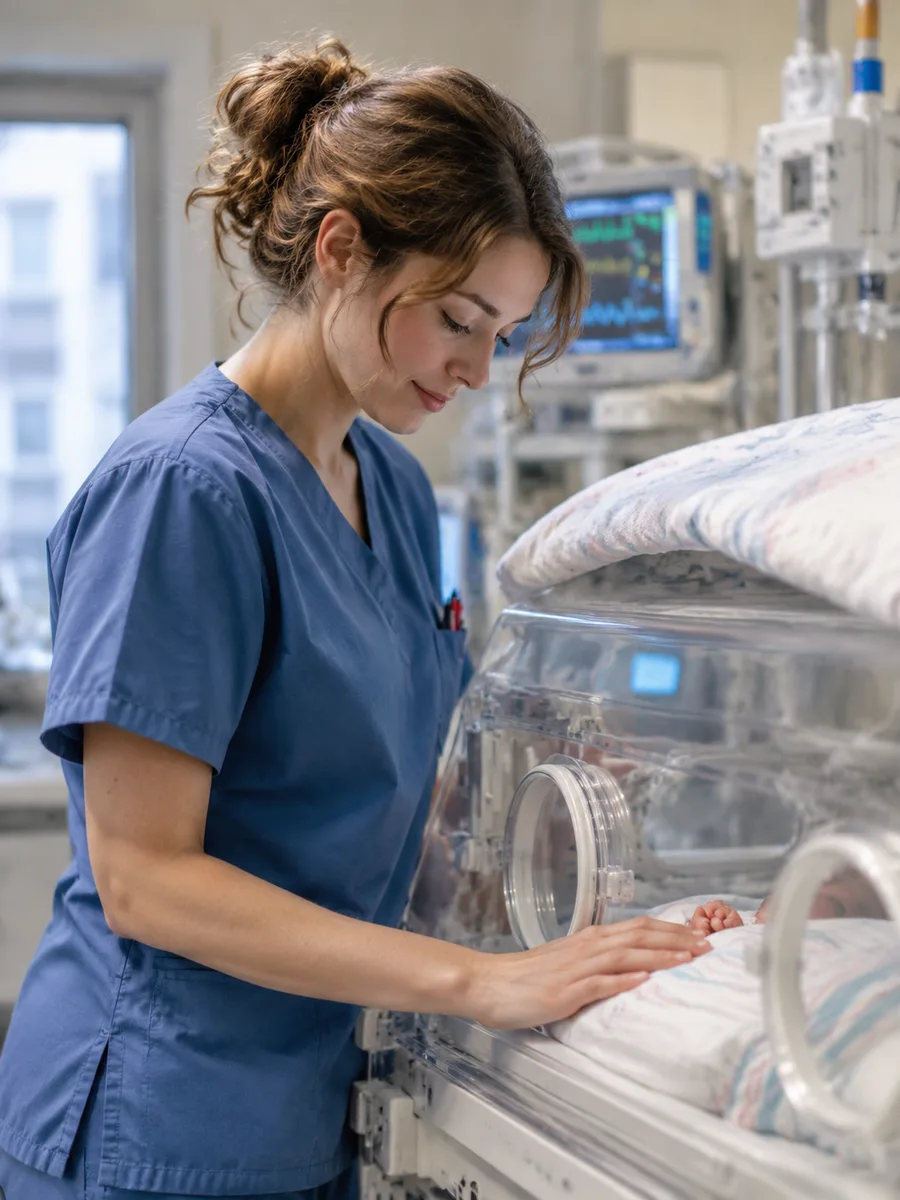
《新生儿》:内克尔医院里的六个月
Inside Paris's Necker Hospital NICU: Clémentine Goldszal's Six Months with Premature Newborns
About this story
Normal-level Chinese listening: Clémentine Goldszal spends six months in the Necker hospital NICU to learn what birth is like for premature newborns. HSK 5+ Chinese listening practice.
This is an HSK 5+ Chinese listening episode that runs about 2 minutes. The full Mandarin script is shown with tap-for-pinyin and a line-by-line English translation, so you can listen and read at once — comprehensible input in the sense of Stephen Krashen's i+1 theory. It teaches 12 key vocabulary words such as 体重、皮肤、记者 and walks through 7 grammar patterns, each explained in English with examples. The same news story is retold at 4 difficulty levels — use the level selector above to find the version that is challenging but still understandable for you.
Read at your level
原文Read the complete story in Chinese. Reveal pinyin and English only when you need them.
English transcript reference
The premature babies in the incubators weigh only around 900 grams, measure barely 50 centimeters, and their skin is so thin it is almost transparent.
Even applying a piece of tape can tear the skin off.
When French journalist Clémentine Goldszal first heard her son Lucien breathe, those sounds seemed sweet to her.
Only later did she learn that they were signs of acute respiratory distress.
From that moment on, what she wanted to understand was no longer whether the sounds were pleasant.
According to the book reviews, the goal she set for herself was to figure out what birth actually means for a newborn.
And in what way injections, intubation, and repeated examinations are experienced by these children.
To that end she spent six months stationed in the neonatal intensive care unit of Necker Hospital in Paris.
According to one independent book review, this is the busiest neonatal intensive care unit in France, and sick infants from all over the country are sent here.
The first thing she noticed in the ward was that everyone here called the children by their names.
When changing diapers, the nurses would cover the incubator with a blanket to shield the child from others' gaze.
And yet in that same incubator, these children were injected, intubated, and lay amid machines that never stopped humming, under harsh lights.
Not one person ever asked for their consent.
Whether these children could survive is partly answered by the numbers given in the book.
Of infants born between 27 and 31 weeks of pregnancy, 94 percent left the hospital alive.
For children born at 25 weeks, the survival rate was 59 percent.
Among the children who survived, 81 percent had no serious complications.
Goldszal turned her six months of observation into a book, titled simply Newborn; the English edition runs 272 pages.
The book was translated from French into English by Natasha Lehrer, and Pushkin Press published the hardcover edition.
The book quotes a line from the writer Ballard.
He said that in the first few seconds after his daughter was born, she looked extremely old, and then suddenly became very young.
What a newborn is actually experiencing, no one to this day can give a complete answer.
Goldszal writes in the book that new life appears where originally there was nothing at all.
And what medicine can do is try its utmost to keep it from returning to nothing.
Listen again
Try it without the transcript and notice what sounds clearer.
What vocabulary does this episode teach?
词汇HSK 4. 体重只有九百克 — 'weighs only 900 grams'.
HSK 4. 皮肤薄得几乎透明 — 'skin so thin it is almost transparent'.
HSK 4. 法国记者 — 'French journalist'.
HSK 4. 听见儿子的呼吸 — 'hear her son's breathing'.
HSK 4. 定下的目标 — 'the goal she set'.
HSK 3. 一次次检查 — 'examination after examination'.
HSK 4. 护士会用毯子把保温箱盖上 — 'nurses cover the incubator with a blanket'.
HSK 3. 征求过他们的同意 — 'asked for their consent'.
HSK 5. 新生儿重症病房 — 'neonatal intensive care ward'.
HSK 5. 挡住旁人的视线 — 'block others' line of sight'.
Beyond level. 保温 'keep warm' + 箱 'box'. The incubators holding the premature infants.
Beyond level. 早产 'premature birth' + 儿 'child'.
* beyond level超纲词
What grammar patterns appear in this episode?
语法在……听来 / 在……看来
在 + person + 听来/看来 marks whose perception or opinion is being described: 'to her ears', 'in her view'.
那些声音在她听来是甜的。
不再 + Verb
不再 means 'no longer' and negates a change of state, unlike 不 alone.
她想弄明白的就不再是声音好不好听。
究竟 + Question word
究竟 in a question adds emphasis, like 'actually' or 'on earth'.
是弄清出生对一个新生儿究竟意味着什么。
一个新生儿究竟在经历什么,至今没有人能给出完整的答案。
以……方式
以 + noun + 方式 means 'in the manner of, by means of'.
究竟是以什么方式被这些孩子感受到的。
被 + Verb (passive)
The 被 construction marks the passive voice; the agent can follow with 被 + agent + verb.
全国各地的病婴都会被送到这里来。
百分之 + Number
百分之... expresses percentages: 百分之九十四 = 94 percent.
百分之九十四活着出院。
存活率是百分之五十九。
百分之八十一没有留下严重并发症。
Verb + 得 + Complement
The 得 structure links a verb to a descriptive complement of degree or manner.
皮肤薄得几乎透明。
Proper nouns
专有名词Sources
来源Free account
Keep learning from this story
Create a free account to keep saved words and your preferred level together.
- Keep words with their story context
- Remember your preferred level
- Build your vocabulary over time