
A Chinese podcast · Same story, 4 levels
《新生儿》:内克尔医院里的六个月
Inside Paris's Necker Hospital NICU: Clémentine Goldszal's Six Months with Premature Newborns
About this story
Easy Chinese: French journalist Clémentine Goldszal spends six months in Paris's Necker Hospital neonatal unit, observing premature babies and their medical care. HSK 3 Chinese listening practice.
This is an HSK 3 Chinese listening episode that runs about 3 minutes. The full Mandarin script is shown with tap-for-pinyin and a line-by-line English translation, so you can listen and read at once — comprehensible input in the sense of Stephen Krashen's i+1 theory. It teaches 12 key vocabulary words such as 小心、记者、声音 and walks through 8 grammar patterns, each explained in English with examples. The same news story is retold at 4 difficulty levels — use the level selector above to find the version that is challenging but still understandable for you.
Read at your level
原文Read the complete story in Chinese. Reveal pinyin and English only when you need them.
English transcript reference
A newborn baby weighs only 900 grams.
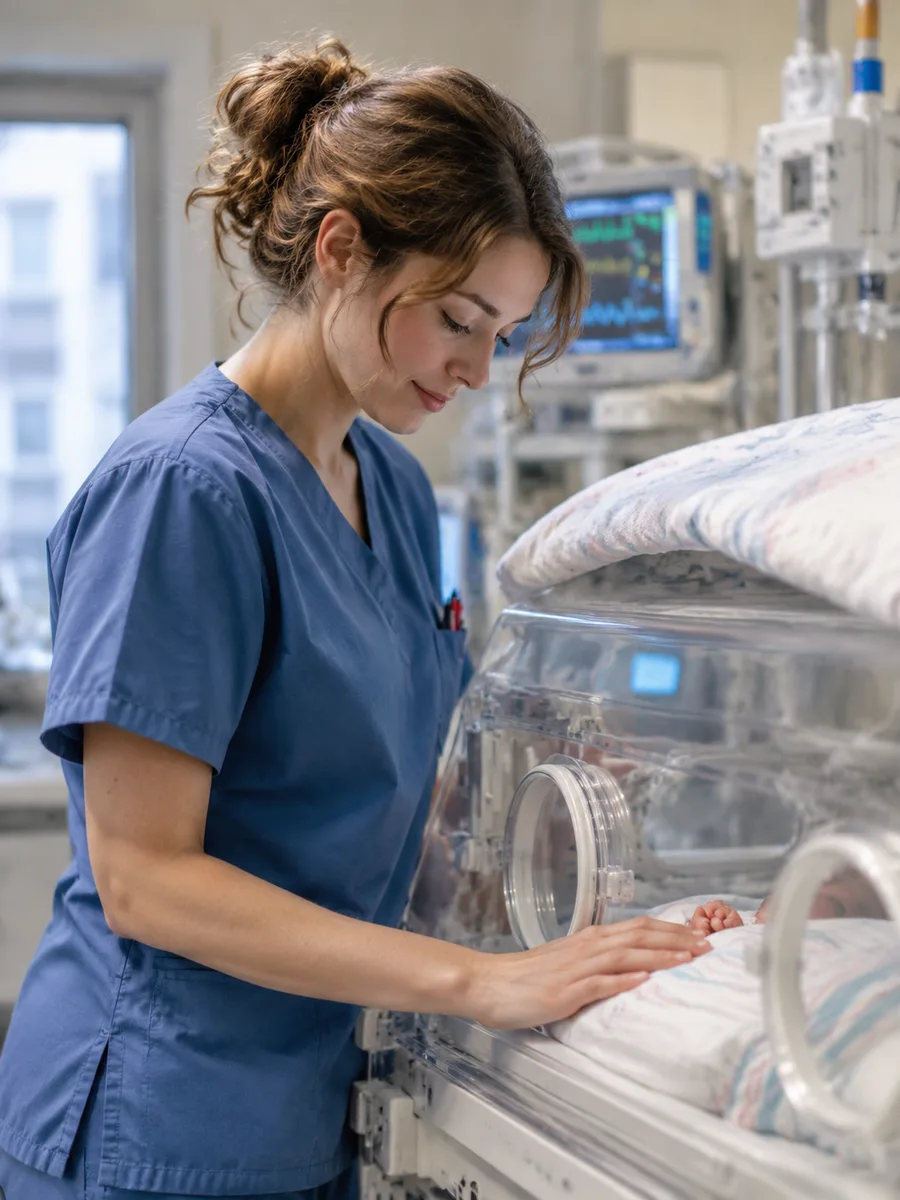
He lies in a warm box; the box is called an incubator.
His skin is almost transparent, like a thin sheet of paper.
The nurse must be very careful when applying tape; the tape will tear his skin.
There is a French journalist; her name is Goldszal.
When her son Lucien was born, she heard some very pleasant sounds.
She thought it was the child gently calling.
Later she learned that it was a sign that the child was having difficulty breathing.
The child was immediately sent to the ward.
She wanted to know what a child feels when he is born.
She also wanted to know what he experiences when doctors give him injections and insert tubes.
Intubation means putting a tube into his mouth to help him breathe.
To answer this question, she went to a hospital in Paris.
This hospital is called Necker Hospital; it is the busiest neonatal ward in France.
Newborns are newly born babies.
Sick children from all over the country are sent here.
She stayed here for six months, standing by the incubators every day watching these children.
The nurses in the ward all call the children by their names.
When changing diapers, they cover the incubator with a cloth.
This way, others cannot see him.
But the same child still has to be injected and intubated.
Around him are constantly beeping machines and very bright lights.
No one has asked him whether he agrees to these things.
Many of these children can survive.
Some children stayed in their mother's womb for only twenty-seven weeks.
The later ones stayed only until thirty-one weeks.
Of these children, ninety-four percent went home alive.
Those born even earlier stayed in their mother's womb for only twenty-five weeks.
Of these children, fifty-nine percent survived.
Of the surviving children, eighty-one percent had no serious problems.
She wrote what she saw into a book; the book is called Newborn.
Someone translated it from French into English, and the publisher printed it as a hardcover.
The book also quotes a sentence from the writer Ballard.
He said that his newborn daughter looked very old in the first few seconds.
Then she suddenly became very small.
The book says that new life appears where there was nothing before.
Doctors do their best to keep it from returning to that place.
Listen again
Try it without the transcript and notice what sounds clearer.
What vocabulary does this episode teach?
词汇HSK 2. Often used as 要小心 (must be careful).
HSK 2. Occupation noun; appears in 法国记者.
HSK 2. Used with 好听 (pleasant) in 很好听的声音.
HSK 2. Often implies a wrong assumption, as in 她以为那是孩子在轻轻地叫.
HSK 2. Used in 呼吸很困难 (breathe with difficulty).
HSK 2. Used in 为了回答这个问题.
HSK 2. Place noun; appears in 巴黎的一家医院.
HSK 2. Used in 全国生病的孩子.
HSK 2. Common noun for a very young baby; appears in 刚出生的婴儿.
HSK 2. Measure word 个; here refers to the incubator (保温箱).
HSK 2. Body part noun; used in 皮肤几乎是透明的.
HSK 2. Common occupation noun; appears in 护士贴胶布.
* beyond level超纲词
What grammar patterns appear in this episode?
语法只有 + Number + Measure Word + Noun
Expresses a small quantity or limitation, often with 只有 (only have).
一个刚出生的婴儿,只有九百克重。
像 + Noun + 一样/似的
Simile pattern meaning 'like' or 'as if'. In the script, 像一层薄纸 (like a thin sheet of paper).
他的皮肤几乎是透明的,像一层薄纸。
把 + Object + Verb + Complement
The 把 construction moves the object before the verb to show disposal or result. Here: 把皮肤撕破 (tear the skin).
胶布会把皮肤撕破。
被 + Verb + Complement
Passive voice. Here: 被送进了病房 (was sent to the ward).
孩子马上被送进了病房。
为了 + Verb Phrase, Subject + Verb Phrase
Expresses purpose: 'in order to...'. Here: 为了回答这个问题,她到巴黎的一家医院去了.
为了回答这个问题,她到巴黎的一家医院去了。
在 + Place + Verb + 着
The 着 particle indicates a continuing state or action. Here: 在妈妈肚子里只待了二十七个星期 (stayed in mother's womb for only 27 weeks).
有的孩子,在妈妈肚子里只待了二十七个星期。
百分之 + Number
Expresses percentage: 'percent'. Here: 百分之九十四 (94%).
这些孩子里,百分之九十四活着回了家。
让 + Object + Verb Phrase
Causative pattern meaning 'let/make someone do something'. Here: 让它不要回到那个地方 (keep it from returning to that place).
医生尽自己的力量,让它不要回到那个地方。
Proper nouns
专有名词Sources
来源Free account
Keep learning from this story
Create a free account to keep saved words and your preferred level together.
- Keep words with their story context
- Remember your preferred level
- Build your vocabulary over time