
A Chinese podcast · Same story, 4 levels
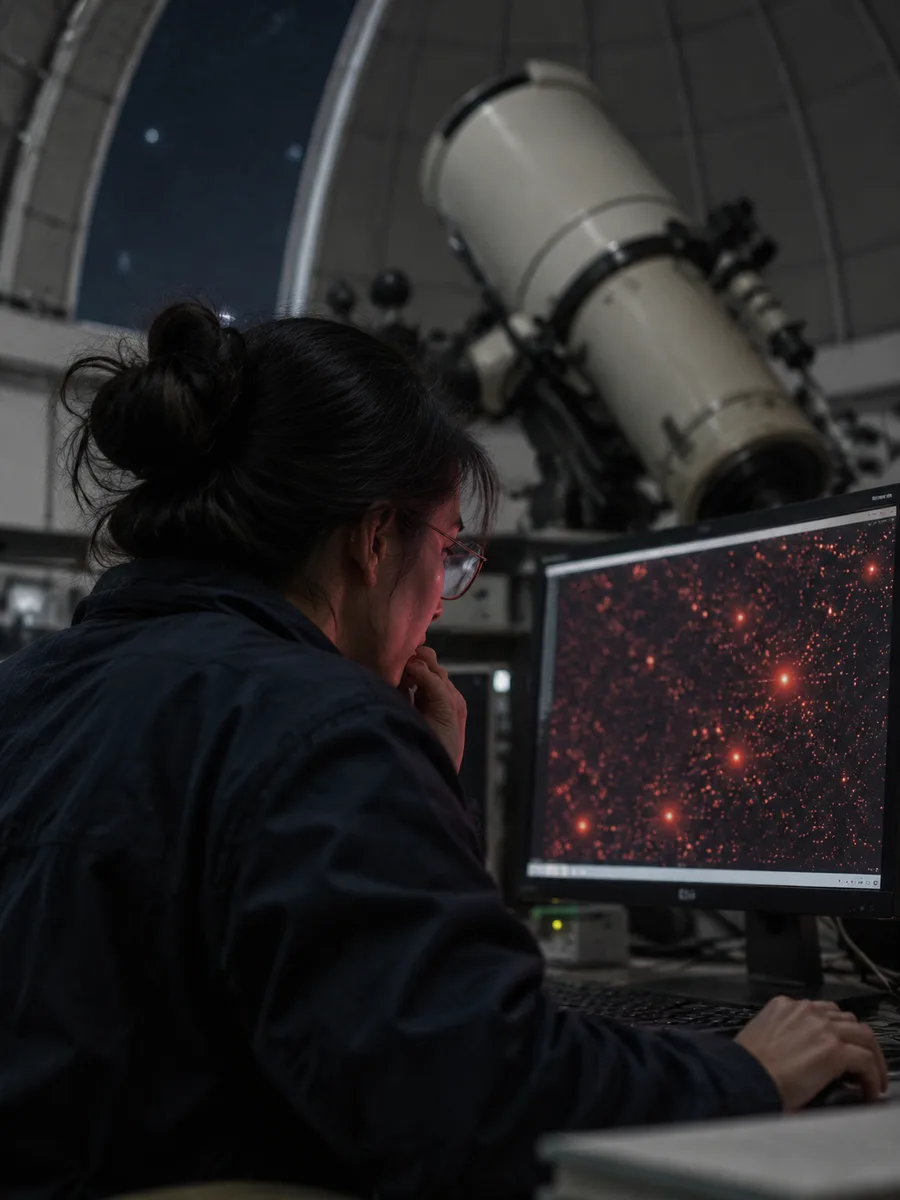
韦布望远镜拍到的小红点:是黑洞,还是黑洞星?
James Webb Telescope's Little Red Dots: Black Holes or Black-Hole Stars?
About this story
Astronomers debate whether the James Webb Space Telescope's little red dots are ordinary black holes or a new object called black-hole stars. HSK 3 Chinese listening practice.
This is an HSK 3 Chinese listening episode that runs about 3 minutes. The full Mandarin script is shown with tap-for-pinyin and a line-by-line English translation, so you can listen and read at once — comprehensible input in the sense of Stephen Krashen's i+1 theory. It teaches 12 key vocabulary words such as 照片、开始、远 and walks through 7 grammar patterns, each explained in English with examples. The same news story is retold at 4 difficulty levels — use the level selector above to find the version that is challenging but still understandable for you.
Read at your level
原文Read the complete story in Chinese. Reveal pinyin and English only when you need them.
English transcript reference
In 2022, a telescope began taking pictures.
In the pictures it sent back, there were hundreds of little red dots.
These red dots are very far from us; light takes 13.4 billion years to travel from them.
So what we see is the universe from a very long time ago.
At first, astronomers thought they were galaxies.
Galaxies have many stars packed together and look very bright.
But growing that many stars takes a long time.
The universe back then was too young; there wasn't enough time.
Astronomer Kocevski was also looking at these red dots.
In the light from the red dots, he found a pattern.
This pattern shows that inside the red dots there is a very dense cloud of gas.
This gas is moving very fast.
For gas to move that fast, there must be something very heavy inside.
This heavy thing must also be squeezed into a very small space.
Astronomers call this kind of heavy, small thing a black hole.
So he thinks the red dots are very ordinary black holes.
These black holes are eating the things around them.
When things fall in, the gas glows red, and the light also turns red.
But such black holes should give off very strong X-rays.
X-rays are a kind of light we cannot see.
Yet the red dots have almost no X-rays.
He says the things fall in too fast, so X-rays cannot get out.
Another astronomer, Naidu, says that's not right.
He says the red dots are another kind of thing, called 'black-hole stars'.
A black-hole star is a black hole wrapped in a very thick cloud of gas.
The outer layer of gas glows red, like the surface of a star.
He says we have to admit that this is a completely new kind of thing.
Both explanations have points that don't add up.
Some say the black-hole star idea cannot explain the few red dots that leak light.
Others say the black hole explanation relies on many 'ifs'.
Later, a team measured the weight of one red dot.
It is tens of millions of times heavier than our Sun.
For the black hole explanation, this is good news.
But astronomer Green says this method of measurement is wrong.
She says this method only works for very clear objects.
Two stars orbiting each other can be measured this way.
A messy cloud of gas cannot.
The team that did the measurement also said they only measured one red dot.
She said, 'People only see what they want to see.'
He said he had never seen an argument like this.
Listen again
Try it without the transcript and notice what sounds clearer.
What vocabulary does this episode teach?
词汇HSK 2. Picture, photograph. Measure word: 张 (zhāng).
HSK 2. To begin. Often followed by a verb, e.g., 开始拍照片 (start taking pictures).
HSK 2. Far. Used in 离我们很远 (far from us).
HSK 2. Time. Common in phrases like 需要时间 (need time).
HSK 2. To find, to discover. Used with an object, e.g., 发现了一个图案 (discovered a pattern).
HSK 2. Fast, quick. Used as complement of degree: 跑得很快 (runs very fast).
HSK 2. Place, space. Used in 很小的地方 (a very small space).
HSK 2. At one's side, around. 身边的东西 means things around.
HSK 2. Almost, nearly. 几乎没有X光 = almost no X-rays.
Compound: 天文 (astronomy) + 学家 (scientist).
Compound: 星 (star) + 系 (system).
Universe, cosmos.
* beyond level超纲词
What grammar patterns appear in this episode?
语法要...,需要...
Expresses that achieving something requires a certain condition or time.
可是要长出那么多星星,需要很长的时间。
气要跑这么快,里面必须有很重的东西。
把...叫...
Means 'to call something something' or 'to refer to something as'.
天文学家把这种又重又小的东西叫黑洞。
太...,...不...
Expresses that something is too much, resulting in an inability to do something.
那时候的宇宙太年轻,时间不够。
东西掉得太快,X光出不来。
Proper nouns
专有名词Sources
来源Free account
Keep learning from this story
Create a free account to keep saved words and your preferred level together.
- Keep words with their story context
- Remember your preferred level
- Build your vocabulary over time