
A Chinese podcast · Same story, 4 levels
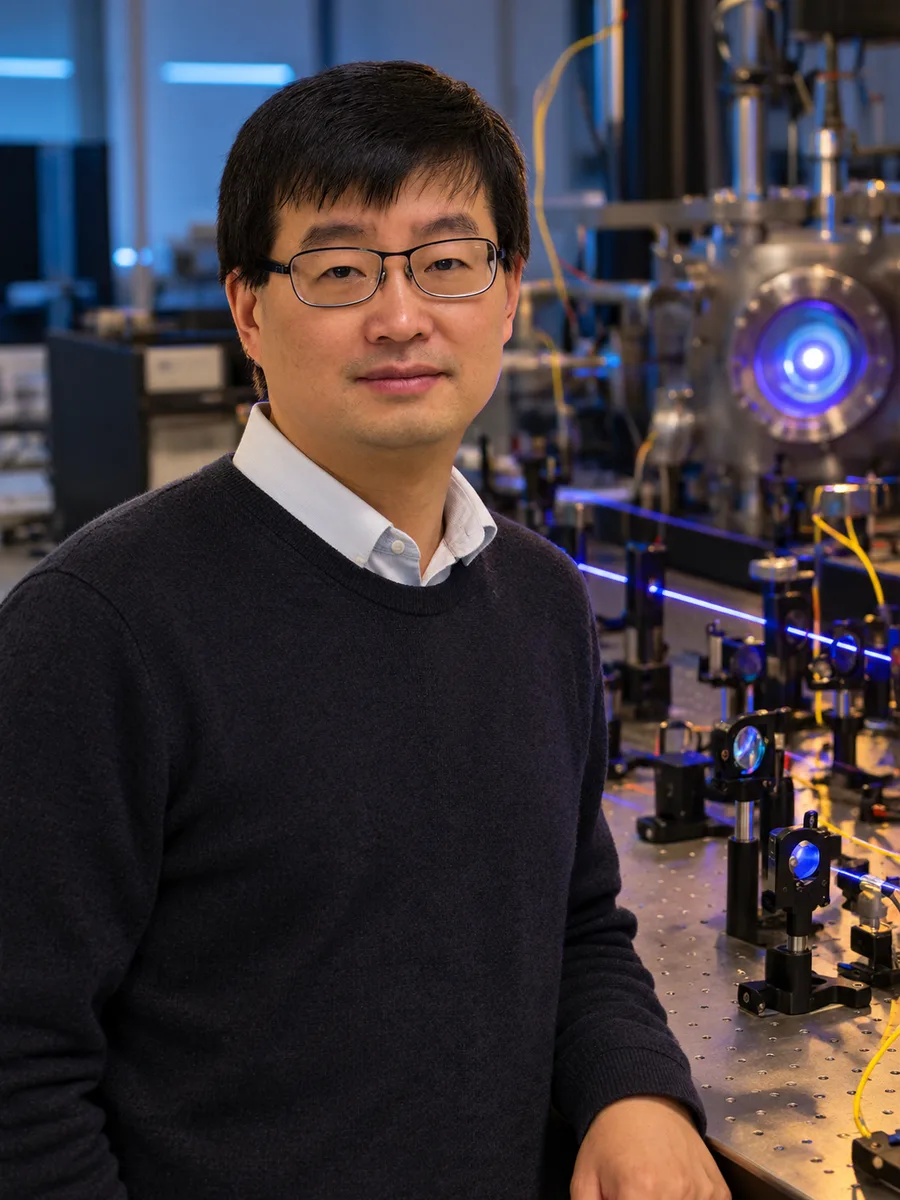
叶军的原子钟一百五十亿年不差一秒,他拿下了被称为诺奖风向标的沃尔夫物理学奖
Jun Ye's Atomic Clock Won't Lose a Second in 15 Billion Years. Now He Has Won the Wolf Prize, Often a Step Before the Nobel.
About this story
Jun Ye wins the Wolf Prize for an atomic clock so precise it shows your head ages faster than your feet. HSK 2 Chinese listening practice.
This is an HSK 2 Chinese listening episode that runs about 4 minutes. The full Mandarin script is shown with tap-for-pinyin and a line-by-line English translation, so you can listen and read at once — comprehensible input in the sense of Stephen Krashen's i+1 theory. It teaches 17 key vocabulary words such as 手机、可能、觉得 and walks through 6 grammar patterns, each explained in English with examples. The same news story is retold at 4 difficulty levels — use the level selector above to find the version that is challenging but still understandable for you.
Read at your level
原文Read the complete story in Chinese. Reveal pinyin and English only when you need them.
English transcript reference
Your phone shows the time.
You probably think the time on your phone is never off by even a second.
So where does your phone's time come from?
Ultimately, it comes from a very special kind of clock, called an atomic clock.
Atomic clocks are extremely accurate — far more accurate than the clock in your home.
The clock in your home might be off by more than ten seconds a month.
But the atomic clock we're talking about today won't be off by a single second in fifteen billion years.
How long is fifteen billion years?
The universe we live in, from its beginning to now, is roughly that long.
The universe means all the stars in the sky, the sun, and our Earth — everything put together.
So if this clock had started running on the day the universe began, it would still be off by less than a second today.
The scientist who made this clock is called Jun Ye.
A scientist is someone who studies questions and looks for answers.
Jun Ye is from Shanghai; he was born there in 1967.
He studied physics at Shanghai Jiao Tong University.
物理 is physics — it studies how the world moves.
Later, Jun Ye went to America and finished his PhD in Colorado in 1997.
He still works in Colorado today, and has kept working on atomic clocks.
On October 1st, Jun Ye won a very big prize.
The prize is called the 沃尔夫奖 — in English, the Wolf Prize.
There are several Wolf Prizes; Jun Ye won the one for physics.
Many people call the Wolf Prize 'the stop before the Nobel Prize.'
诺贝尔奖 is the Nobel Prize — you've surely heard of it.
Why do they say that?
Look at these two numbers: so far, seventy-two people have won the Wolf Prize in physics.
Of those seventy-two, twenty-six later went on to win a Nobel Prize.
That's about one in every three.
This year's Nobel Prize in physics will be announced on October 6th.
Just five days later.
Jun Ye is the second Chinese person to win the Wolf Prize in physics.
The first was Chien-Shiung Wu, in 1978.
Chien-Shiung Wu was a woman scientist who also worked in America.
From 1978 to today, forty-eight years passed before there was a second.
So what's the use of such an accurate clock?
The first use is something you use every day.
The map on your phone relies on atomic clocks to know where you are.
If the clock is off by a tiny bit, your position on the map will be off by a long way.
The second use is even more interesting.
You may not know this, but whether time runs fast or slow depends on how high up you are.
Einstein said this more than a hundred years ago.
Up high, time runs a little faster; down low, time runs a little slower.
So when you're standing, time runs a tiny bit faster for your head than for your feet.
That tiny bit is so small that ordinary clocks can't detect it at all.
But in 2022, Jun Ye's atomic clock detected it.
The top and the bottom were only one millimeter apart.
One millimeter is about a tenth of the thickness of your phone — very, very short.
Just one millimeter apart, and Jun Ye's clock found that time ran a little faster at the top.
What Einstein said holds true even across a single millimeter.
A scientist born in Shanghai made a clock that won't be off by a second in fifteen billion years.
On October 6th, let's see whether the Nobel Prize goes to him too.
Think about it: if your head were a tiny bit older than your feet, would that feel strange to you?
Listen again
Try it without the transcript and notice what sounds clearer.
What vocabulary does this episode teach?
词汇HSK 2. 你的手机上,有时间.
HSK 2. 你可能觉得…… = you might think…
HSK 2. 你觉得奇怪吗?
HSK 2. 原子钟非常准.
HSK 2. 所以你站着的时候……
HSK 2/3. 你一定听说过 = you have surely heard of it.
HSK 2. 为什么这么说? = why do people say that?
HSK 2. 十月六号就会告诉大家 = will be announced on October 6.
HSK 2. 第一个用处 = the first use; 第二个 = the second.
原子钟 = atomic clock.
原子 (atom) + 钟 (clock). The clocks behind GPS and phone time.
About 13.8 billion years old.
科学 (science) + 家 (specialist).
物理学家 = physicist.
一百五十亿年都不会差一秒.
只差一毫米 = only one millimeter apart.
拿到一个奖 = win a prize.
* beyond level超纲词
What grammar patterns appear in this episode?
语法是从 + place + 来的
Asks or states where something comes from.
那手机的时间,是从哪里来的呢?
它最后是从一种很特别的钟来的。
A 比 B + Adj + 很多
A is much more Adj than B.
比你家里的钟准很多很多。
Verb + 得 + Adj
Describes how an action is done.
时间走得快还是慢……
上面的时间,走得快一点。
和 X 有关系
Is related to X; depends on X.
时间走得快还是慢,和你在多高的地方有关系。
X,就是 Y
Defines a new word.
宇宙,就是天上所有的星星……
科学家,就是研究问题、找答案的人。
才 + verb
Only then; it took that long.
过了四十八年,才有了第二个。
Proper nouns
专有名词Free account
Keep learning from this story
Create a free account to keep saved words and your preferred level together.
- Keep words with their story context
- Remember your preferred level
- Build your vocabulary over time