
A Chinese podcast · Same story, 4 levels
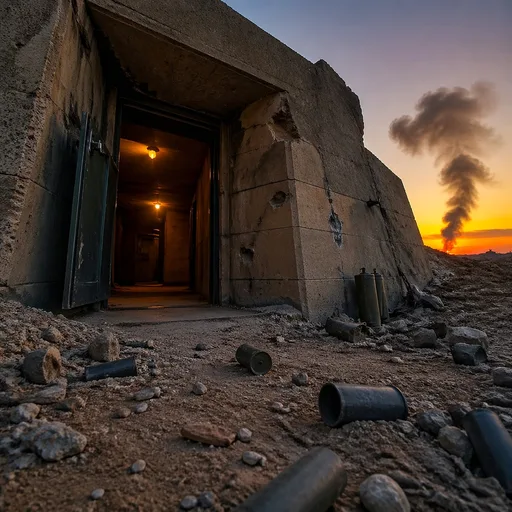
中东惊雷:哈梅内伊身亡与美以“史诗之怒”行动始末
Khamenei Killed in US–Israel Strike on Iran
About this story
Khamenei killed in Operation Epic Fury — Trump and Netanyahu's US-Israel strike on Iran, and Tehran's retaliation. HSK 5-6 Chinese listening practice.
This is an HSK 5-6 Chinese listening episode that runs about 11 minutes. The full Mandarin script is shown with tap-for-pinyin and a line-by-line English translation, so you can listen and read at once — comprehensible input in the sense of Stephen Krashen's i+1 theory. It teaches 14 key vocabulary words such as 局势、确认、警告 and walks through 5 grammar patterns, each explained in English with examples. The same news story is retold at 4 difficulty levels — use the level selector above to find the version that is challenging but still understandable for you.
Read at your level
原文Read the complete story in Chinese. Reveal pinyin and English only when you need them.
English transcript reference
Just two hours ago, the geopolitical landscape of the world experienced what may be the most violent upheaval of this century.
According to the latest confirmed reports, Iran's Supreme Leader Grand Ayatollah Ali Khamenei has been killed in a massive airstrike launched by U.S.-Israeli coalition forces under the codename "Epic Fury."
This was not merely a military strike — it was a strategic storm aimed at fundamentally reshaping the Middle Eastern order.
Let us first piece together the chain of events behind this operation that has stunned the entire world.
U.S. President Donald Trump and Israeli Prime Minister Netanyahu joined forces to launch an unprecedented devastating blow against Iran's leadership and military core.
Trump posted an eight-minute video on his social media platform "Truth Social," with fierce rhetoric and an unwavering tone.
He made it clear that the fundamental purpose of this operation was to ensure that Iran could never obtain nuclear weapons.
In the video, Trump declared that the U.S. military would completely destroy Iran's missile industry, leveling it to the ground, and warned the Iranian armed forces to lay down their weapons in exchange for "complete immunity" — otherwise they would face "certain death."
This ultimatum-style language, combined with the military action that followed, demonstrated that the U.S. side intended to seek a fundamental change of the Iranian regime.
He even addressed the Iranian people directly, calling on them to prepare to overthrow the existing clerical system, saying this might be "the only opportunity in generations."
Meanwhile, Israeli Prime Minister Netanyahu confirmed in a televised address that the Israeli military had destroyed Khamenei's residence in central Tehran, calling it "the fortress of a tyrant."
Subsequently, Iran's Supreme National Security Council issued a statement through state television, officially confirming Khamenei's death.
The confirmation of this news instantly triggered a massive political tsunami across the Middle East and the entire world.
Beyond the Supreme Leader, CBS News reported, citing intelligence sources, that approximately 40 senior Iranian officials were killed in the initial wave of strikes.
Among them were Ali Shamkhani, the secretary of Iran's Defense Council; Brigadier General Aziz Nasirzadeh, the Defense Minister; and General Mohammad Pakpour, commander of the Islamic Revolutionary Guard Corps.
It can be said that Iran's military and security command structure suffered a devastating "decapitation" strike in a very short time.
Although the office of Iranian President Pezeshkian was also hit, state media reported that the president is currently safe and has issued a statement.
However, the situation inside Iran can currently be described as utter chaos — one might even say the country has fallen into a massive information blackout.
Since Saturday morning, 24 out of Iran's 31 provinces have reported being struck.
Videos circulating on social media show explosions and billowing black smoke rising from the capital Tehran to the central cities of Isfahan and Qom, all the way to Kermanshah in the west.
According to the Israel Defense Forces, approximately 200 fighter jets participated in this massive airstrike, simultaneously dropping hundreds of munitions on roughly 500 targets inside Iran.
These targets included Islamic Revolutionary Guard Corps facilities, air defense systems, missile and drone launch sites, and military airfields.
This density and breadth of strikes is extremely rare in the history of modern warfare.
Even more alarming, Iran is currently in a state of near-total internet blackout.
This means the outside world can hardly obtain real-time, reliable information about conditions on the ground — this "fog of war" has further heightened international anxiety.
According to the Iranian Red Crescent Society, more than 200 people have been killed and over 700 injured nationwide so far.
And at a school in southern Iran, an explosion killed at least 108 people, a tragedy that has undoubtedly added a deeply bloody dimension to this conflict.
Faced with such a devastating strike, Iran's counterattack came with exceptional swiftness and ferocity.
Iran's Foreign Minister Abbas Araghchi accused the U.S. and Israel of launching a "completely unprovoked, illegal, and illegitimate" war.
He responded forcefully on social media, stating that Iran's powerful armed forces were prepared for this and would teach the aggressors a deserved lesson.
As it turned out, this was no empty threat.
Following Khamenei's death, Iran swiftly launched a massive retaliatory operation, deploying ballistic missiles and drones to carry out wide-ranging attacks against U.S. assets and their allies in the Gulf region.
This move directly spread the flames of war across the entire Middle East.
Qatar, Bahrain, Jordan, and Kuwait — countries hosting U.S. military bases — all reported intercepting missiles launched from Iran.
Although most missiles were intercepted, falling debris still caused widespread damage.
According to the semi-official Tasnim News Agency, the Islamic Revolutionary Guard Corps claimed they struck not only multiple targets inside Israel but also focused attacks on five major U.S. military facilities in the region.
These included Al Udeid Air Base in Qatar, Al Dhafra Air Base in the UAE, the U.S. Fifth Fleet headquarters in Bahrain, Ali Al Salem Air Base in Kuwait, and Muwaffaq Salti Air Base in Jordan.
The IRGC even claimed that a U.S. combat support vessel was "severely damaged" by a missile, and a U.S. radar system in Qatar had been "completely destroyed."
This direct targeting of U.S. military bases marks a qualitative escalation in the nature of the conflict.
In response, U.S. Central Command stated that U.S. forces successfully defended against hundreds of Iranian missile and drone attacks, and there were currently no reports of U.S. casualties, with facility damage described as "minimal."
However, the huge gap between this official statement and Iran's claimed battlefield results means the true combat situation will likely require time to verify.
On the Israeli side, local media reported that Iran launched approximately 150 ballistic missiles and dozens of attack drones at Israel.
Although air defense systems intercepted some of the missiles, others still struck open areas.
The Israel Defense Forces confirmed that two Israelis were killed and 456 were injured in Iran's retaliatory strikes.
Beyond the intense military confrontation, the potential threat this conflict poses to the global economy and energy security cannot be ignored.
The EU's naval task force in the region revealed that the Islamic Revolutionary Guard Corps has issued radio warnings to passing vessels, prohibiting any ships from transiting the Strait of Hormuz.
As is well known, the Strait of Hormuz is the jugular vein of global oil transportation — approximately 20% of the world's oil and natural gas shipments pass through here.
If the strait were blockaded, global energy markets would inevitably face a severe earthquake, and a surge in oil prices would be all but certain.
On the political front, with the death of Supreme Leader Khamenei, Iran faces a grave power vacuum and succession crisis.
Although Alireza Arafi has been appointed as interim Supreme Leader, the formal succession process is fraught with uncertainty.
According to the Iranian constitution, a new Supreme Leader must be elected by the Assembly of Experts, which consists of 88 senior clerics.
However, convening these clerics and completing the election process while the country is under heavy airstrikes and the security situation is extremely unstable is a task of unimaginable difficulty.
This political uncertainty has undoubtedly cast an even heavier shadow over Iran's future.
Additionally, the impact of this conflict on civilian life and international transportation has been immediate.
Thousands of flights have been canceled or rerouted — this is arguably the most severe disruption to global aviation since the COVID-19 pandemic.
According to aviation analytics firm Cirium, nearly a quarter of the more than 4,200 flights scheduled to land in the region on Saturday were canceled.
Flight cancellations on Sunday were equally severe.
Wizz Air, British Airways, Swiss International Air Lines, Lufthansa, and many other international carriers announced the suspension of flights to Tel Aviv, Tehran, Amman, Beirut, and other destinations.
Kuwait, Iraq, Jordan, and other countries even temporarily closed their airspace, while the UAE also partially closed its airspace as a precautionary measure.
This large-scale transportation paralysis has not only stranded countless travelers but also severed the region's normal connections with the outside world.
Looking back at this series of heart-stopping events, we cannot help but ask: where is the Middle East situation headed?
The U.S.-Israeli coalition's "Epic Fury" operation, while achieving astonishing military results by successfully "decapitating" Iran's Supreme Leader, remains an open question — will it truly bring about the regime change Trump desires,
or will it ignite even stronger anti-American sentiment and more enduring resistance among the Iranian people?
Iran's retaliatory actions demonstrate that it still possesses considerable military counterattack capability, with strike ranges already covering U.S. military bases across the entire Gulf region.
Will this "tit-for-tat" escalation ultimately drag the United States and its allies into a protracted full-scale war?
For ordinary people, whether it's the smoke rising from the streets of Tehran, the alarms sounding in Tel Aviv, or the helplessness of being stranded at airports due to flight cancellations, the shadow of war has truly descended over everyone's heads.
Khamenei's death is undoubtedly the end of an era, but the new chapter it opens seems filled with even more bloodshed and uncertainty.
The situation remains in rapid flux. The internet blackout makes it difficult to see the full picture inside Iran, but from the fragmentary information available, we can still piece together a scene of widespread devastation and looming crisis.
This is not merely a war between two nations — it is a final showdown between two ideologies and two major geopolitical blocs.
As night falls, the roar of warplanes above the Middle East has not ceased, and the world's gaze remains fixed on this ancient and long-suffering land, waiting for the next dawn to arrive — or for even deeper darkness.
Listen again
Try it without the transcript and notice what sounds clearer.
What vocabulary does this episode teach?
词汇Refers to the state of affairs, often used in news regarding politics or war.
To verify or validate something.
To alert someone to danger or consequences.
A state of disorder.
To menace or pose a danger to.
Revenge or counterattack.
To completely ruin something (buildings, systems, etc.).
Politics, especially international relations, as influenced by geographical factors.
Used here metaphorically to describe a major political or economic disturbance.
Idiom literally meaning 'the origin and course of development'. Used to describe the full story or history of an event.
A final demand or statement of terms, the rejection of which will result in retaliation or a breakdown in relations.
Used metaphorically in military contexts ('decapitation strike') to mean targeting the leadership.
Idiom literally meaning 'pin against wheat awn'. Describes a situation of sharp, direct confrontation.
Idiom meaning 'wounds and sores meet the eye everywhere'. Describes a scene of great destruction (e.g., after a war or disaster).
* beyond level超纲词
What grammar patterns appear in this episode?
语法This pattern means 'not only is it A, but even more so/importantly it is B'. It emphasizes the second part as being more significant or deeper in meaning.
这不仅仅是一次军事打击,更是一场旨在彻底重塑中东秩序的战略风暴。
这不仅仅是两个国家之间的战争,更是两种意识形态、两大地缘政治阵营之间的一次总摊牌。
Verbal phrase meaning 'aimed at' or 'intended to'. It is often followed by a verb phrase describing the purpose of an action.
更是一场旨在彻底重塑中东秩序的战略风暴。
Means 'to exchange [A] for [B]'. It describes giving up one thing to get another.
警告伊朗武装部队放下武器以换取“完全豁免”
A formal way to say 'Whether it is A, or B, or C'. It lists multiple possibilities that all lead to the same conclusion or share a common trait.
对于普通民众来说,无论是德黑兰街头的硝烟,还是特拉维夫响起的警报,亦或是因航班取消而滞留机场的无奈,战争的阴霾已经实实在在地笼罩在了每个人的头顶。
Means 'along with...' or 'as...'. It introduces a changing circumstance that leads to another event.
随着最高领袖哈梅内伊的身亡,伊朗正面临着严峻的权力真空和继任危机。
随着夜幕的降临,中东上空的战机轰鸣声依然未绝
Proper nouns
专有名词Sources
来源Free account
Keep learning from this story
Create a free account to keep saved words and your preferred level together.
- Keep words with their story context
- Remember your preferred level
- Build your vocabulary over time