
A Chinese podcast · Same story, 4 levels
美国公布 UFO 文件:天上的亮东西
Pentagon Releases 162 UFO Files
About this story
A simple story about UFOs — bright things in the sky and what the US government has been looking at. HSK 1 Chinese listening practice.
This is an HSK 1 Chinese listening episode that runs about 7 minutes. The full Mandarin script is shown with tap-for-pinyin and a line-by-line English translation, so you can listen and read at once — comprehensible input in the sense of Stephen Krashen's i+1 theory. It teaches 18 key vocabulary words such as 天、看、星星 and walks through 7 grammar patterns, each explained in English with examples. The same news story is retold at 4 difficulty levels — use the level selector above to find the version that is challenging but still understandable for you.
Read at your level
原文Read the complete story in Chinese. Reveal pinyin and English only when you need them.
English transcript reference
Tonight, Xiao Ming is at home.
He's looking at something very interesting.
He's looking at the sky.
There are stars in the sky.
There's a moon.
All very pretty.
But Xiao Ming sees something.
That thing isn't a star.
It isn't the moon either.
It isn't a plane either.
What is it?
That thing is very bright.
Very yellow.
Also very strange.
It's flying in the sky.
Flying very fast.
Then, it's gone.
Xiao Ming can't see it anymore.
Xiao Ming says: wow!
Xiao Ming runs to find his dad.
Dad, dad!
I saw something!
Dad says: what did you see?
Xiao Ming says: there's a bright thing in the sky.
Not a star, not the moon.
Flying very fast.
I didn't see it clearly.
Dad says: oh.
I've heard about this too.
Xiao Ming says: have you seen it too?
Dad says: no.
But many people have seen it.
Not just Chinese people.
Americans have seen it too.
Japanese people have too.
People all over the world have seen it.
Xiao Ming asks: what is it?
Dad says: we don't know.
Really, we don't know.
Xiao Ming says: how can we not know?
Dad says: it's true.
Let me tell you something.
Yesterday,
the US government released some things.
They released 162 documents.
There are photos.
There are videos.
There are also written texts.
All about the bright things in the sky.
They call these things "UFO."
U-F-O.
It's an English abbreviation.
It means:
"We saw something.
But we don't know what it is."
Xiao Ming says: wow.
Xiao Ming asks: does the US government know?
Dad says: they don't know either.
They looked for a long time.
They investigated for a long time.
But in the end,
they said:
"We don't know either."
Xiao Ming says: how strange.
Dad says: yes.
Let me tell you some interesting things.
One time,
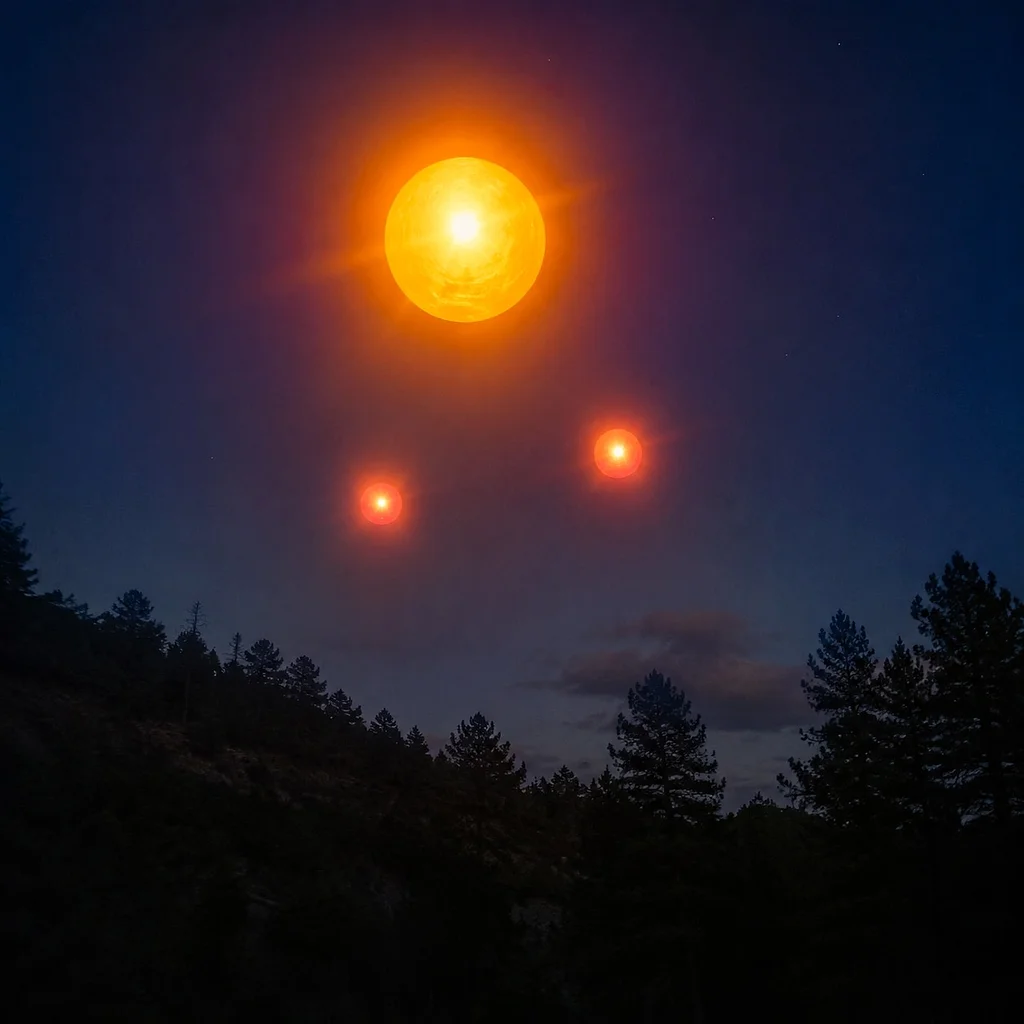
seven police officers in the US mountains
all saw it together.
There were bright orbs in the sky.
Not one.
Several of them.
They were orange.
And they would "give birth" to smaller orbs.
Sounds like toys.
But they all saw it.
All seven of them saw it.
They all drew pictures too.
They all found it strange.
Xiao Ming says: wow.
There's something even more amazing.
Over fifty years ago,
people went to the moon.
You know the moon?
That white round ball in the sky.
People went there.
They rode a very big rocket.
They flew to the moon.
They reached the moon.
They walked on it.
When they looked at the sky,
they also saw bright things.
They said:
"Wow, there are so many bright things here.
Right beside us."
They also said:
"They're flying.
It's not our eyes playing tricks.
It's real."
Xiao Ming says: amazing.
Xiao Ming asks: so are these all aliens?
Dad says: don't know.
Some people say yes.
Some people say no.
The US government says:
"We have no evidence."
"Evidence" means real things.
You can see them, you can touch them.
Right now we have no evidence.
So we can't say they're aliens.
And we can't say they aren't.
Xiao Ming says: so what now?
Dad says: wait.
Wait and slowly see.
Maybe one day,
we'll know.
Maybe we'll never know.
But there's one interesting thing.
That is:
people all over the world have seen them.
A hundred years ago people saw them.
Now people see them too.
Police see them.
People in planes see them.
People on the moon saw them too.
Not one person fooling everyone.
These things really happened.
Xiao Ming says: wow.
I want to see one too.
Dad smiles.
He says: you saw one today.
Xiao Ming says: yes.
But I didn't see it clearly.
Dad says: that's okay.
What you saw, you saw.
Xiao Ming,
maybe next time,
you'll see more clearly.
Xiao Ming says: okay.
I'll watch again.
Dad says: then go to bed early.
Tomorrow we'll watch the stars again.
Xiao Ming says: okay.
Dad,
thank you for telling me.
Dad says: you're welcome.
You learned something new today.
You learned about UFOs.
You learned:
in our world,
there are still many things we don't know.
This is also good.
Because
not knowing is what makes it interesting.
Not knowing is what makes a story.
Xiao Ming nods.
He goes back to his room and goes to bed.
But he's still thinking:
that bright thing —
what was it really?
He doesn't know.
The whole world
also doesn't know.
But everyone is watching.
Everyone is waiting.
Maybe one day,
we'll know.
By then,
Xiao Ming will have grown up.
Maybe he'll tell his own children:
"I saw one when I was little too."
The story ends here.
Today Xiao Ming learned:
there are bright things in the sky.
We all don't know what they are.
The whole world is watching.
Yesterday,
the US government also said: "We don't know either."
That's strange.
But it's also true.
Listen again
Try it without the transcript and notice what sounds clearer.
What vocabulary does this episode teach?
词汇HSK 1. 天上 = in the sky. The episode anchor.
HSK 1. 看到了 = saw it. The episode is built on 看.
HSK 2. 天上有星星 = there are stars in the sky.
HSK 2. People went to the 月亮. Featured in the Apollo angle.
HSK 2. 亮亮的 = bright (reduplicated for cuteness/emphasis). The keyword of the episode title.
HSK 2. 在天上飞 = flying in the sky. Used for both planes and UFOs.
HSK 2. 很奇怪 = very strange. The whole episode is about 奇怪 things.
HSK 1. 不知道 = don't know. The Pentagon's actual answer.
HSK 2. 听过 = have heard. 我没听过 = I haven't heard of it.
HSK 4. 你记住一件事 = remember one thing.
Beyond. English acronym kept as-is. Glossed inline as '我们看见了一个东西。但是我们不知道它是什么。'
HSK 4. 美国政府 = the US government. The actor that released the files.
HSK 6. 档 (file) + 案 (case). The 162 official files released.
HSK 5. Glossed inline as 真的东西,你可以看,可以摸. Central to the 'we don't know' framing.
Beyond. 外 (outside) + 星 (star) + 人 (person). The big question of the episode.
HSK 4. 七个警察 = seven officers (in the orbs case). The episode's 'professional witness' angle.
HSK 5. 火 (fire) + 箭 (arrow). 坐火箭,飞到月亮 = take a rocket to the moon.
HSK 3. 不知道才有故事 = without knowing, there's a story. The episode's closing line.
* beyond level超纲词
What grammar patterns appear in this episode?
语法X 不是 ... 也不是 ...
'X is not A, nor is it B.' Used to rule out options before introducing the unknown.
那个东西不是星星。也不是月亮。也不是飞机。
不是飞机,不是鸟,不是云,什么都不是。
不是一个人骗大家。
X 也 + Verb
也 = also. Comes BEFORE the verb. Adds a parallel idea.
我也听过。
美国人也看过。
月亮上的人也看到了。
也许 ...
'Maybe / perhaps.' Used to express uncertainty without committing.
也许有一天,我们会知道。
也许我们永远不知道。
也许下一次,你看得更清楚一点。
X 就是 Y (definition)
The teaching pattern. Used to define new words inline.
"证据"就是真的东西。
意思是:"我们看见了一个东西。但是我们不知道它是什么。"
X 不是 ... 是 ...
Corrective: 'not A, but B.' Used for emphasis.
不是眼睛看错。是真的。
看到了,就是看到了。
Verb + 过 (experiential)
Verb + 过 = have done V (at some point). Used for past experiences.
我也听过。
你也看过吗?
美国人也看过。
X 就是 / 才 ... (emphasizer)
'Precisely / only.' Used for emphasis at the end of a clause.
不知道才有意思。
不知道才有故事。
看到了,就是看到了。
Proper nouns
专有名词Free account
Keep learning from this story
Create a free account to keep saved words and your preferred level together.
- Keep words with their story context
- Remember your preferred level
- Build your vocabulary over time