
A Chinese podcast · Same story, 4 levels
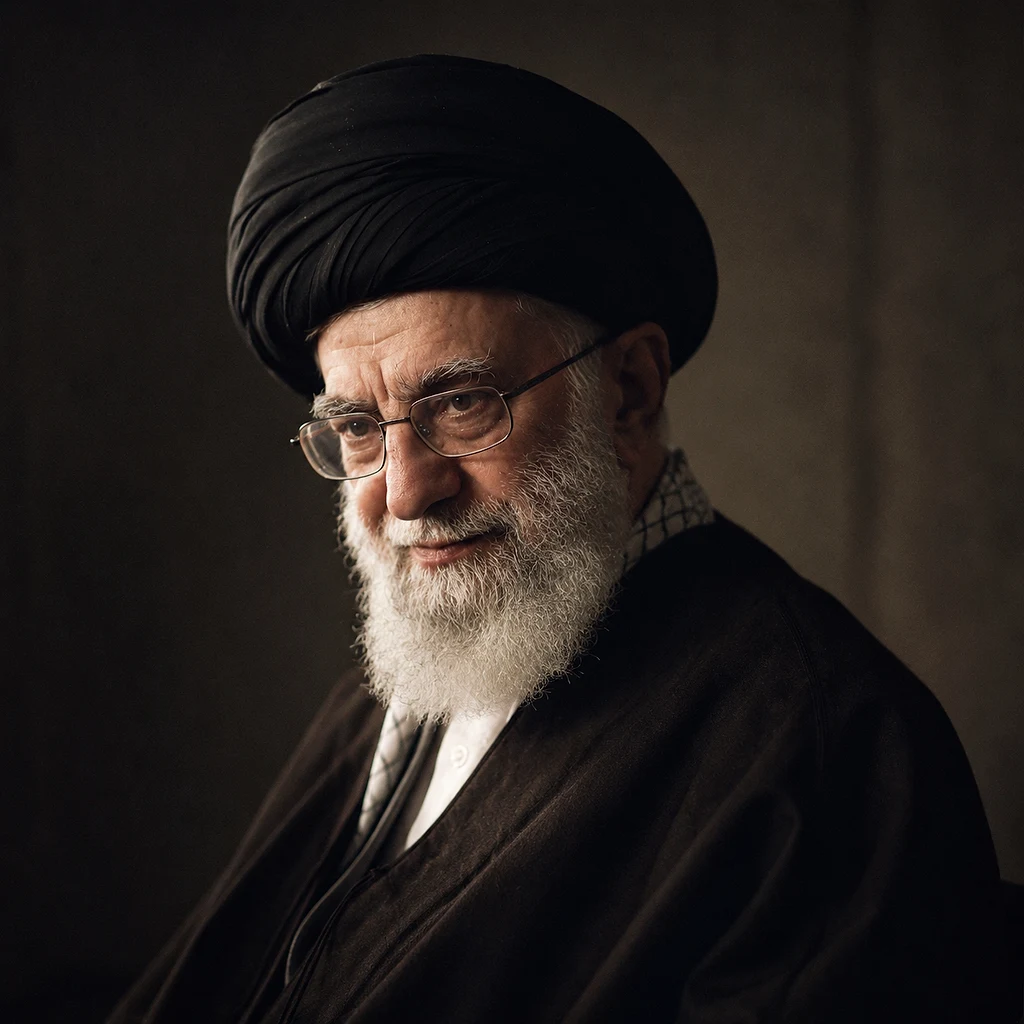
德黑兰的迷雾:哈梅内伊之后,谁主沉浮?
Iran Searches for Leader After Khamenei
About this story
Who rules Iran after Khamenei — Tehran's power vacuum, Israeli infiltration, and the regime collapse scenarios. HSK 5-6 Chinese listening practice.
This is an HSK 5-6 Chinese listening episode that runs about 9 minutes. The full Mandarin script is shown with tap-for-pinyin and a line-by-line English translation, so you can listen and read at once — comprehensible input in the sense of Stephen Krashen's i+1 theory. It teaches 15 key vocabulary words such as 敏锐、崩溃、渗透 and walks through 5 grammar patterns, each explained in English with examples. The same news story is retold at 4 difficulty levels — use the level selector above to find the version that is challenging but still understandable for you.
Read at your level
原文Read the complete story in Chinese. Reveal pinyin and English only when you need them.
English transcript reference
With Supreme Leader Khamenei killed in an Israeli airstrike, and the smoke of gunpowder not yet cleared from the streets of Tehran, a huge question mark hangs over the Middle East: in this moment of power vacuum, who exactly is controlling Iran?
This event is undoubtedly the most violent geological shock encountered by the Iranian political landscape since the 1979 Islamic Revolution.
Even though Iranian officials quickly announced a temporary leadership in an attempt to stabilize the morale of the military and the public, any keen observer could smell the restless anxiety in the air.
This is not only because of the passing of a spiritual leader, but even more so because this war launched by the United States and Israel is impacting Tehran's power center with unprecedented intensity.
However, if we assert that the Iranian regime will collapse instantly like dominoes just because of Khamenei's fall, that would appear too naive regarding this complex political system.
The power structure of the Islamic Republic of Iran, after more than forty years of careful design and reinforcement, has long formed a defensive system that is deep-rooted, intertwined, and mutually supportive.
The original intention of this system's design was precisely to prevent the overthrow of the entire regime due to the replacement or accident of individual leaders.
In fact, when we peel back the cloak of religious ideology and observe its internal operations deeply, we find that this is a massive machine with a strong survival instinct.
This leads to a crucial question: in the post-Khamenei era, who is the real helmsman?
Although the current situation is chaotic, several clear threads of power are surfacing, and the most striking among them is undoubtedly the Islamic Revolutionary Guard Corps.
This armed force, originally acting as the defender of the revolution, has long penetrated every pore of Iranian society over the past few decades.
From oil extraction to infrastructure construction, from telecommunication networks to foreign trade, the Revolutionary Guards control the lifeline of the national economy and have built a huge business empire.
With the Supreme Leader absent, those hardline generals holding heavy military power are very likely to step from behind the scenes to the forefront and become the actual decision-makers.
This shift is not without omens; in fact, the trend of "militarization" in Iranian politics has become increasingly obvious in recent years.
Facing external war pressure and internal waves of protest, the Revolutionary Guards are likely to use "national security" as a reason to further tighten power, pushing Iran from a theocratic republic toward some form of military dictatorship.
For them, maintaining the survival of the regime is an overwhelming task, and because their own interests are highly bound to the regime's survival, this will to resist is often underestimated by the outside world.
At the same time, we must examine another variable frequently mentioned by Western media—the Iranian opposition.
In the narrative of many Western observers, the fall of Khamenei should be an opportunity for the rise of democratic forces.
However, reality is often much harsher than the ideal.
The current Iranian opposition, whether domestic or in exile, faces a serious crisis of fragmentation.
They lack a spiritual leader with absolute appeal like Khomeini back in the day, and also lack a tightly organized political group capable of immediately taking over the state apparatus.
What is more fatal is that many exiled opposition figures, due to long-term detachment from local Iranian society, lack sufficient resonance for their political proposals on the streets of Tehran.
Although the public is dissatisfied with the status quo, this does not mean they are willing to accept a proxy government supported by external forces that lacks a basis of legitimacy.
This creates a dangerous power vacuum: the old order is crumbling, while the new order is slow to be established.
Against this backdrop, U.S. President Trump's policy toward Iran appears particularly confusing.
President Trump's goal setting for this war seems to be in a state of constant shifting and revision.
Initially, the reason was the imminent nuclear threat, then it shifted to striking terrorism support networks, and in recent days, the tone suddenly changed to bringing "freedom" to the Iranian people.
This repeated jumping back and forth on goals not only reflects divisions within Washington's decision-making circle but also exposes the deep confusion in the U.S. strategy toward Iran.
Trump seems to be pursuing a quick "regime change," even fantasizing that the Middle East landscape can be reshaped through a few precision airstrikes.
The "Venezuela model" he mentioned—attempting to replace the existing regime by recognizing an opposition leader—is likely difficult to replicate in Iran, a country with profound historical heritage and complex geopolitical influence.
What is more worrying is that this strategy can extremely easily lead to misjudgments.
If the U.S. is merely satisfied with a "decapitation strike" without a meticulous post-war reconstruction plan, then the result is likely not the arrival of democracy, but the beginning of chaos.
We might as well look back at the lessons of Iraq and Libya; after forcibly removing dictators, what remains is often not flowers and peace, but long-term sectarian conflicts and a breeding ground for terrorism.
If Iran, a major Middle Eastern power with a population of over eighty million, falls into a state of anarchy, the consequences will be catastrophic.
It would not only lead to a wave of refugees flooding into Europe but also likely split Iran into a battlefield partitioned by various forces, or even become a new safe haven for extremist organizations.
In this sense, the "peace in the Middle East and even the world" claimed by Trump may be facing the risk of becoming an empty slogan.
In fact, the course of war often does not shift according to the will of the initiator.
As the war drags on, the power restructuring within Iran may develop in a more radical and unpredictable direction.
The hawkish forces within the Revolutionary Guards may use nationalist sentiments to divert the public's anger from the regime itself to external aggressors.
This is an ancient and effective means of political mobilization: when a country faces life and death, internal contradictions often give way to external threats.
Therefore, although Israel's airstrikes physically eliminated Iran's top leadership, it remains an unknown whether they have truly broken the Iranian regime's will to resist psychologically.
In addition, we cannot ignore the reactions of regional allies.
Iran has operated in the Middle East for many years and possesses a vast network of proxies, including Hezbollah in Lebanon and the Houthi armed forces in Yemen.
Once the central regime in Tehran collapses, these armed forces will not only not disappear but may become more out of control due to the loss of restraint, thereby spreading the flames of war to the entire Middle East region.
This is precisely the most terrifying part of the current situation when thinking carefully: we are standing at a historical crossroads, with a possible geopolitical reshuffle on one side and a bottomless abyss on the other.
For ordinary Iranian people, this is probably the darkest moment.
They protest in the streets, expressing anger at economic depression and political repression, but at the same time, the warplanes roaring overhead remind them that the country's fate is in the hands of others.
This sense of powerlessness and uncertainty constitutes the heaviest background color of Tehran in the spring of 2026.
When we try to answer the question "Who is leading Iran," the answer may not lie in a specific person, but in that massive system with huge inertia and full of desire for survival.
Even without Khamenei, this system is still operating according to established logic, trying to rebuild order in the ruins.
For the Trump administration, the biggest challenge lies not in how to drop more bombs, but in how to face the shattered world after the bombs fall.
After all, destroying an old world is easy, but building a new world requires not only force but also wisdom, patience, and reverence for history.
In this game, whether Washington, Tel Aviv, or Tehran, everyone seems to be walking a tightrope.
And beneath the tightrope is a bottomless abyss.
Iran now is like a giant ship that has lost its captain in a storm; although the engines are still roaring and the crew is still rushing about, the course has become blurred.
The coming days or even weeks will be the critical moments deciding whether this giant ship strikes a reef and sinks or sails into unknown waters.
In this process, every tiny misjudgment could trigger a chain reaction, ultimately changing the fate of millions of people.
The world is holding its breath, watching every tremor on this ancient land.
Listen again
Try it without the transcript and notice what sounds clearer.
What vocabulary does this episode teach?
词汇Adjective used to describe senses or observation skills (e.g., a keen observer).
Verb often used for regimes, economies, or emotional states.
Verb indicating gradual entry or influence into a system or society.
Noun or verb referring to high-level decision making.
Verb used to indicate a shortage of abstract things like courage, resources, or leadership.
Noun or verb used in political or physical contexts.
Noun referring to a terrible event.
Noun or adjective describing intense displeasure.
Noun referring to the future course of events.
Idiom literally meaning 'twisted roots and gnarled branches'; used to describe complex, difficult situations or systems.
Metaphor for a leader or person in charge of a country or organization.
Idiom used to describe a situation that is complex and hard to figure out.
A modern idiom/internet slang derived from '细思恐极'.
Metaphor for taking a dangerous path or maintaining a delicate balance.
Often found in the phrase '理想很丰满,现实很骨感' (Ideals are plump/rich, reality is skinny/harsh).
* beyond level超纲词
What grammar patterns appear in this episode?
语法随着 (Suízhe) ...
Indicates that one event happens in conjunction with or as a result of another ('Along with...', 'As...').
随着最高领袖哈梅内伊在以色列的空袭中身亡...
随着战事的拖延...
不仅仅是 ... 更是 ... (Bùjǐnjǐn shì ... gèng shì ...)
A progressive structure meaning 'Not only is it A, but even more importantly/significantly, it is B'.
这不仅仅是因为一位精神领袖的离世,更是因为这场...战争...
不仅仅是武力,更需要智慧、耐心...
以 ... 为由 (Yǐ ... wéiyóu)
A formal structure meaning 'using ... as a reason/excuse' or 'on the grounds of ...'.
革命卫队很可能会以“国家安全”为由...
无论 ... 还是 ... (Wúlùn ... háishì ...)
Means 'No matter if A or B' or 'Whether A or B'. It indicates that the result or situation remains the same regardless of the condition.
目前的伊朗反对派,无论是在国内还是流亡海外...
无论是华盛顿、特拉维夫还是德黑兰...
不仅不 ... 反而 ... (Bùjǐn bù ... fǎn'ér ...)
Means 'Not only does it not [do X], on the contrary, it [does Y]'. Used to highlight a result that is opposite to what might be expected.
这些武装力量不仅不会消失,反而可能因为失去约束而变得更加失控...
Proper nouns
专有名词Sources
来源Free account
Keep learning from this story
Create a free account to keep saved words and your preferred level together.
- Keep words with their story context
- Remember your preferred level
- Build your vocabulary over time