
A Chinese podcast · Same story, 4 levels
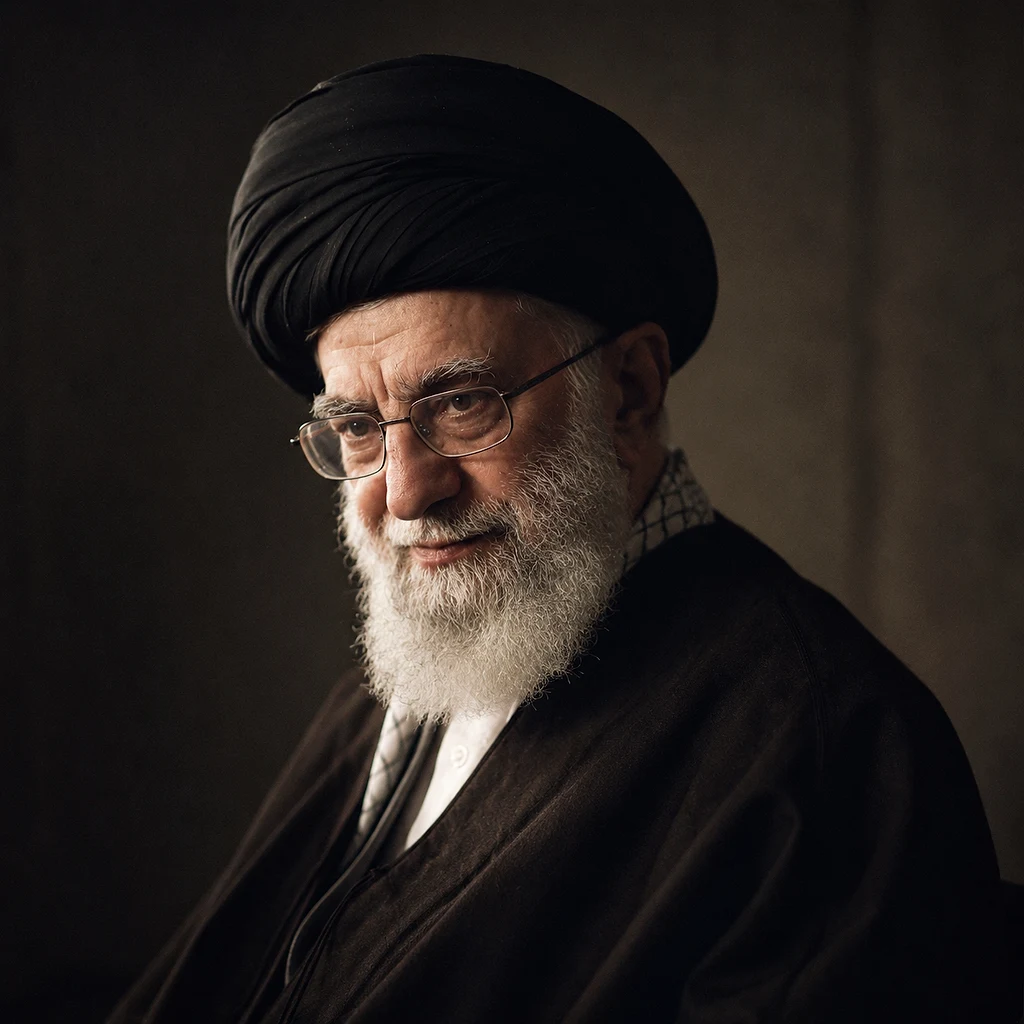
伊朗现在谁说了算?
Iran Searches for Leader After Khamenei
About this story
A simple story about who is in charge of Iran now — Khamenei, the US, Israel, and Trump in a tense Middle East. HSK 1 Chinese listening practice.
This is an HSK 1 Chinese listening episode that runs about 8 minutes. The full Mandarin script is shown with tap-for-pinyin and a line-by-line English translation, so you can listen and read at once — comprehensible input in the sense of Stephen Krashen's i+1 theory. It teaches 15 key vocabulary words such as 房子、椅子、事情 and walks through 5 grammar patterns, each explained in English with examples. The same news story is retold at 4 difficulty levels — use the level selector above to find the version that is challenging but still understandable for you.
Read at your level
原文Read the complete story in Chinese. Reveal pinyin and English only when you need them.
English transcript reference
Speaking of things happening in a big house, everyone listen.
This is a story about a very big family.
This home is very big.
This home is also very old.
Inside live many, many people.
There are men, and also women.
There are old people, and also children.
Everyone lives here.
Everyone eats here.
Everyone sleeps here.
This home is their world.
In this home, there used to be a person.
He was an old man.
He was very old in age.
He was the number one person in this home.
He was the greatest.
Everyone knew him.
Everyone listened to his words.
In the home, there is a very big chair.
Only he could sit on this chair.
He sat on the chair, looking at everyone.
He said: "We must do it this way."
Everyone then said: "Okay, we will do it this way."
He said: "We will not do it that way."
Everyone then said: "Okay, we will not do it that way."
In this home, he was the person who had the final say.
He was everyone's father.
Also everyone's teacher.
But, yesterday something happened.
This is a very big thing.
This is a very bad thing.
That old man disappeared.
Where is he?
Everyone is looking for him.
Everyone went to his room to look for him.
He was not in the room.
Everyone went to the place where they eat to look for him.
He was not there either.
Everyone looked at that big chair.
There was no one on the chair.
The chair was empty.
That old man is gone.
He went to a very far place.
He will not come back.
He is no longer here.
This is a very big problem.
Now, the people in the home are very scared.
Everyone is very worried.
Everyone is asking: "Now who is the number one person?"
"Now who sits on that big chair?"
"Whose words do we listen to from now on?"
No one knows the answer.
In this home, there are some other people.
They are that old man's students.
They are also that old man's friends.
Their bodies are very good.
They have a lot of strength.
They are wearing special clothes.
They feel they are very big.
They feel they can sit on that chair.
One of them said: "I am the new number one person."
Another person said: "No, I am."
A third person said: "Neither of you are, I am."
They are arguing.
They are all fighting for that chair.
But, there is only one chair.
It is impossible for three people to all sit.
So, the home is very chaotic.
Everyone doesn't know who to listen to.
A son asks his father: "Who should we listen to?"
The father doesn't know.
A student asks the teacher: "Who should we listen to?"
The teacher doesn't know either.
This is the matter inside the home.
Let's look outside the home again.
Outside this home, there are people.
Those people are not friends.
Those people live nearby.
Those people have a lot of money.
Those people also have many things.
They do not like this home.
They also do not like that old man.
The people outside are very happy that old man is gone.
Among them, there is one person from outside.
He speaks very loudly.
He has many airplanes.
He has many very hot things.
He threw those things into this home.
Bang!
The sound was very loud.
This is a very scary sound.
The home's windows broke.
The home's tables broke.
The people in the home became even more scared.
That outside person said: "I want to change a person."
He said: "I don't like that previous old man."
He said: "I want you to change to a new number one person."
He said: "I want to give you freedom."
He said: "I want you to listen to my words."
However, his ideas are constantly changing.
Today he says: "I want to break this home."
Tomorrow he says: "I just want to change someone."
The day after tomorrow he says again: "I want to be friends with you."
No one knows what he actually wants to do.
He keeps changing.
But, he keeps throwing things.
He is hitting this home.
The people in the home cannot sleep.
The people in the home cannot eat.
Everyone is very cold.
Everyone has no water to drink.
Now, this home is very dangerous.
The people inside are arguing.
Everyone is fighting for that chair.
The people outside are fighting.
They are throwing very hot things.
What will happen to this home?
Will this home break?
Will this home fall?
No one knows.
Also, no one is driving.
This home is like a car.
Before, that old man was driving.
Now no one is driving anymore.
But the car is still running.
And it is running very fast.
This is very dangerous.
Maybe tomorrow there will be a new number one person.
Maybe tomorrow the people from outside will come in.
Maybe tomorrow this home will be gone.
Everyone is watching.
Everyone is listening.
Everyone is waiting.
This is the story.
What is this story talking about?
Actually, this story is talking about a country.
This country's name is Iran.
The "old man" in the story is Iran's leader.
His name is Khamenei.
He is the biggest person in Iran.
But, he is no longer here due to a war.
The "people outside" in the story are the United States and Israel.
They have a bad relationship with Iran.
They are fighting with Iran.
The "people who want to sit on the chair" in the story are Iran's army.
They want to be the new leaders.
That "person who speaks very loudly" is the US President Trump.
He wants to let Iran change to a new leader.
But now, Iran is very chaotic.
No one knows who the new leader is.
Also no one knows what will happen tomorrow.
This is the matter regarding Iran.
Listen again
Try it without the transcript and notice what sounds clearer.
What vocabulary does this episode teach?
词汇A common noun for house or building. Used here metaphorically for a country.
A common noun. Used metaphorically here for a position of power or throne.
Refers to an affair, matter, or business, rather than a physical object.
Used to express opinions or physical sensations.
Used for knowing people or recognizing characters.
Expresses a desire for something to happen.
HSK 1. we; us.
HSK 1. you (plural).
A narrative or tale.
The earth or the universe; here used metaphorically for their entire life environment.
An adjective or verb describing fear.
Literally 'carry heart'; meaning to be anxious about something.
Adjective describing a lack of safety.
Verbal conflict between people.
The person or people in charge.
* beyond level超纲词
What grammar patterns appear in this episode?
语法Place + 有 + Object
Used to express existence (There is/are...). It states that something exists in a specific location.
家里有一把很大的椅子。
在这个家的外面,有人。
Verb + 着 (zhe)
The aspect particle 着 is added after a verb to indicate the continuation of an action or a state.
里面住着很多很多人。
他坐在椅子上,看着大家。
他们穿着特别的衣服。
只有... (zhǐyǒu...)
Means 'only'. It restricts the scope of the subject or condition.
只有他可以坐在这个椅子上。
那个椅子只有一个。
Verb + 得 + Complement
Used to describe how an action is performed. The particle 得 connects the verb to the adjective describing it.
而且跑得很快。
他说话很大声。
是... 的 (shì... de)
Used here to categorize or define a person or thing by a specific characteristic.
他是说了算的人。
这个故事说的是什么?
Proper nouns
专有名词Sources
来源Free account
Keep learning from this story
Create a free account to keep saved words and your preferred level together.
- Keep words with their story context
- Remember your preferred level
- Build your vocabulary over time