
A Chinese podcast · Same story, 4 levels
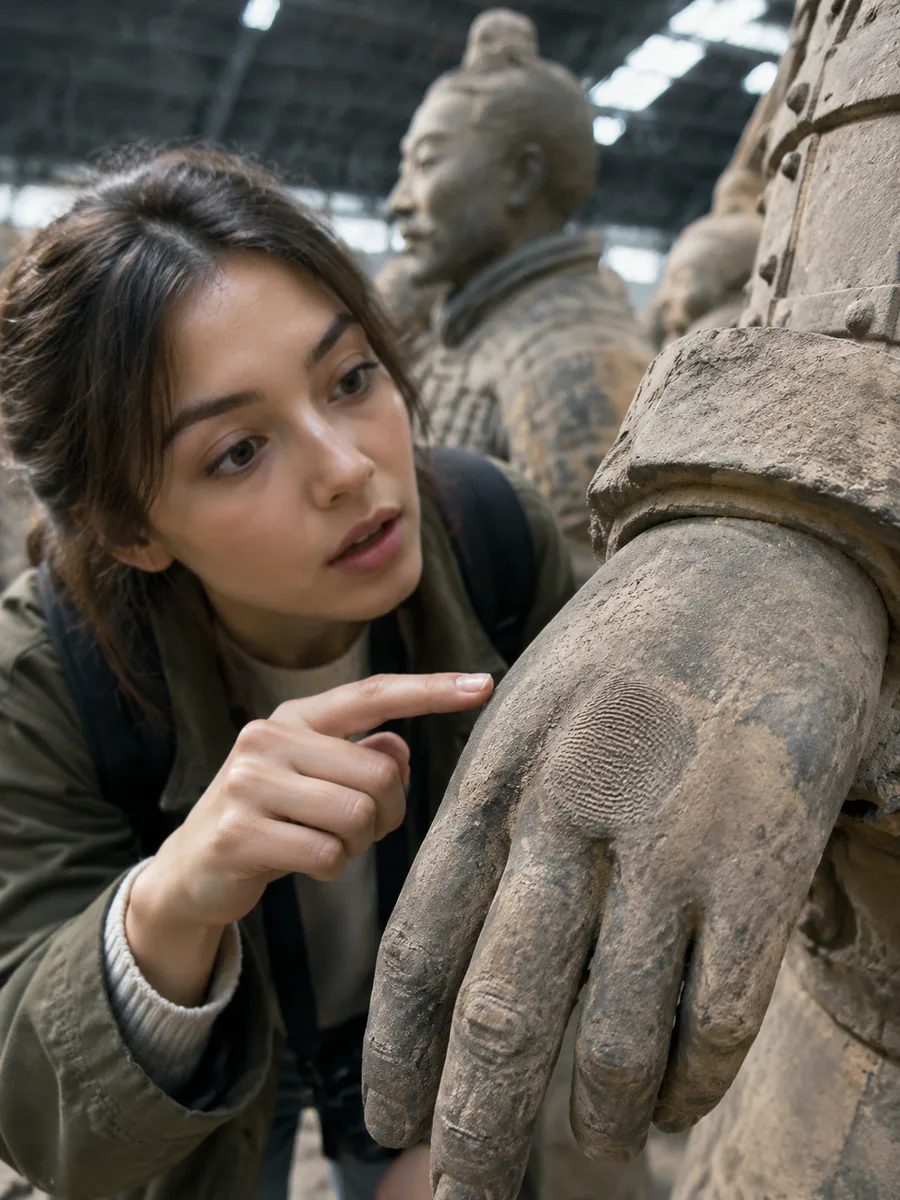
兵马俑上有女人和少年留下的指纹
Fingerprints on the Terracotta Army Suggest Women and Teenagers Helped Make It
About this story
A Bayesian study of 79 fingerprints on the Terracotta Army suggests women and children under 15 may have helped make the figures. HSK 4 Chinese listening practice.
This is an HSK 4 Chinese listening episode that runs about 5 minutes. The full Mandarin script is shown with tap-for-pinyin and a line-by-line English translation, so you can listen and read at once — comprehensible input in the sense of Stephen Krashen's i+1 theory. It teaches 12 key vocabulary words such as 人、手、女人 and walks through 4 grammar patterns, each explained in English with examples. The same news story is retold at 4 difficulty levels — use the level selector above to find the version that is challenging but still understandable for you.
Read at your level
原文Read the complete story in Chinese. Reveal pinyin and English only when you need them.
English transcript reference
There is a fingerprint on the head of a terracotta figure.
This fingerprint is small, but very clear.
The person making it pressed a finger into the clay before it dried.
The fingerprint was left in the clay.
Clay is wet earth.
The Terracotta Army is a set of clay figures made for Qin Shi Huang.
The people who made them are long gone.
But the fingerprint is still there.
Now researchers look at it and say this may be a woman.
This claim differs from what many people think.
Because everyone has long believed the makers were adult men.
This study was done by the Emperor Qinshihuang's Mausoleum Site Museum and Shandong University.
They examined 23 terracotta figures.
On these figures they found 79 fingerprints.
Press your finger on a table, and the small mark it leaves is a fingerprint.
Everyone's fingerprints are different.
The method used in this study is called a Bayesian model.
A Bayesian model is a way of getting a computer to calculate how likely something is.
The computer first studies many known fingerprints, from men, women, and children.
Then it looks at the fingerprints on the figures.
It asks: does this fingerprint look more like a man's hand or a woman's hand?
An adult or a child?
Fingerprint ridges are sometimes thick and sometimes thin.
Being an adult means being grown up.
Adult hands differ from children's hands, and men's hands differ from women's.
The computer has seen many such fingerprints, so it can tell them apart.
After comparing, the computer gives these numbers:
Of these fingerprints, 45.0% may have been left by adult men.
32.7% may have been left by adult women.
22.3% may have been left by children under 15.
You may wonder: does this mean 32.7% of the makers were women?
The researchers say it cannot be read that way.
A Bayesian model gives probabilities.
Probability means how likely something is.
It cannot tell us whether a particular maker was a man or a woman.
What we can say is that some of these fingerprints may have been left by women.
Also, they only looked at one very small area.
The result describes a group of many people.
So where are these fingerprints?
28 on the heads, 27 on the armor, 16 on the arms, 4 on the hands, 3 on the top of the armor, and 1 on the feet.
Armor is the hard clothing on the figures, made of separate pieces.
The arm is the part between the hand and the body.
The fingerprints are most common on the heads and armor, with only 4 on the hands.
Why is that?
Because one person did not make a figure from start to finish.
The head, arms, and armor were made separately and then assembled.
When people made these parts, they had to hold, press, and support them.
As soon as the hand pressed hard, a fingerprint was left.
Of the 79 fingerprints, 73 were pressed by hand.
The other 6 were left when people held other pieces.
For example, when attaching small clay pieces to the armor, the hand had to hold them.
Even earlier, people had seen women's names.
In Qin Shi Huang's time, people made lacquerware.
Lacquerware is bowls and plates with a shiny coating.
Some characters were carved on the lacquerware.
Some of the characters were "da nüzi", "xiao nüzi", and "xiao nanzi".
"Da nüzi" means an adult woman.
"Xiao nüzi" and "xiao nanzi" mean girls and boys.
These characters tell us that women and children also made lacquerware.
In 1975, people found such lacquerware at Shuihudi in Yunmeng.
There is also a woman's name: Huanli Da Nüzi Ao.
People found 81 pieces of lacquerware, and at least 23 of them bear her name.
These 23 pieces are 5 different kinds of objects.
One person making 5 kinds of objects shows she could make many things.
This study is the first to use numbers and fingerprints to explain who made the Terracotta Army.
Before, people looked at the characters on objects.
This time, people looked at marks left by human hands.
The researchers say the Terracotta Army was mainly made by adult men.
Women and children may also have made, moved, or assembled them.
In the future, they want to study more fingerprints elsewhere.
At that point, we may know more.
Think about this: the things you made with your hands today, do they have your fingerprints on them?
Listen again
Try it without the transcript and notice what sounds clearer.
What vocabulary does this episode teach?
词汇HSK 1. The story keeps returning to the people behind the figures: 做兵马俑的人 = the people who made the Terracotta Army.
HSK 1-3. 手上 = on the hand; 手要拿住它 = the hand must hold it. Hands are where the fingerprints come from.
HSK 1-3. 女 = female, 人 = person. The study suggests women were among the makers.
HSK 1. 看指纹 = to examine fingerprints. The researchers 看 the fingerprints; the computer also 看 them.
HSK 1-3. It marks an estimate, not a fact: 45.0%可能是成年男人留下的 = 45.0% may have been left by adult men.
HSK 1. 做东西 = to make things. It covers the clay parts, the lacquerware, and everyday objects.
指 = finger, 纹 = pattern or lines. 79 fingerprints were found on 23 figures.
The clay army buried with Qin Shi Huang. 兵 = soldier, 马 = horse, 俑 = burial figure.
The name Bayes in Chinese. 贝叶斯模型 = a Bayesian model, a statistical method that updates probabilities from evidence.
The hard protective clothing on the figures, made of separate pieces. 27 fingerprints were on the armor.
Objects with a shiny lacquer coating. Qin-era lacquerware carried the names of the people who made it.
The museum at the mausoleum site. One of the two institutions that did the study.
* beyond level超纲词
What grammar patterns appear in this episode?
语法把 moves the object in front of the verb to show what is done to it: 'take X and do Y to it'.
做兵马俑的人,把手指按在还没有干的泥上。
……的时候
The phrase before 的时候 sets the time: 'when…' or 'while…'.
人做这些东西的时候,手要拿住它,要按,要扶。
因为……
因为 gives the reason for what was just said or asked.
因为兵马俑不是一个人从头做到尾的。
可能 + Verb Phrase
可能 before a verb means 'may' or 'possibly'. It marks an estimate rather than a fact.
45.0%可能是成年男人留下的。
32.7%可能是成年女人留下的。
Proper nouns
专有名词Sources
来源Free account
Keep learning from this story
Create a free account to keep saved words and your preferred level together.
- Keep words with their story context
- Remember your preferred level
- Build your vocabulary over time