
A Chinese podcast · Same story, 4 levels
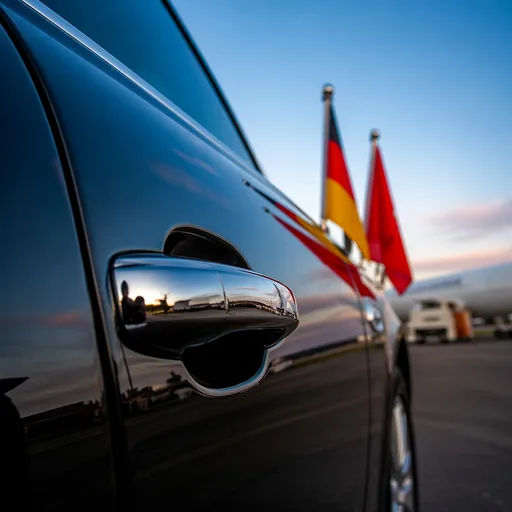
贸易失衡下的握手:默茨访华与德国工业的焦虑
German Chancellor Merz Visits Beijing
About this story
Chancellor Friedrich Merz's first Beijing trip — Great Hall handshakes, trade imbalance fears, German industry anxiety. HSK 5-6 Chinese listening practice.
This is an HSK 5-6 Chinese listening episode that runs about 7 minutes. The full Mandarin script is shown with tap-for-pinyin and a line-by-line English translation, so you can listen and read at once — comprehensible input in the sense of Stephen Krashen's i+1 theory. It teaches 17 key vocabulary words such as 降落、握手、危机 and walks through 5 grammar patterns, each explained in English with examples. The same news story is retold at 4 difficulty levels — use the level selector above to find the version that is challenging but still understandable for you.
Read at your level
原文Read the complete story in Chinese. Reveal pinyin and English only when you need them.
English transcript reference
When Friedrich Merz's plane pierced through the clouds and slowly descended at Beijing Capital International Airport, this new German Chancellor was perhaps facing the most delicate and thorny moment in decades of Sino-German relations.
That handshake inside the Great Hall of the People, amid the flash of cameras, seemed especially laden with meaning, because behind this diplomatic courtesy lay a trade chasm that has been keeping Berlin awake at night.
On the eve of Merz's departure, the alarm bells from the German business community were already deafening — one might even call them ear-splitting.
The latest data published by the Federal Statistical Office landed like a bucket of cold water on the German economic community: last year, Germany's imports from China were nearly double its exports to China.
This alarming trade deficit is no longer merely a numbers game in statistics — it is now seen as the structural agony being endured by Germany, Europe's largest economy.
Let's turn our attention to the specific figures: in 2025, goods worth 170.6 billion euros flooded into the German market like a tide, with a year-on-year growth rate of 8.8%, and at the same time,
German exports to China shrank by nearly 10%, falling to 81.3 billion euros.
The widening of this scissors gap is triggering an existential crisis about the future of German industry.
Jürgen Matthes, an expert at the German Economic Institute, issued a stern warning, arguing that this trend is 'eroding the core of German industry,'
especially in those pillar industries that once made Germans beam with pride — automotive, mechanical engineering, and the chemical sector.
Matthes bluntly stated that this market distortion is mainly attributable to China's 'massive' subsidy policies and currency valuation issues.
In his view, the price advantage exhibited by Chinese companies cannot possibly stem solely from innovation and efficiency improvements — there are more complex non-market factors at play.
However, Beijing's response to these accusations has been consistent and firm: its subsidy policies are transparent, fully comply with international trade rules, and the RMB exchange rate is a floating mechanism based on market supply and demand.
This situation of each side sticking to its own story precisely reflects the deep-seated divergence in economic models between the world's two major trading powers.
Bruegel, the Brussels-based economic think tank, offered an interpretation from another perspective, arguing that this phenomenon — dubbed the 'new China shock' — is partly due to soaring production costs within Europe itself.
The lingering aftermath of the pandemic hadn't subsided before the energy crisis triggered by the Russia-Ukraine war followed in its wake, keeping European manufacturing costs stubbornly high.
Meanwhile, China is in a prolonged deflationary phase, where overinvestment in manufacturing has created enormous excess capacity, and these goods desperately seeking an outlet have naturally flowed toward the open European market.
For Merz, this is not merely an economic arithmetic problem, but a complex game of geopolitics.
At this moment, Europe finds itself in an unprecedented strategic squeeze: across the Atlantic, the shadow of former U.S. President Trump's tariff policies looms large; while in the East, China's powerful manufacturing capacity is reshaping global supply chains.
As Noah Barkin of the German Marshall Fund put it, "No European wants to deal with two trade wars simultaneously — one from the world's top superpower, the United States, and another from the second-largest economy, China."
This is the awkward predicament Merz faces on this visit: as a traditional free-trade supporter and staunch transatlanticist, his political instincts are colliding violently with the cruel realities of the global landscape.
The Federation of German Industries is pressuring him to send a clear signal on this first visit to China since taking office as Chancellor, addressing a series of thorny issues including competition distortions and rare earth export controls.
The German auto industry in particular — this once-glorious sector — is now stumbling on the road to electrification, forced to resort to layoffs to weather the winter, while China has already established a formidable dominant position in this field.
This anxiety reflects Germany's deep soul-searching about the diplomatic philosophy of 'change through trade' pursued over the past several decades.
The creed once held sacred during the Merkel era — that deepening economic ties would drive political and social change — now seems to have reached a dead end.
Merkel was controversial for allegedly shelving human rights concerns for economic interests, but it is undeniable that deep economic dependence had already taken shape, like deeply entangled old tree roots — trying to sever them would be not only painful
but potentially fatal.
Therefore, when we discuss the anti-dumping investigations launched by the EU or Brussels's attempts to protect domestic industries through tariff barriers, we must recognize that Europe's toolbox is actually quite limited.
Unlike the United States, which can wield the tariff stick flexibly and aggressively, attitudes toward trade protectionism within the EU remain deeply divided — France leans toward a protectionist agenda, while Germany, due to its enormous commercial interests in China, remains far more cautious.
Barkin hit the nail on the head: China needs markets to absorb its excess capacity, which theoretically gives Europe negotiating leverage — but how to use that leverage tests the wisdom of politicians.
In his final remarks before boarding the plane, Merz's statement was thought-provoking: he reaffirmed that Germany would continue its 'de-risking' policy, but also clearly emphasized that 'seeking to decouple from China would be a mistake.'
This statement is perhaps the truest reflection of Germany's current mindset: fearful of dependence, yet unable to bear the cost of separation.
In this game of balance, reliability, and fairness, Merz must not only face the Chinese leader across the negotiation table, but also respond to the mounting anxiety at home,
as well as the geopolitical appeal of urging China to use its influence over Moscow to end the war in Ukraine.
The enormous trade deficit hangs over his head like the Sword of Damocles, constantly reminding this new Chancellor: the old era has ended, but a new equilibrium has yet to be established.
This is not merely about the buying and selling of cars or chemicals — this is about how a veteran industrial power redefines its position amid the violent tremors of the restructuring global economic map.
When the red carpet is rolled out in Beijing and both sides take their seats, the real contest has only just begun — and the outcome of all this will profoundly shape the Eurasian economic landscape for the next decade and beyond.
Listen again
Try it without the transcript and notice what sounds clearer.
What vocabulary does this episode teach?
词汇Common verb used for planes landing.
Standard gesture of greeting or agreement.
A crucial or unstable state of affairs.
Opposite of 出口 (export).
The ratio of useful work to resources expended.
To keep safe from harm or injury.
To be dependent on someone or something.
Discussion aimed at reaching an agreement.
HSK 1-4. society.
Figuratively used to describe a major difference or divide.
Economic term where imports exceed exports.
Idiom meaning 'shocking to the eye and astonishing to the heart'.
Economic term referring to the widening gap between two related indicators.
Formal phrase used to assign fault or cause.
Economic situation where industries produce more than the market demands.
Often used in 'game theory' or political maneuvering.
Idiom meaning to hold something as an absolute standard or model.
* beyond level超纲词
What grammar patterns appear in this episode?
语法A formal way to make a simile, meaning 'like' or 'as if'.
联邦统计局最新公布的数据,如同一盆冷水浇在了德国经济界的心头
巨大的贸易逆差如同悬在头顶的达摩克利斯之剑
A structure indicating a shift in understanding: 'No longer just [A], but rather [B]'.
这一触目惊心的贸易逆差,不再仅仅是统计学上的数字游戏,而是被视为德国这一欧洲最大经济体正在承受的结构性痛楚
A formal verb structure meaning 'to attribute blame to' or 'to ascribe to (a negative cause)'.
马特斯直言不讳地指出,这种市场扭曲主要归咎于中国“大规模”的补贴政策以及货币估值问题
Expresses two simultaneous qualities or states: 'Both... and...' or 'At once... and...'.
这句话,或许正是德国当前心态的最真实写照:既恐惧于依赖,又无法承受分离
Proper nouns
专有名词Sources
来源Free account
Keep learning from this story
Create a free account to keep saved words and your preferred level together.
- Keep words with their story context
- Remember your preferred level
- Build your vocabulary over time