
A Chinese podcast · Same story, 4 levels
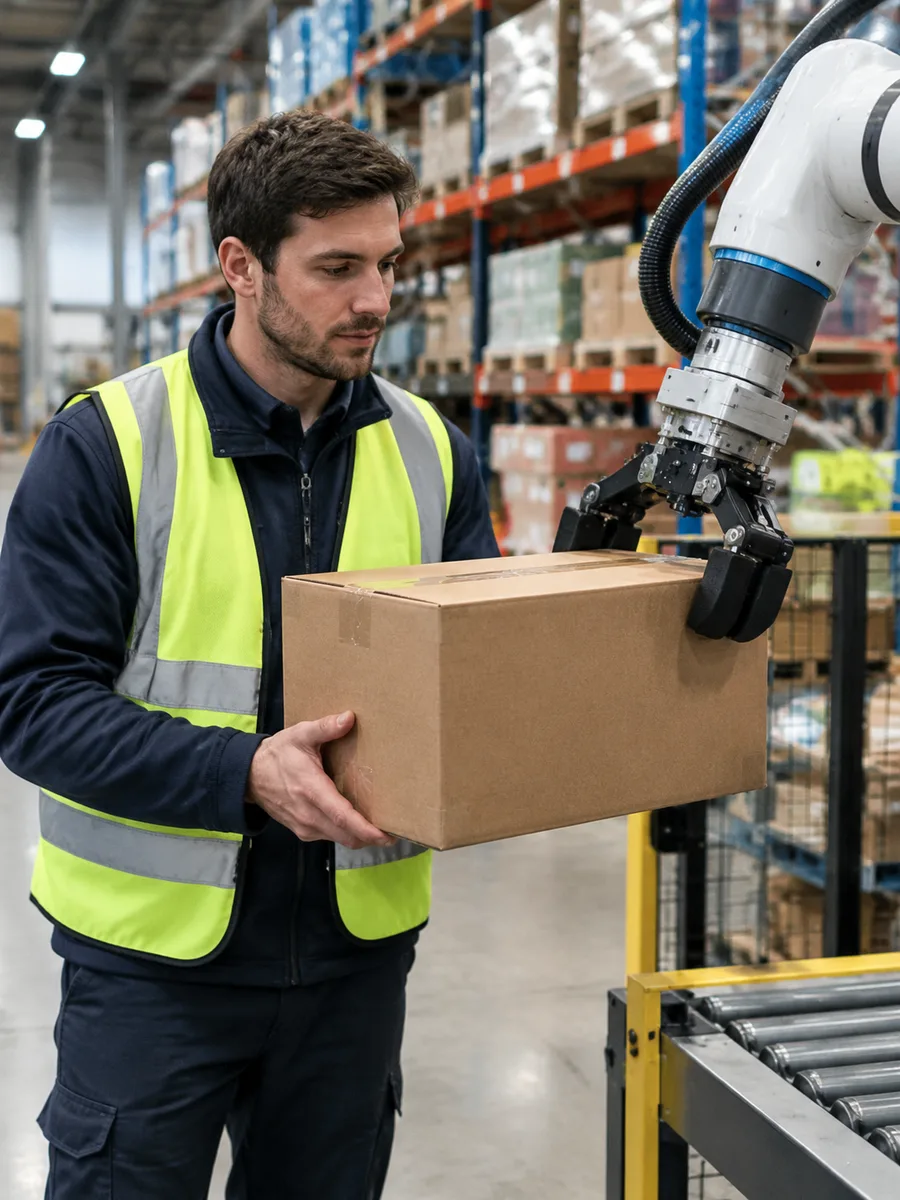
沃尔玛的机器人,为什么搬不好箱子?
Walmart Robots Struggle With Everyday Goods
About this story
HSK 1-2 Chinese listening. Walmart warehouse robots meet problems with boxes and frozen goods, while workers adapt packaging and keep goods moving.
This is an HSK 2 Chinese listening episode that runs about 3 minutes. The full Mandarin script is shown with tap-for-pinyin and a line-by-line English translation, so you can listen and read at once — comprehensible input in the sense of Stephen Krashen's i+1 theory. It teaches 12 key vocabulary words such as 东西、可以、但是 and walks through 4 grammar patterns, each explained in English with examples. The same news story is retold at 4 difficulty levels — use the level selector above to find the version that is challenging but still understandable for you.
Read at your level
原文Read the complete story in Chinese. Reveal pinyin and English only when you need them.
English transcript reference
Walmart is a very big store in the United States, selling many, many things.
These things first have to be put in very big warehouses.
There are many, many boxes in the warehouse; in the past, people always moved them.
People are very good at moving boxes, but people get very tired.
One person might walk twenty thousand steps in a day.
So Walmart thought: Let robots move the boxes, okay?
A robot is a machine that can work; it does not get tired moving things.
Walmart spent a lot of money and bought many robots.
But the robots did not do a good job.
Why?
Because the boxes are not the same; some boxes are big, and some boxes are small.
Some things are very heavy, for example a big bag of dog food; the robot cannot move it.
There are also turkeys; turkey is a kind of big bird that Americans eat on holidays.
Turkeys are very big and very heavy; when put in the refrigerator, they are cold.
When the robot picks up boxes of frozen turkey, it does not do a good job.
The turkey boxes are not good, and the robot cannot hold them.
Walmart asked the company that makes turkey boxes to make the boxes a little better.
Robots also break down; when they break, people have to come look at them and repair them.
Repairing robots costs a lot of money.
Also, electricity is very expensive.
The warehouse has to run air conditioning, and the electricity bill is a lot of money every month.
So Walmart now knows: robots can do some things, but they cannot do everything.
In some warehouses, many things can already be moved by robots.
People still have to do many things.
People move boxes, people repair robots, people drive forklifts.
Walmart says it will still need people in the future.
Walmart says that in the future there will be more shoppers, and possibly many more people will need to work together.
Walmart's robotics company is called Symbotic, in Massachusetts.
Symbotic's robots sometimes break down, and when they break, they have to be repaired.
Last year, fewer than ten percent of the robots needed repairs.
Now, about five percent of the robots need repairs.
Walmart also has another big warehouse, in Brooksville, in Florida.
This warehouse is very big; eighty percent of the things inside can be moved by robots.
There is also twenty percent of the things that robots cannot move.
For example, very big televisions, and also very big bags of dog food.
These things still have to be moved by people.
Walmart says that when robots move things, they use a lot of electricity.
In some warehouses, the monthly electricity bill is eight hundred thousand US dollars.
In the past, when people moved things, the electricity bill was only two hundred fifty thousand US dollars.
Electricity is very expensive, and repairing robots is also very expensive.
But Walmart still wants to use robots.
Because Walmart wants to be faster and wants to spend a little less money.
Walmart says that in the future there will be more shoppers, and possibly many more people will need to work together.
Think about it: if you had a robot, what would you want it to help you do?
Listen again
Try it without the transcript and notice what sounds clearer.
What vocabulary does this episode teach?
词汇HSK 2. A very common noun for physical things or stuff. In this script: 卖很多很多东西, 搬东西.
HSK 2. Used before a verb to say something is possible or allowed. In this script: 机器人是可以工作的机器, 机器人可以做一些事.
HSK 2. A common contrast conjunction. In this script: 但是人很累, 但是机器人做不好.
HSK 2. Here it means 'still' before a verb. In this script: 人还是要做很多事, 沃尔玛还是要用机器人.
HSK 2. Introduces a reason, often with 所以 in the other clause. In this script: 因为箱子不一样, 因为沃尔玛想快一点.
HSK 2. Introduces a result. In this script: 所以,沃尔玛想, 所以,沃尔玛现在知道了.
Beyond HSK 2. A place for storing goods. In this script: 很大的仓库, 仓库里有很多很多箱子.
Beyond HSK 2. 机器 means machine; 机器人 is a machine that can work. In this script: 让机器人来搬箱子, 机器人搬不动.
Beyond HSK 2. To move a heavy object by hand. In this script: 人来搬, 搬东西不累.
Beyond HSK 2. A large bird eaten by Americans on holidays. In this script: 还有火鸡, 冷冻火鸡的箱子.
Beyond HSK 2. 电 means electricity; 费 means fee. In this script: 电费一个月要很多很多钱, 电费很贵.
Beyond HSK 2. To fix something broken. In this script: 人来修, 修机器人要花很多钱.
* beyond level超纲词
What grammar patterns appear in this episode?
语法让 + Person/Thing + Verb Phrase
The causative 让 means 'let' or 'make' someone/something do something. It is followed by a person or thing and then a verb phrase.
所以,沃尔玛想:让机器人来搬箱子,好不好?
有的仓库,很多东西已经可以让机器人来搬。
有的……有的……
This pattern means 'some... and some...' and is used to talk about different members of a group.
因为箱子不一样,有的箱子大,有的箱子小。
有的仓库,很多东西已经可以让机器人来搬。
要 + Verb Phrase
要 before a verb can mean 'need to' or 'have to' do something. It often expresses necessity.
这些东西先要放在很大的仓库里。
机器人拿冷冻火鸡的箱子,做不好。
还是 + Verb Phrase
还是 before a verb means 'still' or 'nevertheless' — the situation continues despite what was said before.
人还是要做很多事。
但是,沃尔玛还是要用机器人。
Proper nouns
专有名词Sources
来源Free account
Keep learning from this story
Create a free account to keep saved words and your preferred level together.
- Keep words with their story context
- Remember your preferred level
- Build your vocabulary over time