
A Chinese podcast · Same story, 4 levels
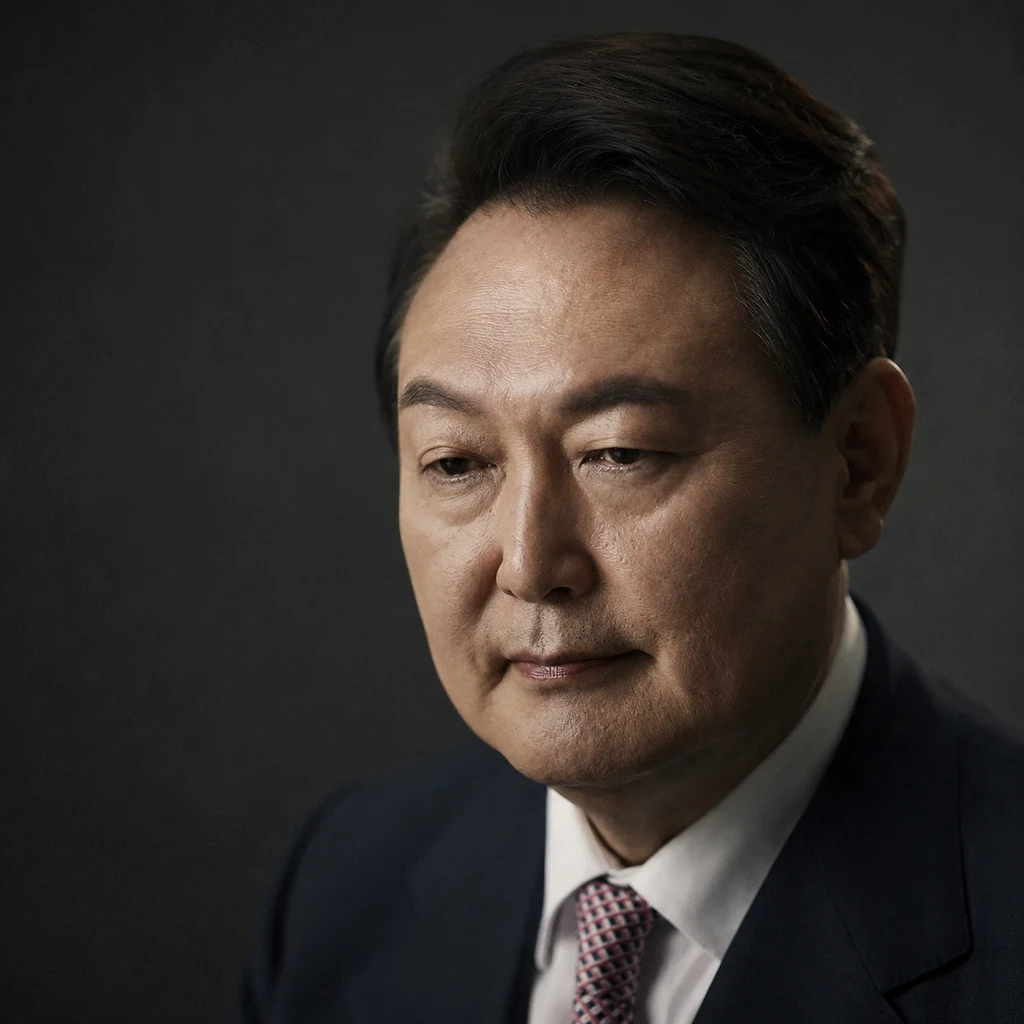
韩国前总统尹锡悦因内乱罪被判无期徒刑
Yoon Suk-yeol Sentenced to Life for Insurrection
About this story
A Seoul court hands South Korea's ex-president Yoon Suk-yeol life in prison for leading insurrection. HSK 3 Chinese listening practice.
This is an HSK 3-4 Chinese listening episode that runs about 8 minutes. The full Mandarin script is shown with tap-for-pinyin and a line-by-line English translation, so you can listen and read at once — comprehensible input in the sense of Stephen Krashen's i+1 theory. It teaches 14 key vocabulary words such as 法律、经济、严重 and walks through 6 grammar patterns, each explained in English with examples. The same news story is retold at 4 difficulty levels — use the level selector above to find the version that is challenging but still understandable for you.
Read at your level
原文Read the complete story in Chinese. Reveal pinyin and English only when you need them.
English transcript reference
Recently, a major event that shocked the world occurred in South Korea; former President Yoon Suk-yeol was sentenced to life imprisonment by the court.
This is not just news for South Korea, but also news that the whole world is paying attention to.
The reason given by the court was very clear: he committed the serious crime of "insurrection."
We need to discuss this matter carefully to see how it happened and what it means.
First, we have to go back to that night that changed everything.
It was a day a few months ago when everyone was resting at home.
Suddenly, President Yoon Suk-yeol's face appeared on TV.
His expression was very serious as he announced that the country was entering a state of "emergency martial law."
This news gave everyone a shock.
What is martial law?
Simply put, it is when the military takes over the country.
During martial law, ordinary laws no longer function.
People cannot go out freely, nor can they speak freely.
News media are controlled and cannot report news opposing the government.
Yoon Suk-yeol said at the time that doing this was to protect the country.
He said there were some people causing destruction, so the military had to be used to solve the problem.
However, most South Koreans did not believe his words.
Everyone felt that the country was not facing such great danger.
What was truly dangerous was actually the President's own way of thinking.
That night, many terrible things happened.
Many soldiers carrying guns flew to Seoul in helicopters.
They surrounded the National Assembly building, wanting to control the lawmakers there.
Helicopters even landed directly at the entrance of the building.
Soldiers broke the windows and jumped inside the building.
This was a very violent scene that made many people feel afraid.
However, the members of the National Assembly behaved very bravely.
Although there was an army outside, they did not run away.
They tried every method, climbing over walls to enter the main assembly hall of the National Assembly.
They knew they had to vote immediately to cancel this terrible order.
In the end, this became a very important moment in South Korean history.
The lawmakers passed a unanimous vote demanding the President lift martial law immediately.
According to South Korean law, if the National Assembly does not agree, the President must obey.
Although Yoon Suk-yeol did not want to give up at first, facing pressure from people across the country, he could only agree.
Although that night was short, only a few hours, its impact was very profound.
After this event, Yoon Suk-yeol was immediately suspended from his presidential duties.
Then, the police and courts began a long investigation.
After a detailed investigation, the court finally made a decision.
The judge believed that Yoon Suk-yeol's actions were not for the country, but for himself.
He wanted to use the military to get rid of those who opposed him.
Such behavior seriously damaged the country's legal system.
In legal terms, this is called "insurrection."
This is a very serious crime, much more serious than corruption or stealing.
Because he attempted to overthrow the country's democratic system.
Therefore, the court decided to sentence him to life imprisonment.
Life imprisonment means he has to stay in prison for his whole life.
Unless there are special circumstances, he can never come out.
For a former President, this is the most shameful ending.
In prison, he will lose all freedom.
He can no longer see his family, nor can he enjoy his previous life.
This is also the first time in South Korean history that a President has been given such a heavy sentence for the crime of "insurrection."
Let's look again at what impact this event has on South Korean society.
First, the mood of the South Korean common people is very complex.
On one hand, everyone feels that justice has been served.
People who did wrong, no matter how high their status, received punishment.
This proves that everyone is equal before the law.
But on the other hand, everyone also feels very sad.
Because this shows that the country's politics have a big problem.
People will ask, why did we elect such a president?
This will make everyone lose trust in the government.
Secondly, this event was a big blow to South Korea's economy.
On that chaotic night, the South Korean stock market almost collapsed.
Many foreign companies, seeing South Korea in such chaos, are afraid to come and invest.
Money is very smart; it only flows to safe places.
If a country's army goes out on the streets at will, who would dare to do business there?
So, recently the exchange rate of the Korean Won has fallen a lot.
This has a very direct impact on the lives of ordinary people.
When people go to the supermarket to buy things, they find that imported goods have become more expensive.
The price of gasoline has also gone up.
The employment pressure on young people has become greater.
Many companies have stopped their hiring plans because they are worried about the future.
These are all bad results brought about by that political storm.
Additionally, we have to mention a strange phenomenon in South Korea.
Many people joke that being the President of South Korea is a "high-risk profession."
If you look at history, you will discover that almost every former president did not have a good ending.
Some were arrested for corruption, such as Lee Myung-bak and Park Geun-hye.
Some committed suicide because they couldn't stand the pressure.
Now, Yoon Suk-yeol has broken the record again, being sentenced to life imprisonment.
This makes many people start to think, is there a problem with South Korea's system?
Why is the President's power so great, but in the end, they always commit crimes?
This is a question worth thinking deeply about.
Perhaps South Korea needs to change some laws to limit the President's power.
One person cannot have the final say; there must be more people to supervise him.
Now, Yoon Suk-yeol has already been sent to prison.
However, South Korea's story is not over yet.
The country now needs a new leader.
The election is about to start soon.
Various political parties are busy selecting their own candidates.
This time, voters will become more careful.
Everyone will check the background of every candidate more seriously.
People do not hope to elect another president who will misuse the military.
After the new president takes office, the tasks faced will be very heavy.
The first thing he must do is restore social stability.
He needs to tell the whole world that South Korea is safe and everyone can invest with peace of mind.
He also needs to repair the society that was divided because of this event.
People who support Yoon Suk-yeol and those who oppose him are arguing fiercely now.
The new president needs to unite everyone again.
This requires high wisdom and also great patience.
At the same time, the international community is also paying attention to changes in South Korea.
As South Korea's ally, the United States very much hopes South Korea can get better quickly.
If South Korea is in chaos, it is bad for the security of all of Asia.
As neighbors, China and Japan also hope South Korea can maintain stability.
After all, everyone has a lot of economic cooperation.
If a neighbor's house catches fire, one's own house will also be affected.
In summary, Yoon Suk-yeol being sentenced to life imprisonment is the end of an era.
It tells all politicians that power is not infinite.
If you betray the people, the law will definitely punish you.
This is a very profound lesson.
Although the current process is painful, in the long run, this might be a good thing for South Korea.
Because it let everyone see the power of the law.
It also makes everyone cherish the hard-won democracy even more.
Only by experiencing darkness can one know the preciousness of light.
We hope South Korea can walk out of this shadow as soon as possible.
We hope that the next time we talk about South Korea, we can hear some good news.
For example, the economy has improved, or life is happier.
Regarding this topic, we will stop here for today, hoping it brings you some food for thought.
Listen again
Try it without the transcript and notice what sounds clearer.
What vocabulary does this episode teach?
词汇A system of rules created and enforced through social or governmental institutions.
Refers to the state of a country or region in terms of the production and consumption of goods and services.
Used to describe a situation, problem, or illness that is critical or severe.
Can refer to physical pressure or psychological stress/burden.
To keep safe from harm or injury.
To accept something as true or to have confidence in someone.
The possibility of suffering harm or injury.
Literally 'internal chaos'; a legal term often used for treason or rebellion against the state.
The imposition of direct military control of normal civil functions or suspension of civil law.
A criminal sentence where the convicted person remains in prison for the rest of their life.
A member of a legislative body like the National Assembly.
The value of one currency for the purpose of conversion to another.
A person who applies for a job or is nominated for election.
A state formally cooperating with another for a military or other purpose.
* beyond level超纲词
What grammar patterns appear in this episode?
语法被 (bèi)
Used to form the passive voice, indicating that the subject is the receiver of the action.
前总统尹锡悦被法院判了无期徒刑。
尹锡悦马上就被停止了总统的工作。
把 (bǎ)
The 'disposal' construction, used to emphasize the result or effect of an action on a specific object.
这个消息把所有人都吓了一跳。
不仅仅... 也是... (bùjǐnjǐn... yěshì...)
A pattern meaning 'not only... but also...', used to connect two clauses where the second adds to the first.
这不仅仅是韩国的新闻,也是全世界都在关注的消息。
虽然... 但是... (suīrán... dànshì...)
A conjunction pair meaning 'Although... (but)...', used to express contrast.
虽然外面有军队,但是他们没有逃跑。
那个晚上虽然很短,只有几个小时,但是它的影响非常深远。
是为了 (shì wèile)
Indicates purpose, meaning 'is for the purpose of' or 'is in order to'.
尹锡悦当时说,这样做是为了保护国家。
尹锡悦的行为不是为了国家,而是为了他自己。
只有... 才... (zhǐyǒu... cái...)
A conditional pattern meaning 'Only if... then...'. It introduces the only condition under which a result can occur.
他们知道,必须马上投票,才能取消这个可怕的命令。
只有经历过黑暗,才知道光明的珍贵。
Proper nouns
专有名词Free account
Keep learning from this story
Create a free account to keep saved words and your preferred level together.
- Keep words with their story context
- Remember your preferred level
- Build your vocabulary over time