
A Chinese podcast · Same story, 4 levels
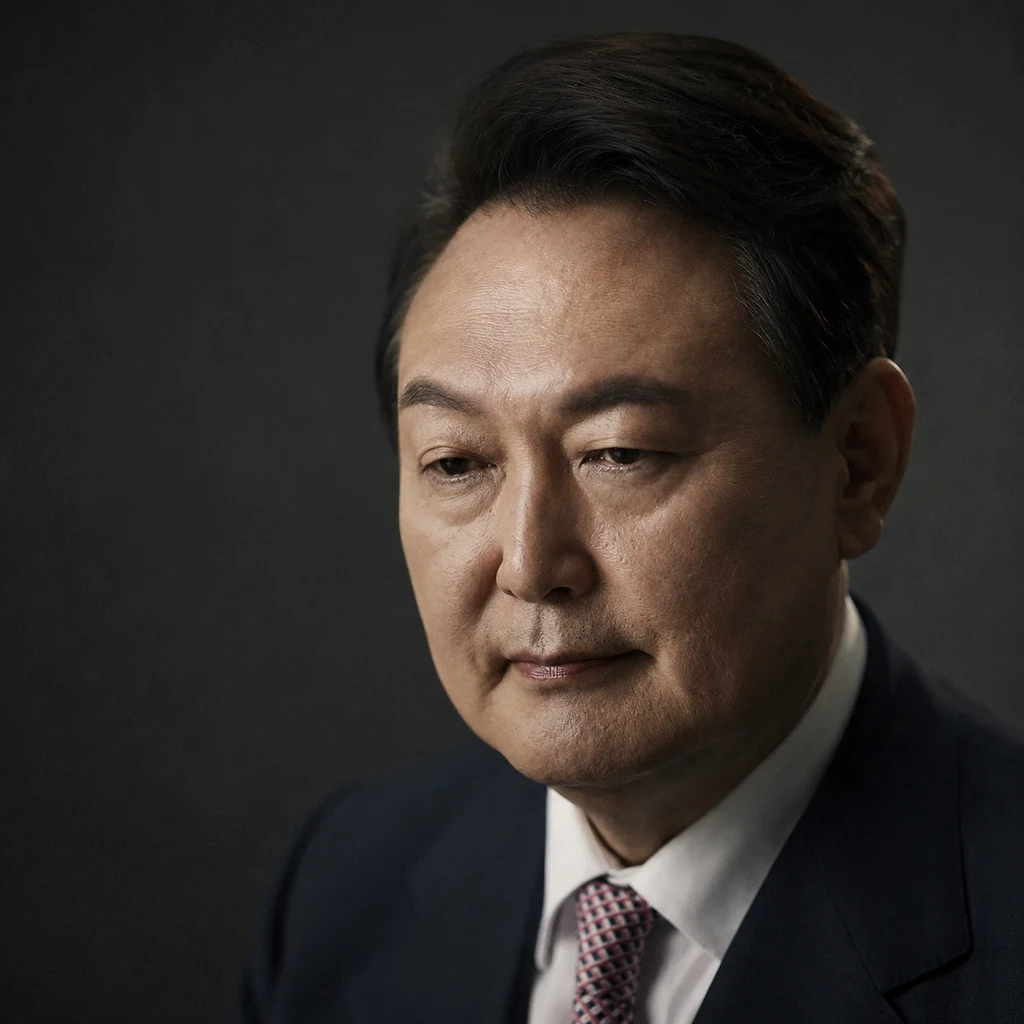
青瓦台魔咒的终极回响:尹锡悦因内乱罪获刑无期
Yoon Suk-yeol Sentenced to Life for Insurrection
About this story
South Korea's ex-president Yoon Suk-yeol gets a life sentence for insurrection, echoing Chun Doo-hwan and Roh Tae-woo. HSK 5-6 Chinese listening practice.
This is an HSK 5-6 Chinese listening episode that runs about 12 minutes. The full Mandarin script is shown with tap-for-pinyin and a line-by-line English translation, so you can listen and read at once — comprehensible input in the sense of Stephen Krashen's i+1 theory. It teaches 13 key vocabulary words such as 宪政、判决、制裁 and walks through 5 grammar patterns, each explained in English with examples. The same news story is retold at 4 difficulty levels — use the level selector above to find the version that is challenging but still understandable for you.
Read at your level
原文Read the complete story in Chinese. Reveal pinyin and English only when you need them.
English transcript reference
The news that former South Korean President Yoon Suk-yeol has been sentenced to life imprisonment for being the "ringleader of an insurrection" has once again pushed the political haze that has long hovered over the Blue House into the global spotlight.
This verdict not only marks the end of the most thrilling chapter in South Korea's constitutional history, but also allows the so-called "Blue House Curse" to continue in the most intense, and arguably tragic, manner.
At the moment the gavel fell, it was not merely a pronouncement on the personal fate of a former head of state, but an extreme stress test for South Korea's fragile yet resilient democratic system.
Let us first look back at that night that shocked the world, when the emergency martial law order spread to every corner via live television, and the air on the streets of Seoul seemed to freeze instantly.
The vibration of tank tracks rolling over the road in the dead of night awakened a collective trauma buried deep in the marrow of many South Koreans who had experienced the turbulent years of the 1980s.
This gamble launched by Yoon Suk-yeol on the grounds of eradicating "anti-state forces" was ultimately characterized by the judiciary as "an act of insurrection destroying the constitutional order," a charge whose weight,
far exceeded the corruption or abuse of power involved with several previous former presidents.
In the context of South Korean law, the "crime of insurrection" implies the subversion of the fundamental system of the state and is the most serious betrayal of the democratic contract by public power.
The term "ringleader of insurrection" mentioned in the verdict places him directly at the core as the planner and commander; in South Korean history, only Chun Doo-hwan and Roh Tae-woo have faced similar accusations.
However, unlike those two dictators of military origin, Yoon Suk-yeol started as a prosecutor and was a civilian president elected legally under a democratic system, which makes his "self-coup" appear particularly absurd and ironic.
An "iron-faced prosecutor" who advertised "rule of law" and "justice" all his life and personally sent two former presidents to prison, ultimately became a prisoner himself for trying to place himself above the law,
such a dramatic reversal is something perhaps even the most imaginative screenwriter would not dare to pen easily.
This forces us to think deeply about a question: Why do South Korean presidents always have such difficult endings?
Is this ultimately a tragedy of personal character, or an inevitability of institutional design?
The so-called "imperial presidency" grants the South Korean president nearly unlimited executive power during a five-year term but lacks corresponding checks and balances; this "winner-takes-all" political ecology often gives those in power an illusion of omnipotence.
Yoon Suk-yeol's tragedy, to some extent, is the result of a violent chemical reaction between this institutional defect and his personal "prosecutor mindset."
His long experience working in the prosecutorial system accustomed him to a black-and-white binary worldview and to using coercive means to solve problems, rather than seeking consensus through political compromise and dialogue.
When faced with a parliamentary deadlock where the opposition was strong and the ruling party weak, and a governance dilemma of low approval ratings, he did not choose political means to resolve it, but instinctively picked up his most familiar weapon—coercive force,
attempting to solve complex political disputes once and for all through the extreme measure of martial law.
This governing logic of viewing political opponents as criminals and dissenting opinions as rebellion ultimately led him to completely lose control at the red line of democratic society.
The court specifically pointed out during sentencing that Yoon Suk-yeol's actions not only seriously damaged the country's constitutional order but also caused irreparable trauma to the psychology of the nationals.
That night, when heavily armed soldiers tried to storm the National Assembly Hall, and images of ordinary citizens and politicians linking arms to block the army spread around the world, South Korean society seemed to return overnight to that authoritarian era filled with smoke and tears.
This fear of a "return to dictatorship" sparked unprecedented anger and a will to resist among the South Korean people, and also doomed Yoon Suk-yeol's political life.
The sentence of life imprisonment, in a sense, is a declaration of South Korean society's zero-tolerance attitude toward "democratic backsliding."
It sends a deafening warning to all politicians holding heavy power: no matter how prominent the power, no matter how high-sounding the reason, any attempt to subvert democratic procedures through force will face the severest legal sanctions.
However, with Yoon Suk-yeol's imprisonment, can South Korean society usher in true peace?
The answer is probably not optimistic.
This event has torn South Korean society apart completely, and the chasm between conservatives and progressives is deeper than ever before.
Yoon Suk-yeol's supporters believe this is political retaliation and a purge by leftist forces, while opponents believe this is justice long overdue and a victory for democracy.
This extreme confrontational emotion will dominate South Korea's political agenda for a long time to come and may even trigger a new round of social unrest.
In addition, this verdict has also caused an inestimable impact on South Korea's international image and diplomatic strategy.
As the world's tenth-largest economy and an important democratic country in Asia, having the incumbent president arrested for insurrection and given a heavy sentence undoubtedly casts a thick shadow over South Korea's national credibility.
Allies are beginning to question the stability of South Korean politics, foreign investors are re-evaluating geopolitical risks, and the northern neighbor may use this chaotic situation to conduct a new round of strategic probing.
At this moment full of uncertainty, what South Korea's political elites urgently need to reflect on is not just how to handle a former president, but how to repair this riddled political system.
If the power structure of the "imperial presidency" cannot be reformed fundamentally, and if this "life-or-death" extreme political culture cannot be changed, then Yoon Suk-yeol might not be the last president to walk into prison.
History is always strikingly similar, but history should not be a simple repetition.
From Chun Doo-hwan to Park Geun-hye, and now to Yoon Suk-yeol, the masters of the Blue House have changed crop after crop, but that road leading to prison seems always particularly crowded.
While there is personal greed and the corrosion of power involved, it is more of a structural dilemma.
The "single five-year term" system stipulated by the South Korean Constitution was originally intended to prevent a recurrence of dictatorship, but in practice, it often leads presidents to face a "lame duck" predicament at the end of their terms; to avoid post-retirement reckoning,
they often choose to take risks or use the prosecutorial organs to strike at dissidents,
thereby falling into a vicious cycle.
The reason Yoon Suk-yeol's case is special lies in the fact that he skipped the traditional path of "corruption" and directly touched the high-voltage line of "insurrection."
His defense in court—claiming it was to save the country from anti-state forces—sounded so pale and powerless, even carrying a Quixotic sense of absurdity.
This self-aggrandizing political narrative appears out of place in front of a mature modern democratic system.
In fact, the moment the army was mobilized, he was already standing on the opposite side of the people.
One of the cornerstones of modern political civilization is the nationalization and neutrality of the army; any attempt to use the army as a private armed force to resolve political disputes is a trampling on the bottom line of civilization.
The maturity and bravery demonstrated by the South Korean people in this crisis were impressive.
Facing soldiers with live ammunition, members of the National Assembly climbed walls to enter the hall to vote down the martial law order, and citizens spontaneously gathered on the streets to protest; this bottom-up power is the fundamental reason why South Korean democracy still stands tall despite the storms.
It can be said that it was the South Korean people who personally sent the president who tried to reverse the wheels of history to prison, rather than the conspiracy of any political faction.
This verdict also triggered a heated discussion in the legal community regarding the boundaries between "command authority" and "constitutional responsibility."
Does the President, as the Commander-in-Chief, have the right to use the military when he judges that the country has entered a state of emergency?
Where is the boundary of this judgment?
Who supervises this judgment?
The Yoon Suk-yeol case provided a bloody footnote to these abstract constitutional questions.
The court's verdict clearly drew a red line: the President's emergency powers cannot override the Constitution, nor can they be used to paralyze the legislative body.
This precedent will become a classic case in the constitutional history of South Korea and even the world, to be studied repeatedly by future generations.
Of course, we cannot ignore the profound socio-economic background behind this event.
In recent years, South Korea's economic growth has slowed, social stratification has solidified, youth unemployment remains high, and gender conflict is becoming increasingly serious; these deep-seated social contradictions provided soil for extreme political behavior.
Yoon Suk-yeol's rise to power was itself a product of this social dissatisfaction, and his downfall also reflects the people's despair and anger at the inability to change the status quo.
When politicians cannot respond to the people's expectations through policy, they often resort to radical means to divert contradictions; Yoon Suk-yeol's "martial law gamble" was essentially an act of escape in the face of a governance crisis.
Now, as he languishes in prison, the South Korean political scene is bound to usher in a violent reshuffle.
The ruling party faces a crisis of disintegration, and the opposition party is sharpening its knives to take over power, but no matter who comes to power, if the deep-seated socio-economic problems are not solved and the power structure is not reformed, similar crises will likely be staged again in different forms.
Watching the old man in the news footage, who was once high-spirited but is now white-haired and looks desolate, we cannot help but lament the impermanence of power and the cruelty of history.
He was once the Prosecutor General who vowed to restore the rule of law and justice, a political novice who shouted with raised arms at campaign rallies, but now he has become synonymous with "constitutional destroyer."
This huge gap in life's fortune is enough to make any observer feel a sense of sighing regret.
But beyond the sighs, we should see that the law has shown its due dignity at this moment.
In the contest between power and law, the law ultimately won the victory; although the cost was heavy, this is the last line of defense for a society under the rule of law.
Yoon Suk-yeol's will spend the rest of his life behind bars; he will have a long time to reflect on that night that changed his fate, to reflect on the nature of power, and to reflect on his relationship with this country.
And for the country of South Korea, although this page is heavy, it has finally been turned over.
Life will continue, the water of the Han River in Seoul still flows endlessly, and the pigeons on Gwanghwamun Square are still dancing.
It is just that everyone who passes by the site of the Blue House may have an extra warning in their hearts: if the cage of power is not closed tightly, the beast released will not only devour the enemy but will ultimately devour oneself.
This may be the most precious legacy left to future generations by the Yoon Suk-yeol case—it reconfirms the simple yet great truth that "everyone is equal before the law" in an almost cruel way.
For the democratic process in East Asia and even the world, this is a moment full of warning significance; it tells us that the democratic system is not a safe that works once and for all, but needs every citizen and every politician to remain vigilant and protect it carefully.
Because once vigilance is relaxed, that specter of dictatorship lurking in the depths of human nature may stage a comeback at any time.
From this perspective, Yoon Suk-yeol's life sentence is both a reckoning of the past and an expectation for the future.
Listen again
Try it without the transcript and notice what sounds clearer.
What vocabulary does this episode teach?
词汇Refers to a political system based on a constitution. Often used in political contexts like 'constitutional crisis' or 'constitutional history'.
The formal decision made by a court of law. Can be used as a verb or noun.
To punish or apply sanctions, often in legal or international contexts.
To think back over something, usually to learn a lesson or evaluate oneself.
The cost paid for an action, often used metaphorically (e.g., 'paid a heavy price').
A method used to achieve a goal. Can imply trickery or shrewdness depending on context.
To be on guard against potential danger.
Specifically refers to civil strife or rebellion against the state authority. Legal term in this context.
The head or leader of a group, often used in a negative context (like a criminal gang or rebellion).
The imposition of direct military control of normal civil functions.
Political term referring to an official in the final period of office, after the election of a successor.
A formal or literary term for prison. Often used in the phrase '身陷囹圄' (to be thrown into prison).
Idiom meaning having cuts and bruises everywhere. Metaphorically means being severely criticized or damaged.
* beyond level超纲词
What grammar patterns appear in this episode?
语法Not only... but also (even more so). This structure emphasizes that the second clause is of greater significance or intensity than the first.
这一判决不仅标志着韩国宪政史上最为惊心动魄的一章画上了句号,更让所谓的“青瓦台魔咒”……得到了延续。
尹锡悦的行为不仅严重损害了国家的宪政秩序,更对国民的心理造成了不可弥补的创伤。
On the grounds of... / Using ... as an excuse. Indicates the reason or pretext given for an action.
尹锡悦以铲除“反国家势力”为由发动的这场豪赌……
Rather than saying A, it is better to say B. (Implied in the text via similar contrastive structures like '不是……而是……').
他没有选择政治手段去化解,而是本能地拿起了他最熟悉的武器……
No matter... [result remains the same]. Indicates that the condition does not affect the outcome.
无论权力多么显赫,无论理由多么冠冕堂皇,任何试图通过武力颠覆民主程序的行为,都将面临最严厉的法律制裁。
无论谁上台,如果不解决深层的社会经济问题……
The so-called... Used to introduce a term, sometimes implying skepticism or highlighting a specific common label.
更让所谓的“青瓦台魔咒”以一种最为激烈……的方式得到了延续。
所谓的“帝王式总统制”,赋予了韩国总统……
Proper nouns
专有名词Free account
Keep learning from this story
Create a free account to keep saved words and your preferred level together.
- Keep words with their story context
- Remember your preferred level
- Build your vocabulary over time