
A Chinese podcast · Same story, 4 levels
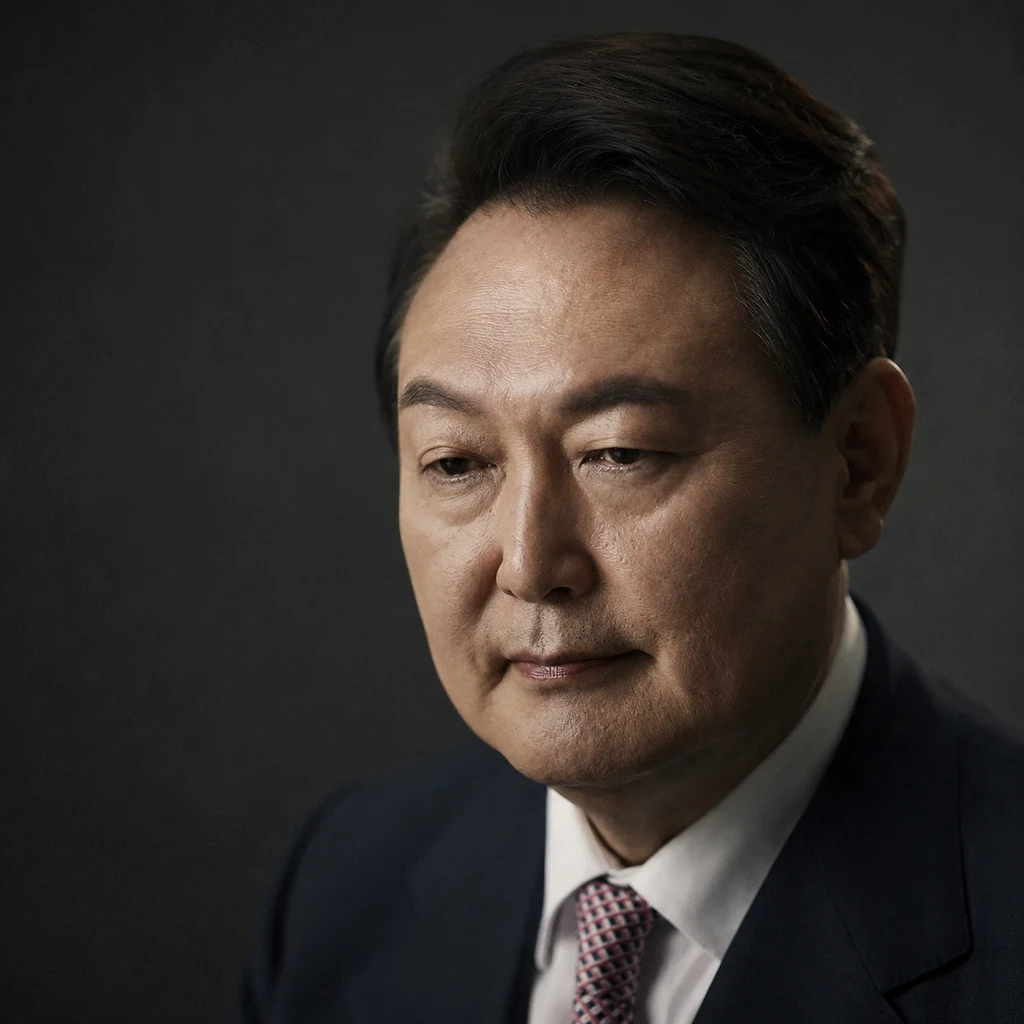
韩国前总统尹锡悦被判无期徒刑
Yoon Suk-yeol Sentenced to Life for Insurrection
About this story
A simple news story about South Korea's former leader Yoon Suk-yeol being sentenced to life in prison in Seoul. HSK 1 Chinese listening practice.
This is an HSK 1 Chinese listening episode that runs about 7 minutes. The full Mandarin script is shown with tap-for-pinyin and a line-by-line English translation, so you can listen and read at once — comprehensible input in the sense of Stephen Krashen's i+1 theory. It teaches 17 key vocabulary words such as 新闻、以前、决定 and walks through 6 grammar patterns, each explained in English with examples. The same news story is retold at 4 difficulty levels — use the level selector above to find the version that is challenging but still understandable for you.
Read at your level
原文Read the complete story in Chinese. Reveal pinyin and English only when you need them.
English transcript reference
Next, let's talk about some news from South Korea.
This news is about a person.
This person's name is Yoon Suk-yeol.
He is South Korean.
He is a man.
He is very old.
He used to have a good job.
What did he use to do?
He was the President of South Korea.
What is a President?
A President is a high-ranking official.
He is the highest-ranking official in the country.
He manages many things.
He manages many people.
He lived in a very big house.
That house was very beautiful.
That house was in Seoul, South Korea.
He worked there every day.
He had many subordinates.
Everyone listened to him.
Whatever he said, everyone did.
He had a lot of power.
He felt he was very impressive.
But, one day something happened.
That was a day a long time ago.
The weather was bad that day.
Yoon Suk-yeol was unhappy.
He felt someone was not obeying.
He felt someone was opposing him.
He was very angry.
He wanted to do something.
He wanted to make everyone obey.
So he made a decision.
This decision was very bad.
This was a wrong decision.
He called many soldiers.
The soldiers had guns in their hands.
He made the soldiers go onto the streets.
He made the soldiers go arrest people.
He said: "Close the doors."
He said: "No talking allowed."
He said: "No going out allowed."
He wanted to control everyone.
He wanted to control this country.
What is this called?
This is called "insurrection."
This is called "martial law."
This is a very big bad thing.
Because the country has laws.
The President also has to listen to the law.
The President cannot arrest people arbitrarily.
The President cannot close doors arbitrarily.
At that time, people were very scared.
Everyone was at home.
Everyone dared not come out.
Everyone was watching TV.
Everyone was making phone calls.
Everyone was asking: "What happened?"
Everyone was asking: "What should we do?"
Later, people got angry.
People were no longer afraid.
People walked out of their homes.
People walked onto the streets.
People spoke loudly.
People said: "You are wrong."
People said: "You are a bad person."
People said: "We want freedom."
Many people came.
Hundreds of people came.
Thousands of people came.
Tens of thousands of people came.
They were all shouting.
They were all opposing Yoon Suk-yeol.
Yoon Suk-yeol saw it.
He was very surprised.
He didn't expect it would be like this.
He thought everyone would fear him.
But everyone did not fear him.
Later, the police came.
Judges also came.
They caught Yoon Suk-yeol.
They said: "You broke the law."
They said: "You did a bad thing."
They said: "You must take responsibility."
Yoon Suk-yeol stopped talking.
He lowered his head.
He knew he was wrong.
Or maybe he didn't know.
But it doesn't matter.
Because the law said he was wrong.
Then, the trial began.
The judge asked many questions.
Yoon Suk-yeol answered.
But the judge was not satisfied.
Because the facts were very clear.
He indeed did a bad thing.
He indeed wanted to control the country.
This is a very big crime.
This is called "treason."
This is called the "crime of insurrection."
Finally, the judge spoke.
The judge had a result.
The judge said: "You must go to jail."
The judge said: "You must go to prison."
Go for how long?
One year?
No.
Ten years?
No.
Twenty years?
No.
It is "life imprisonment."
What is life imprisonment?
It is being in prison forever.
It is being in prison for a lifetime.
Until he dies.
He can never go home again.
He can never come out again.
Now, where is he?
He is in a prison.
That place is very small.
That place is not good.
There are no big houses there.
There are no big tables there.
There is only a bed there.
There is only a small window there.
He sits there every day.
He looks outside the window.
Outside there are birds flying.
Outside there are trees growing.
But he cannot go out.
He can only stay inside.
He wears prison clothes.
He eats prison food.
The food there is not tasty.
The water there does not taste good.
But he must eat.
But he must drink.
He has no friends.
He has no subordinates.
No one listens to him anymore.
No one fears him anymore.
He is just an old man.
He is a prisoner.
He thinks every day.
He thinks about past events.
He thinks about that day's events.
Does he regret it?
We do not know.
Maybe he regrets it.
Maybe he is very sad.
But time cannot go back.
If you do something wrong, you must be punished.
This is very fair.
This is his end.
This is his outcome.
His name is Yoon Suk-yeol.
He used to be the President.
Now he is a prisoner.
He will spend his whole life in prison.
This is the news from South Korea.
What does this news tell us?
It tells us to be good people.
It tells us to obey the law.
No matter who you are.
No matter how old you are.
No matter how rich you are.
If you do bad things.
If you harm the country.
You will be punished.
You will go to prison.
Just like Yoon Suk-yeol.
He lost his freedom.
He lost everything.
This is a big event.
This is the story about the former President of South Korea.
Listen again
Try it without the transcript and notice what sounds clearer.
What vocabulary does this episode teach?
词汇Information about current events.
Used to indicate past time or states.
Can be used as a noun or a verb.
A common feeling verb.
Lit. 'grow air/qi'. To get angry or take offense.
The system of rules in a country.
To be clear about something or something is distinct.
Indicates strong necessity.
HSK 1. to make a phone call.
Head of state in a republic.
The ability or right to control people or things.
Temporary military control of government.
Internal chaos or rebellion within a country.
The crime of betraying one's country.
The judicial process of examining a case.
A prison sentence lasting for the rest of the convict's life.
A facility where people are confined as punishment.
* beyond level超纲词
What grammar patterns appear in this episode?
语法Used to emphasize a detail (like time, place, or manner) of a past event. In this script, it emphasizes the nature of his past job.
他以前是做什么的?
A causative structure meaning 'to make' or 'to let' someone do something.
他想让大家都听话。
他让军人上街。
他让军人去抓人。
Indicates an action currently in progress (Present Continuous tense).
大家都在看电视。
大家都在打电话。
外面有鸟在飞。
Indicates that the result remains the same regardless of the condition ('No matter...'). Note: In this script, it is followed by a conditional 'if' block, but the 'No matter' structure sets the context.
不管你是谁。
不管你多大。
不管你多有钱。
Proper nouns
专有名词Free account
Keep learning from this story
Create a free account to keep saved words and your preferred level together.
- Keep words with their story context
- Remember your preferred level
- Build your vocabulary over time