
A Chinese podcast · Same story, 4 levels
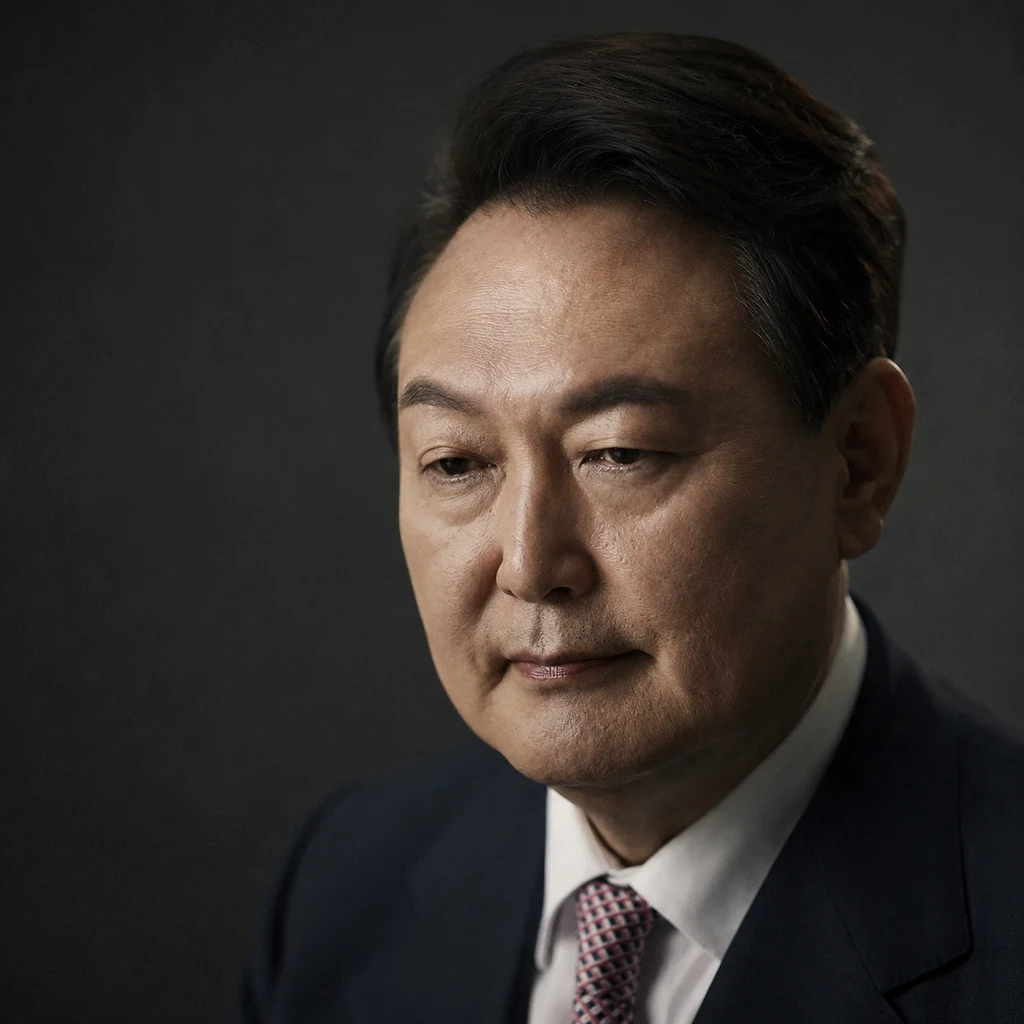
韩国前总统被判无期徒刑
Yoon Suk-yeol Sentenced to Life for Insurrection
About this story
South Korea's former president Yoon Suk-yeol is sentenced to life in prison — a historic court decision. HSK 2 Chinese listening practice.
This is an HSK 2 Chinese listening episode that runs about 7 minutes. The full Mandarin script is shown with tap-for-pinyin and a line-by-line English translation, so you can listen and read at once — comprehensible input in the sense of Stephen Krashen's i+1 theory. It teaches 14 key vocabulary words such as 新闻、生气、担心 and walks through 4 grammar patterns, each explained in English with examples. The same news story is retold at 4 difficulty levels — use the level selector above to find the version that is challenging but still understandable for you.
Read at your level
原文Read the complete story in Chinese. Reveal pinyin and English only when you need them.
English transcript reference
Speaking of a big piece of news from South Korea recently, we are going to talk about a very famous person.
This person is named Yoon Suk-yeol.
He used to be the president of South Korea.
The president is the biggest leader of the country.
However, now he cannot be the president anymore.
Moreover, he has encountered a very big trouble.
What is this trouble?
It is because he did a very wrong thing.
This thing made many South Koreans very angry.
It also made many South Koreans very worried.
Everyone is watching TV.
Everyone is listening to the news.
Because this matter concerns every South Korean.
So, what exactly did he do?
Simply put, he wanted to use the army to control the country.
There are many soldiers in the army.
Soldiers have guns in their hands.
Yoon Suk-yeol made these soldiers walk into the city.
He made the soldiers go to the place where the government works.
He wanted to make the government stop.
He didn't want to let others speak.
This is very dangerous.
Because in a country, a president cannot use soldiers casually.
The president must listen to the law.
What is the law?
The law is the rules that everyone must obey.
Whether it is an ordinary person or the president, they all have to listen to the law.
But Yoon Suk-yeol did not listen.
He felt that he was right.
But everyone felt that he was wrong.
So, the police caught him.
Now, the court has made a decision about him.
The court is the place where words count the most.
The judges there looked at all the evidence.
The judges listened to many people speak.
Finally, the judge said Yoon Suk-yeol is guilty.
Being guilty means he did something wrong and bad.
Because he is guilty, he has to accept punishment.
This punishment is very heavy.
The judge said he must go to prison.
Prison is a place that locks up bad people.
There is no freedom there.
Once inside prison, one cannot come out casually.
Cannot go home to see family.
Cannot go to restaurants to eat with friends.
Cannot go to stores to buy things.
Can only live in a small room.
So, how long does he have to stay?
Is it one year?
No.
Is it ten years?
No.
The judge said it is "life imprisonment".
The meaning of this word is "forever".
In other words, he has to live in prison for his whole life.
As long as he is still alive, he cannot come out.
This is a very serious decision.
Why was the sentence so heavy?
Because the judge believed his mistake was too big.
He wanted to change the country's system.
He made the country become unsafe.
If he is not punished, others will do this in the future too.
So, for the good of the country, he must live in prison.
Many South Koreans heard this news.
Some people feel very happy.
Because they feel the bad person was caught.
Some people feel very sad.
Because this is, after all, their former president.
A country's president going to prison is a very sad thing.
This shows that the country's politics has problems.
Actually, being the president of South Korea is a very difficult job.
Before, other presidents have also gone to prison.
This has happened several times in South Korea's history.
Every time, everyone feels it is a pity.
However, this also tells us a principle.
What principle?
That is, the law is bigger than anyone.
Even if you are the president, if you do wrong, you must take responsibility.
You cannot refuse to listen to the law just because you are a leader.
This is the rule of modern society.
Now, Yoon Suk-yeol is no longer working in that big house.
He went to that small room.
His life has changed completely.
Before, many people listened to him.
Now, he must listen to others.
Before, he could go anywhere.
Now, he cannot go anywhere.
This is because he made a wrong decision.
That decision was to let soldiers come out.
That decision was not listening to everyone's opinions.
Each of us must be responsible for the things we do.
If you do good things, everyone will like you.
If you do bad things, there will be bad results.
For Yoon Suk-yeol, this result is losing freedom.
Freedom is a very precious thing.
We can go wherever we want to go.
We can eat whatever we want to eat.
But people who lose freedom cannot do anything.
So, everyone must obey the law.
Do not do things that hurt others.
Do not do things that hurt the country.
This matter has now ended.
The judge has spoken.
Yoon Suk-yeol's future is in prison.
For the country of South Korea, this is also a new beginning.
Everyone hopes the future will be better.
Everyone hopes future presidents can do better.
Let such things not happen again.
This is the story about the former president of South Korea.
We need to learn from this story.
We need to know what is right and what is wrong.
We need to know the importance of the law.
Finally, let's summarize the words we just said.
The "life imprisonment" we just mentioned is a legal term.
It means that while this person is alive, they are locked in prison continuously and cannot come out.
The "letting soldiers come out to control the country" we just mentioned is called "insurrection" in the news.
"Insurrection" is when the country fights within itself, being very chaotic.
Because Yoon Suk-yeol took the lead in doing this "insurrection" thing, he was sentenced to "life imprisonment".
This is all the content we need to understand today.
Listen again
Try it without the transcript and notice what sounds clearer.
What vocabulary does this episode teach?
词汇Information about recent events. Measure word: 个 (gè) or 条 (tiáo).
To get angry or be mad. Literally 'produce air/energy'.
To worry or be anxious about something.
Can be used as a verb (to decide) or a noun (a decision).
An auxiliary verb indicating strong necessity or obligation.
Refers to past events or the study of the past.
HSK 1-2. why.
The head of state in a republic.
A large organized body of armed personnel.
The system of rules which a particular country or community recognizes.
A place where people are held as punishment for crimes.
A legal sentence where the convict remains in prison for the rest of their life.
Internal chaos or rebellion within a country.
The power or right to act, speak, or think as one wants.
* beyond level超纲词
What grammar patterns appear in this episode?
语法让 (ràng) + Person + Verb
This is a causative structure meaning 'to let', 'to make', or 'to allow' someone to do something.
尹锡悦让这些军人走进城市 (Yoon Suk-yeol made these soldiers walk into the city).
他想让政府停下来 (He wanted to make the government stop).
只要...就... (zhǐyào... jiù...)
A conditional structure meaning 'as long as... then...'. It introduces a sufficient condition.
只要他还活着,就不能出来 (As long as he is still alive, he cannot come out).
不管...还是...都... (bùguǎn... háishì... dōu...)
A pattern meaning 'regardless of whether A or B, [subject] all/both...'. It indicates the result is the same despite different conditions.
不管是普通人,还是总统,都要听法律的 (Whether it is an ordinary person or the president, they all have to listen to the law).
想 + Question Word + 就 + Verb + Question Word
This structure expresses freedom of action, meaning 'whatever/wherever/whoever one wants to [verb], one [verbs]'.
我们可以想去哪里就去哪里 (We can go wherever we want to go).
我们可以想吃什么就吃什么 (We can eat whatever we want to eat).
Proper nouns
专有名词Free account
Keep learning from this story
Create a free account to keep saved words and your preferred level together.
- Keep words with their story context
- Remember your preferred level
- Build your vocabulary over time