
A Chinese podcast · Same story, 4 levels
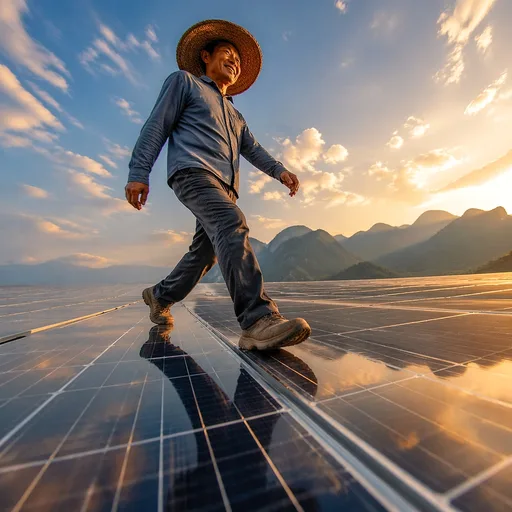
十五五规划:清洁能源如何重塑中国经济版图
China's 15th Five-Year Plan Backs Clean Energy
About this story
China's 15th Five-Year Plan reshapes the economy — Gobi solar mega-bases, Inner Mongolia, Gansu, and the geopolitics. HSK 5-6 Chinese listening practice.
This is an HSK 5-6 Chinese listening episode that runs about 9 minutes. The full Mandarin script is shown with tap-for-pinyin and a line-by-line English translation, so you can listen and read at once — comprehensible input in the sense of Stephen Krashen's i+1 theory. It teaches 18 key vocabulary words such as 重塑、蓝图、可再生能源 and walks through 7 grammar patterns, each explained in English with examples. The same news story is retold at 4 difficulty levels — use the level selector above to find the version that is challenging but still understandable for you.
Read at your level
原文Read the complete story in Chinese. Reveal pinyin and English only when you need them.
English transcript reference
Today we're going to discuss a topic that is profoundly reshaping China's economic landscape — the energy strategy within the 15th Five-Year Plan.
In March 2026, during the Two Sessions, China officially approved the 15th Five-Year Plan.
This blueprint, spanning from 2026 to 2030, has sent an unprecedentedly clear signal in the energy sector: renewable energy is no longer a supporting player, but the undisputed protagonist.
Let's start with a few key figures.
The plan stipulates that by 2030, non-fossil energy must account for 25 percent of primary energy consumption.
Offshore wind power capacity is to exceed 100 gigawatts, and nuclear power capacity is to reach 110 gigawatts.
By 2035, the combined installed capacity of wind and solar power is to reach 3,600 gigawatts.
What does this mean?
A simple calculation shows that from now until then, China needs to add approximately 200 gigawatts of wind and solar capacity every year.
This pace is virtually unimaginable for any other country in the world.
But what truly warrants attention is not these figures themselves, but the fundamental shift in thinking behind this plan.
Over the past decade, China's strategy in the new energy sector can be summarized in four characters: "go big, go fast."
Solar panels have blanketed the Gobi Desert in the northwest, and wind turbines stand along coastlines stretching from Inner Mongolia to Guangdong.
The results were remarkable — the previously set target of 1,200 gigawatts of wind and solar capacity, originally planned for completion by 2030, was achieved ahead of schedule in 2024.
This execution capability has garnered worldwide attention.
However, the problems arising from this rapid scaling have also become increasingly pronounced.
Curtailment of wind and solar power — meaning clean electricity that is generated but cannot be absorbed by the grid, wasted entirely — was at one point quite severe in certain regions.
The northwest has abundant sunshine and strong winds, but electricity demand is concentrated along the eastern coast.
There exists an enormous spatial mismatch between power supply and demand.
You can think of it as a paradox: the more resource-rich an area is, the more likely it is to face the predicament of "having electricity but being unable to transmit it."
The 15th Five-Year Plan attempts to address this problem at its root.
Its core logic has shifted from the singular pursuit of installed capacity to systemic integration.
What does systemic integration mean?
It means no longer viewing each energy form in isolation, but rather planning wind, solar, hydroelectric, nuclear, energy storage, and transmission networks as an organic whole.
Specifically, the plan has laid out several clear pathways.
First, strengthening cross-provincial and cross-regional power transmission corridors.
From clean energy-rich regions such as Inner Mongolia, Gansu, Qinghai, Ningxia, Xinjiang, and Tibet, new ultra-high voltage transmission corridors will be constructed to deliver electricity directly to load centers in the east and central regions.
This is not a new concept, but the 15th Five-Year Plan has elevated it to an unprecedented strategic priority.
Second, building a multi-energy complementary regulation system.
What is the greatest weakness of renewable energy?
Intermittency.
When the sun sets, solar panels stop generating electricity; when the wind dies, turbines cease to turn.
What's the solution?
The plan's answer is: use hydroelectric and nuclear power as baseload, and use pumped-storage hydropower stations as "giant batteries" for peak shaving and valley filling.
China's hydroelectric resources, especially the large reservoirs in the southwest, are naturally equipped with flexible regulation capabilities.
Nuclear power provides stable baseload electricity.
The principle of pumped-storage is straightforward — when there is surplus electricity, water is pumped from downstream to upstream reservoirs for storage; when electricity is needed, the water is released to generate power.
This technology is mature, high-capacity, and long-lasting, making it one of the most reliable large-scale energy storage methods available today.
Third, and this is the most exciting part — the plan explicitly promotes the development of green hydrogen, green ammonia, concentrated solar power, and geothermal energy.
Each of these technologies is worthy of an in-depth discussion on its own.
Green hydrogen, as the name suggests, is hydrogen produced by electrolyzing water using clean electricity.
Its significance lies in the fact that hydrogen can be stored, transported, and used as an industrial feedstock.
Steel smelting, chemical production, heavy-duty transportation — these industries that have traditionally been extremely dependent on fossil fuels could see revolutionary emissions reduction potential if green hydrogen were substituted.
Green ammonia, which is ammonia synthesized from green hydrogen, is not only an important fertilizer feedstock but is also regarded as a highly promising zero-carbon fuel, particularly suited for ocean-going shipping.
Concentrated solar power, also known as concentrating solar thermal power, is entirely different from the photovoltaic panels we are familiar with.
It uses mirrors to focus sunlight onto a single point, generating extreme heat, and then uses steam to drive turbines for electricity generation.
What is its greatest advantage?
Built-in energy storage.
Molten salt can store thermal energy and continue generating electricity even when there is no sunlight.
This effectively resolves the intermittency problem of photovoltaic power.
China's Qinghai, Gansu, and Xinjiang enjoy exceptionally favorable solar irradiation conditions, making them ideal locations for developing concentrated solar power.
Geothermal energy is yet another clean energy source that has been chronically underestimated.
The heat contained within the Earth's interior is virtually inexhaustible.
China's Yangbajing geothermal power station in Tibet has been in operation since the 1970s, yet for a long time, the scale of geothermal development has remained modest.
The 15th Five-Year Plan has brought geothermal energy back into focus, demonstrating the foresight of policymakers in pursuing energy diversification.
From a more macroscopic perspective, this plan conveys a profound signal: clean electricity is not merely an energy issue, but a matter of industrial strategy.
The plan explicitly states that clean electricity will become the primary source of future power growth and the core driving force behind industrial restructuring.
In other words, China does not merely intend to replace coal and natural gas with clean energy, but aims to reconstruct the entire industrial system around clean energy.
What does this mean?
Consider this: when the cost of electricity is sufficiently low and the supply sufficiently stable, many technological pathways that were previously economically unviable become feasible.
Aluminum smelting powered by clean electricity would see dramatic reductions in carbon emissions.
Data centers powered by clean electricity would alleviate the energy anxieties associated with artificial intelligence.
Electric vehicles charged with clean electricity would constitute genuinely zero-emission transportation.
Every link in the industrial chain would be redefined.
Of course, the challenges are equally immense.
Adding 200 gigawatts of wind and solar capacity annually places unprecedented pressure on supply chains.
Polysilicon, lithium batteries, rare earth permanent magnet materials, copper — the supply-demand balance of these critical raw materials will directly impact the pace of the plan's implementation.
Furthermore, the construction of ultra-high voltage transmission lines involves extensive land acquisition, environmental assessments, and cross-provincial coordination, none of which can be accomplished overnight.
As for nuclear power expansion, although the technology is increasingly mature, public acceptance and site selection remain perennially sensitive issues.
There is also a dimension that is easily overlooked: electricity market reform.
No matter how much clean power capacity is installed, without rational pricing mechanisms to guide the production and consumption of electricity, system efficiency cannot be truly improved.
China's electricity market reform has been advancing for years, yet interprovincial barriers, cross-subsidization, and conflicts between planned and market-based electricity quotas — these deep-seated institutional issues persist.
Whether the 15th Five-Year Plan can achieve breakthroughs in these areas will, to a significant extent, determine the quality of the energy transition.
Viewed in an international context, China's energy plan is unparalleled in both scale and ambition.
The EU's Green Deal and the United States' Inflation Reduction Act are both driving their respective energy transitions, yet no single country or economic bloc has ever produced such a systematic and detailed roadmap.
This concerns not only China's own carbon peaking and carbon neutrality targets, but will also profoundly influence the structure of global energy markets, the cost curves of clean technologies, and even the balance of geopolitical power.
From the early achievement of 1,200 gigawatts to the new target of 3,600 gigawatts, from sheer scaling to refined systemic integration, the 15th Five-Year Plan marks China's energy transition entering an entirely new phase.
This is no longer a debate about "whether to transition," but a practice of "how to transition faster, more steadily, and more deeply."
Over the next five years, we will witness how this blueprint materializes step by step — and its impact will extend far beyond the energy sector itself.
Listen again
Try it without the transcript and notice what sounds clearer.
What vocabulary does this episode teach?
词汇Used in the title and opening to describe how clean energy is fundamentally reshaping China's economic landscape. 重 means again/re- and 塑 means to mold/shape.
Refers to the Five-Year Plan as a strategic blueprint covering 2026-2030. Literally blue picture, used metaphorically for a grand plan or vision.
A key compound term in the episode. 可 (can) + 再生 (regenerate) + 能源 (energy). Central to the entire discussion of China's energy transition.
Used to describe the integrated planning approach of the 15th Five-Year Plan. A common term in Chinese policy language meaning holistic coordination.
Used in the context of steel smelting, one of the heavy industries that could benefit from green hydrogen. 冶 means to smelt and 炼 means to refine.
A four-character idiom describing how regions like Qinghai and Gansu have uniquely favorable conditions for solar thermal power.
Used with 绝非 (absolutely not) to emphasize that building UHV transmission infrastructure cannot be done overnight. A literary idiom where 蹴 means to stamp or kick.
Describes the decision-makers' strategic foresight in diversifying energy sources. 深 (deep) 谋 (to plan) 远 (far) 虑 (to consider).
Used in the concluding section to describe how China's energy plan will affect the global geopolitical balance of power. 地缘 (geographical) + 政治 (politics).
A technical energy term used repeatedly. 装机 means to install equipment and 容量 means capacity. Refers to the total generating power of installed equipment.
A specialized energy sector term meaning the grid's ability to absorb and distribute generated electricity. Used when discussing the curtailment problem.
Describes the spatial mismatch between where clean energy is produced (northwest) and where demand is concentrated (east coast). 错 (wrong/mis-) + 配 (to match/allocate).
Refers to ultra-high voltage power transmission technology, a key infrastructure for sending electricity across vast distances in China. 特 (ultra) + 高压 (high voltage).
The biggest weakness of renewable energy. Solar stops when the sun sets, wind stops when there is no wind. 间歇 means intermittent and 性 makes it a noun property.
A four-character technical term describing how pumped-storage hydropower balances electricity supply: reducing peak demand and filling low-demand periods.
Mentioned in the description of concentrated solar power, where steam drives turbines to generate electricity. 涡轮 (turbine/vortex wheel) + 机 (machine).
A key material in concentrated solar power that stores heat energy. 熔 (to melt) + 盐 (salt). Allows power generation to continue when there is no sunlight.
China's goal to reach peak carbon emissions before 2030. 碳 (carbon) + 达 (to reach) + 峰 (peak). Often paired with 碳中和 (carbon neutrality).
* beyond level超纲词
What grammar patterns appear in this episode?
语法Expresses contrast: not A, but rather B. Used to correct a possible assumption and emphasize the true situation. A key pattern for advanced argumentation.
可再生能源不再是配角,而是绝对的主角。
真正值得关注的,不是这些数字本身,而是这份规划背后思路的根本性转变。
Indicates a transition or shift in direction from one approach/state to another. Commonly used in policy and strategic discussions to describe changing priorities.
核心逻辑,从单纯追求装机规模,转向了系统集成。
从单纯的规模扩张到精细的系统集成。
A progressive structure meaning not merely A, but even more so B. Used to add emphasis and elevate the importance of the second point beyond the first.
清洁电力不仅仅是能源问题,更是产业战略问题。
中国不只是要用清洁能源替代煤炭和天然气,更要围绕清洁能源重新构建整个工业体系。
Means regardless of A or B, all... Used to express that something holds true in all cases mentioned. A staple of formal/written Chinese.
无论从规模还是雄心来说,都是独一无二的。
A correlative pattern meaning the more A, the more B. Expresses a proportional or paradoxical relationship. Often used to highlight counterintuitive results.
越是资源丰富的地方,越可能出现有电送不出去的困境。
A multi-layered instrumental structure: use A as B to accomplish C. Commonly seen in explanations of systems, mechanisms, and strategies.
用水电和核电作为基础负荷,用抽水蓄能电站作为巨型电池来调峰填谷。
An emphatic negation meaning absolutely not or by no means. Stronger than 不是, used in formal writing and speeches to stress that something should not be underestimated.
特高压输电线路的建设涉及大量的土地征用、环境评估和跨省协调,绝非一蹴而就。
Proper nouns
专有名词Free account
Keep learning from this story
Create a free account to keep saved words and your preferred level together.
- Keep words with their story context
- Remember your preferred level
- Build your vocabulary over time