
A Chinese podcast · Same story, 4 levels
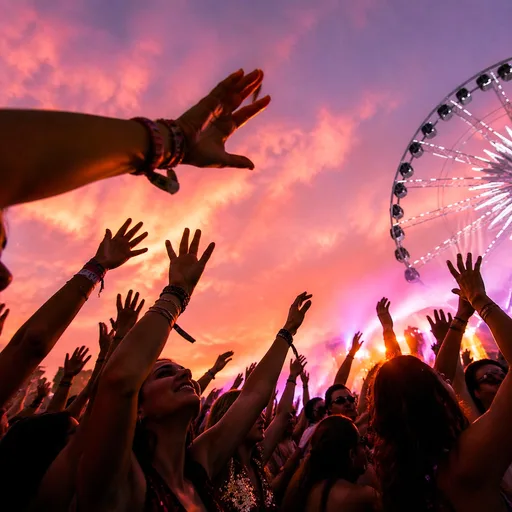
Coachella 2026:一千万美元的怀旧、第一位拉丁女头号、和一个正在变质的音乐节
Karol G Leads Coachella's 2026 Headliners
About this story
Coachella 2026 lands Karol G as its first Latina headliner alongside Sabrina Carpenter and Justin Bieber — a festival in flux. HSK 5-6 Chinese listening practice.
This is an HSK 5-6 Chinese listening episode that runs about 8 minutes. The full Mandarin script is shown with tap-for-pinyin and a line-by-line English translation, so you can listen and read at once — comprehensible input in the sense of Stephen Krashen's i+1 theory. It teaches 12 key vocabulary words such as 品牌、工业、实验 and walks through 5 grammar patterns, each explained in English with examples. The same news story is retold at 4 difficulty levels — use the level selector above to find the version that is challenging but still understandable for you.
Read at your level
原文Read the complete story in Chinese. Reveal pinyin and English only when you need them.
English transcript reference
When people think of Coachella, the image that comes to mind is desert sunsets, flower crowns, and Instagram compositions.
But if you only see it as an influencer check-in spot, you'll miss a lot.
Coachella is one of the world's most influential music festivals.
Its lineup decisions directly influence the narrative direction of global pop music.
The first weekend of this year just ended.
Three days.
Three headliners.
About 250,000 people poured into the desert of Indio, California.
Forty degrees during the day.
Evening shows running from six PM until one AM.
Tickets ranging from five hundred dollar general admission to several thousand for VIP.
That's not counting accommodation, transportation, and food.
The real total cost of attending once is roughly three to five thousand dollars.
Even so, it sells out every year.
Coachella is no longer just a music festival.
It's a content engine.
Every April across two weekends.
Content volume on TikTok and Instagram surges several times over.
Brand sponsorships, influencer parties, fashion bloggers checking in.
For many attendees, listening to music is secondary.
Being photographed is the point.
But that doesn't diminish the brilliance of what happens on stage.
This year's three headliners were Sabrina Carpenter on Friday, Justin Bieber on Saturday, and Karol G on Sunday.
First, Carpenter.
She's one of the focal points of the global pop scene this year.
Her Coachella debut wasn't just a concert.
She turned it into an immersive five-act musical.
Each act had independent set design, costumes, and narrative arc.
One look per song.
Outfit changes at a pace rivaling a fashion show backstage.
Sam Elliott narrated a short film interspersed in the performance.
Will Ferrell appeared as a handyman character, producing the biggest laugh of the entire show.
Susan Sarandon also made a cameo.
The entire production quality approached Broadway standards.
This trend of "immersive headlining" is becoming increasingly obvious.
Ever since Beyoncé's 2018 performance.
Coachella's headlining acts can no longer get by with just "singing plus dancing."
You need to give people a narrative.
A visual experience.
An image worth screenshotting and sharing.
Carpenter clearly understands this.
Then Bieber.
He reportedly received a ten million dollar fee.
If true, that's the highest in Coachella history.
His performance sparked polarized reactions.
He put a laptop on stage.
Opened YouTube.
Played videos of himself singing in his bedroom over a decade ago.
The very videos that got him discovered in 2008.
Then he sang along with them.
Baby.
Never Say Never.
That Should Be Me.
Tens of thousands singing together.
From a nostalgia perspective, this was deeply moving.
A boy discovered on YouTube.
Eighteen years later standing on the world's biggest music festival stage.
Playing those same videos.
Singing the same song to tens of thousands of people.
The weight of time became very concrete in that moment.
But from a performance quality perspective.
Vice's review was "messy and not focused."
Some said it felt like being in his living room.
Some said this isn't what ten million dollars should look like.
But others said this is precisely Bieber at his best.
Not perfect, but real.
No over-choreography.
No lip-syncing.
Just a former boy singing his own songs in the desert.
I lean toward the latter view.
Last and most importantly — the final headliner.
Karol G.
Colombian.
Singing reggaeton and Latin pop.
She is the first female Latin headliner in Coachella's twenty-plus year history.
The significance of this "first" isn't just symbolic.
Latin music has become one of the biggest growth engines in global pop over the past five years.
Bad Bunny has been Spotify's most-streamed artist globally for two consecutive years.
Shakira's World Cup performance was watched by over a billion people.
But on Coachella's main stage.
Latin music has always been placed in non-headlining positions.
This year Karol G broke through that ceiling.
What was the most viral moment of her performance?
She invited an all-female Mariachi band from Los Angeles on stage.
Mariachi is a traditional Mexican music performance form.
An all-female Mariachi band is itself a breakthrough in a traditionally male-dominated field.
When they stood on Coachella's main stage in their gorgeous traditional costumes.
What you saw wasn't just music.
What you saw was a culture claiming its rightful place.
This image had the highest share count of all Coachella content online.
Besides the three headliners.
There were several performances worth discussing.
BINI is from the Philippines.
An eight-member girl group.
They are the first Filipino artist in Coachella history.
A forty-five-minute set.
Performed in English and Filipino.
After K-pop and J-pop.
Southeast Asian pop music is becoming the next force to enter the Western mainstream.
BINI is at the front of this trend.
Jack White's appearance was a last-minute addition.
But his 3 PM set in the Mojave tent delivered the purest rock moment of the entire festival.
In a festival increasingly dominated by electronic and pop music.
His guitar solos and the Seven Nation Army closer reminded people of what Coachella used to be.
Nine Inch Nails and Boys Noize's collaboration "Nine Inch Noize" was another kind of experiment.
Industrial rock meets electronic dance music.
Dancers in grey bodysuits writhing on stage like zombies.
This kind of crossover can only happen at Coachella.
Laufey quietly played piano and sang jazz in a tent.
You just came from a main stage with tens of thousands of people.
Walk into a tent.
Listen to an Icelandic girl sing From the Start in a very soft voice.
That contrast itself is an experience.
FKA Twigs' performance paid tribute to West Coast Ballroom culture.
Called by many reviewers "the most artistic performance of the entire festival."
This is the most interesting thing about Coachella.
You can experience five completely different music cultures in a single day.
From Latin reggaeton to Icelandic jazz.
From industrial rock to K-pop.
From nostalgic pop to avant-garde dance.
No other place can give you this density of cultural experience.
But there's also criticism.
More and more voices say Coachella has "lost its soul."
It used to be a place to discover new music.
Now it's a place for brands to do marketing.
People used to come to listen to music.
Now people come to take photos.
This criticism isn't without merit.
But I think this isn't Coachella's problem.
It's the entire cultural industry's problem.
When music and content and social media fully merge.
The act of purely "listening to music" itself is being redefined.
Coachella is just at the forefront of this change.
There's still the second weekend next week.
Same desert.
Same lineup.
But different people.
Maybe different surprises.
No matter how you view Coachella.
One thing is certain.
It remains the most concentrated three days of global pop culture.
If you want to know what the world is listening to, wearing, watching, and talking about right now.
Coachella is the answer.
Listen again
Try it without the transcript and notice what sounds clearer.
What vocabulary does this episode teach?
词汇HSK 1-4. brand.
HSK 1-4. industry.
HSK 1-4. experiment.
HSK 1-4. number, digit.
HSK 1-4. desert.
HSK 1-4. tradition.
The story or framing that media and culture follows.
A system that generates massive amounts of content.
Deeply engaging experience that surrounds you.
Opinions split into two extreme opposing sides.
The main driver of growth in an industry.
An upper limit that is hard to break through.
* beyond level超纲词
What grammar patterns appear in this episode?
语法Proper nouns
专有名词Sources
来源Free account
Keep learning from this story
Create a free account to keep saved words and your preferred level together.
- Keep words with their story context
- Remember your preferred level
- Build your vocabulary over time