
A Chinese podcast · Same story, 4 levels
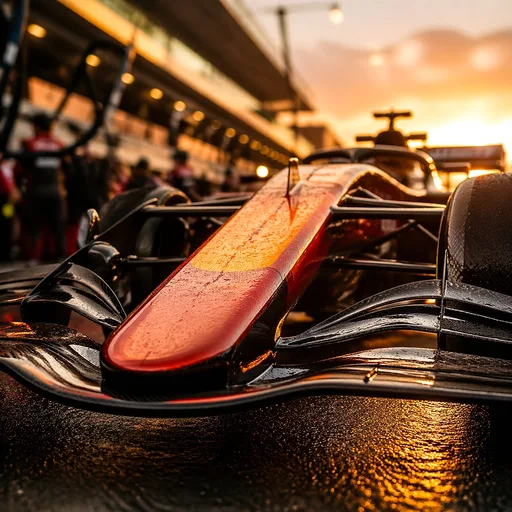
F1的2026革命:当速度遇上可持续
F1's 2026 Rules Reshape the Grid
About this story
F1's 2026 reset brings 50% hybrid power and sustainable fuel — Audi, Honda, Aston Martin and Red Bull all in play. HSK 5-6 Chinese listening practice.
This is an HSK 5-6 Chinese listening episode that runs about 7 minutes. The full Mandarin script is shown with tap-for-pinyin and a line-by-line English translation, so you can listen and read at once — comprehensible input in the sense of Stephen Krashen's i+1 theory. It teaches 13 key vocabulary words such as 混合动力、电气化、百分之 and walks through 6 grammar patterns, each explained in English with examples. The same news story is retold at 4 difficulty levels — use the level selector above to find the version that is challenging but still understandable for you.
Read at your level
原文Read the complete story in Chinese. Reveal pinyin and English only when you need them.
English transcript reference
The 2026 F1 season is undergoing its biggest rule reset in recent years.
From power units to aerodynamics, from fuel type to overtaking mechanisms, almost every core technical dimension has been redefined.
This isn't a tweak — it's a rewrite.
Let's start with the power unit, because this is where the most fundamental change lies.
In recent years, the internal combustion engine contributed about eighty percent of the power in F1's hybrid system, with the electric motor playing a supporting role.
This year that ratio has been pulled to fifty-fifty.
The electric motor's output has surged from 120 kilowatts to 350 kilowatts — nearly a threefold increase.
This means that under certain conditions, behind the engine sound you hear, half the thrust comes from the electric motor.
At the same time, the most controversial component — the MGU-H — has been eliminated.
The MGU-H is a device that recovers energy from turbo exhaust heat.
Technically elegant, but extremely expensive to produce and requiring very long development cycles.
It was one of the biggest barriers preventing new manufacturers from joining F1.
With the MGU-H removed, the technical barrier for engines has been lowered, and the architecture has become more streamlined.
The direct effect of this decision is obvious.
Audi has joined the paddock with a self-developed engine.
Honda chose to return after a two-year absence, partnering with Aston Martin.
Red Bull ended its partnership with Honda, pivoting to co-develop its own power unit with Ford.
Together with Mercedes and Ferrari, F1 now has five engine manufacturers.
This is the richest competitive landscape in nearly a decade.
General Motors' Cadillac has also entered as a new team, temporarily using Ferrari engines, with plans to launch their own power unit in 2029.
The fuel revolution is equally noteworthy.
F1 has fully switched to sustainable fuels this year.
This isn't a token gesture of mixing a bit of ethanol into gasoline.
The raw materials for this fuel come from carbon capture, municipal waste, and non-food biomass.
In simple terms, it's fuel made from garbage and carbon captured from the air.
F2 and F3 already trialed this fuel in 2025.
This year it's F1's turn to go fully live.
The signal behind this is clear.
F1 no longer wants to carry the label of high carbon emissions.
It wants to prove that peak performance and environmental responsibility can coexist.
The aerodynamic changes are equally profound.
In recent years, F1's underbody design relied on complex ground-effect tunnels to generate downforce.
This year that design has been dramatically simplified.
The long Venturi tunnels are gone, replaced by flatter floors and diffusers with larger openings.
Total downforce has decreased, but the wake turbulence affecting trailing cars has also noticeably diminished.
This means following cars is easier, and overtaking opportunities increase.
Complementing this is the boldest aerodynamic innovation in F1 history: active aero.
Both front and rear wings can adjust their angle based on real-time needs.
On straights, the flaps open, drag reduces, top speed increases.
In corners, the flaps close, downforce restores, grip strengthens.
This system can be used on every straight of every lap, without any restrictions.
Traditional DRS has been completely replaced.
Layered on top of active aero is an additional competitive mechanism.
If a car is within one second of the car ahead at a designated detection point, it can activate Overtake Mode for the entire next lap.
Overtake Mode allows an extra 0.5 megajoules of electrical energy recovery, converting to stronger acceleration capability.
Combined with an always-available boost button, drivers now have unprecedented tactical space between attack and defense.
When to deploy electrical power, when to harvest energy, when to use boost — these decisions dramatically increase the intellectual dimension of racing.
On the chassis side, the cars have become shorter, narrower, and lighter.
The shortened wheelbase makes cars more responsive in corners.
Narrower tires reduce rolling resistance and overall vehicle weight.
Visually, the new generation of F1 cars looks more compact and aggressive.
The safety upgrades reflect F1's consistent rigor.
The survival cell's testing standards have been raised once again.
The roll hoop's load capacity has increased by twenty-three percent, equivalent to the weight of nine passenger cars stacked on top.
The front impact structure has been redesigned with a two-stage system, providing protection even in secondary collisions.
Yesterday's 50G impact by Bearman at Turn 13 in Japan was the best proof.
The car was destroyed, but the driver was largely fine.
Knee contusion, no fractures.
The safety system passed its test.
From a broader perspective, the core logic of the 2026 regulations can be summarized in three words: electrification, sustainability, competition.
Electrification isn't about chasing trends — it's because electric technology genuinely outperforms pure combustion in energy efficiency.
Sustainable fuels aren't a PR gimmick — they're a response to the entire automotive industry's transformation trajectory.
Attracting more manufacturers isn't about padding the grid — it's because diverse competition is what catalyzes genuine technical innovation.
Three races in, the new regulations' effects are already emerging.
Antonelli has two wins and a pole position at Mercedes, becoming the youngest-ever championship leader.
Piastri returned from injury to land on the podium in his first race back.
Verstappen has dropped to eighth.
The order has been disrupted — exactly what the new rules intended.
F1 spent two years preparing this transformation.
Looking at it now, the gamble paid off.
Of course, three races are far from enough to draw conclusions.
There are still over twenty races left in the season.
As teams deepen their understanding of the new rules, the performance hierarchy will likely shuffle significantly.
But at least from the opening rounds, the new rules have successfully achieved their core objective: making racing more open and outcomes less predictable.
Verstappen's two-season dominance of F1 has been broken.
He finished only eighth at the Japanese Grand Prix.
Two years ago, this would have been unimaginable.
And a twenty-one-year-old Italian, in his first season replacing Hamilton, is leading the championship.
That image alone is the best advertisement for the new regulations.
F1 spent two years preparing for this transformation.
From the results so far, the wait was worthwhile.
Speed, sustainability, competition, safety.
When these four goals achieve balance within a single regulatory framework.
What you're seeing isn't just a sport evolving.
You're seeing a multi-billion-dollar global industry redefining the meaning of its own existence.
Next stop: Miami, May first through third.
By then we'll see what upgrade packages teams bring after a month-long break.
At that point, the true face of these new regulations will become much clearer.
But regardless, the 2026 season has already given us a spectacular opening.
The story ahead is worth looking forward to.
Listen again
Try it without the transcript and notice what sounds clearer.
What vocabulary does this episode teach?
词汇A system combining petrol engine and electric motor.
The shift toward electric-powered systems.
HSK 1-4. percent.
HSK 1-4. to prove.
HSK 1-4. system.
HSK 1-4. tradition.
HSK 1-4. standard.
A complete overhaul of the rules governing the sport.
A device recovering energy from turbo exhaust heat. Eliminated in 2026.
The restricted area where F1 teams work on their cars.
Fuel made from waste and captured carbon, not fossil sources.
Aerodynamic force pushing the car onto the track for grip.
Ground-effect channels under the car generating downforce.
* beyond level超纲词
What grammar patterns appear in this episode?
语法Proper nouns
专有名词Sources
来源Free account
Keep learning from this story
Create a free account to keep saved words and your preferred level together.
- Keep words with their story context
- Remember your preferred level
- Build your vocabulary over time