
A Chinese podcast · Same story, 4 levels
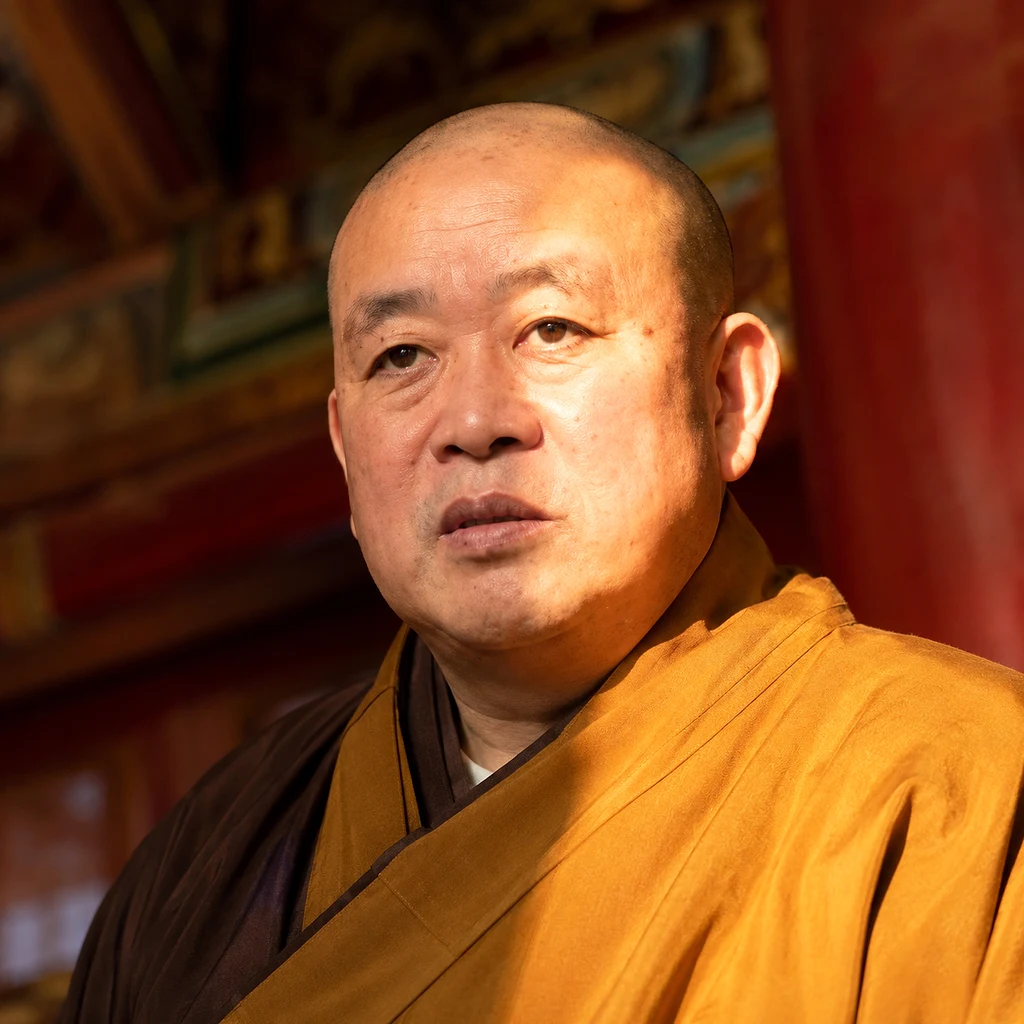
释永信被判二十四年——少林寺的"CEO 和尚"出事了
Shaolin Abbot Shi Yongxin Gets 24 Years
About this story
The Shi Yongxin case in detail: the four charges, the ~300M yuan case total, his 1999 abbot tenure, the 706 trademarks, the 'CEO Monk' nickname, and what it means when a 1,500-year-old temple becomes a corporation. HSK 3 Chinese listening practice.
This is an HSK 3-4 Chinese listening episode that runs about 8 minutes. The full Mandarin script is shown with tap-for-pinyin and a line-by-line English translation, so you can listen and read at once — comprehensible input in the sense of Stephen Krashen's i+1 theory. It teaches 12 key vocabulary words such as 历史、表演、关系 and walks through 6 grammar patterns, each explained in English with examples. The same news story is retold at 4 difficulty levels — use the level selector above to find the version that is challenging but still understandable for you.
Read at your level
原文Read the complete story in Chinese. Reveal pinyin and English only when you need them.
English transcript reference
There's a recent news story that all of China is watching.
The former great abbot of Shaolin Temple is called Shi Yongxin.
You might have heard of him.
He's a very famous person.
On May 29, the court issued its verdict.
He was sentenced to twenty-four years in prison.
He also has to pay a 3.5-million-yuan fine.
The moment this news broke, it hit the top of the trending list.
All of China was discussing it.
My friend feed was full of this news too.
Those three characters "Shi Yongxin" filled the screens for several days.
Today we're going to talk about this.
Why is this such a big deal?
Why do so many people care?
Let's take it slowly.
First, a bit about Shaolin Temple.
Shaolin Temple is in Henan.
It has over fifteen hundred years of history.
Very old.
And very famous.
Why so famous?
Because the monks here practice kung fu.
"Shaolin kung fu" — those four characters — the whole world has heard them.
A lot of Jet Li movies are about Shaolin Temple.
Many films have been shot about Shaolin Temple.
Many foreigners come to China specifically for Shaolin Temple.
Some learn kung fu for years before going home.
So for Chinese people, Shaolin Temple is not just a temple.
It's not only a monastery.
It's also a cultural banner.
It's a calling card that goes abroad.
Shi Yongxin was the "boss" of this temple.
He became the great abbot in 1999.
He served for almost thirty years.
What did he do?
He turned Shaolin Temple into a big company.
More precisely, into many companies.
He set up the first company in 1997.
Then one after another.
Food, lodging, retail, kung fu performances — he did them all.
He reportedly registered over seven hundred trademarks.
The two characters "Shao Lin."
Became a global brand.
Tickets also sold very well.
In 2017, just the tickets alone.
Sold 350 million yuan.
Think about it — 350 million.
In one year.
From ticket sales alone.
In 2019, over 4 million people visited Shaolin Temple.
That year, Shaolin Temple earned a total of 1.2 billion.
That's a huge amount of money.
For a temple.
This is an unimaginable number.
So many people called him the "CEO Monk."
CEO means the head of a company.
Some also called him the "political monk."
Meaning he had ties to many powerful figures.
For many Chinese people, Shi Yongxin was Shaolin Temple itself.
The moment he appeared, everyone knew: this is a Shaolin Temple person.
But starting last year, things changed.
On July 27, 2025, Shaolin Temple itself put out a notice.
A notice is a kind of official announcement.
The notice said: Shi Yongxin has problems.
He used the temple's money for his own affairs.
He also violated the rules of monkhood.
What rules?
He had long-running relationships with several women.
And he had his own children.
These are two things — one is a money issue.
The other is a personal-life issue.
In the rules for monks, both of these are major matters.
After the notice came out, all of China was discussing it.
Some didn't believe it.
They said: he's the great abbot, how could this be?
They said: did someone frame him?
Others said: I felt something was off long ago.
Every day he was so rich, like a big boss.
How could he be a real monk?
The two camps argued for several months.
Then the police started investigating.
They investigated for over three hundred days.
The investigation was very thorough.
They checked every transaction.
They checked every company.
They checked who he was connected to.
On March 20 of this year.
The case was sent to court.
The court announced a trial date.
May 29.
The verdict came out.
The court said he had four crimes.
Let me go through them one by one.
First, "occupational embezzlement."
That means he used his position as great abbot to turn temple property into his own.
The court found that from 2003 to 2025, he embezzled over 131 million this way.
Second, "misappropriation of funds."
That means he borrowed the temple's money.
Used it himself, over three months without returning it.
This is different from "embezzlement."
"Embezzlement" is direct taking.
"Misappropriation" is using first — supposed to return it, but doesn't.
From 2012 to 2022.
He misappropriated over 151 million this way.
Third, "bribe-taking by a non-state employee."
That means he took other people's money.
And helped them with their affairs.
For example: if someone wanted to do construction at Shaolin Temple.
They'd give him money, and he'd give them the job.
From 2006 to now.
He took over 11.6 million this way.
Fourth, "bribery."
That means he gave money to government officials.
To get them to help him.
From 1995 to 2022.
He gave out over 5.6 million.
Four of them added together.
Comes to almost 300 million yuan.
300 million.
For a monk.
That's an unimaginable number.
The court ultimately sentenced him to twenty-four years.
He listened and said: I accept.
He won't appeal.
Meaning he accepts the result.
The court also said: he is no longer a monk.
The name "Shi Yongxin" can no longer be used.
From now on he can only use his name before he became a monk: Liu Yingcheng.
Listening to this news, I have several feelings.
First, what he did is genuinely wrong.
The money belonged to Shaolin Temple, not to him.
That money was supposed to be used on the temple.
He took it to live his own good life.
He also did things monks are absolutely not allowed to do.
That's a fact.
And that's the basis of the verdict.
But second, I'm also thinking about a bigger question.
That is: should a temple be doing business at all?
Shi Yongxin wasn't like this from the start.
When he first became great abbot.
Shaolin Temple was actually poor.
He thought: to keep Shaolin Temple alive.
We need to make money.
So he opened companies.
Registered trademarks.
Did performances.
At first, many people felt he was doing the right thing.
He let Shaolin Temple be seen by the whole world.
He made sure many monks had food to eat.
He also brought a lot of tourists to this part of Henan.
But slowly, the money grew and grew.
The power grew bigger and bigger.
Nobody could supervise him.
Nobody dared to tell him he was wrong.
In the end.
He himself couldn't tell apart anymore.
Which money belonged to the temple.
Which money was his own.
So this thing isn't just one person's problem.
It's not just a "one bad monk" problem.
It's the question of what happens when a temple becomes a company.
What happens.
It's the question of what happens when a person has money and fame and no one watching.
What happens.
Of course, that said.
Even if Shaolin Temple is very commercial, not every monk would do this.
The one who ended up doing wrong is still him as a person.
The responsibility lies with him.
And finally I want to say one more thing.
For many Chinese people.
Watching this news is a little sad.
Not because they feel sorry for him.
It's because Shaolin Temple.
Is something in everyone's heart.
The two characters "Shao Lin."
Used to be clean.
Used to represent tradition, martial arts, monks.
Now when you see Shaolin Temple again.
There's something extra in your heart.
Something more complicated has been added.
This feeling — digest it slowly.
Finally I want to ask you a question.
What about you?
Is there a place like this in your heart?
Or, a person like this?
Someone you used to deeply trust.
And later you discovered they weren't who you thought.
At that time, what did you do?
Did you still trust people after that?
Take your time, no rush.
Listen again
Try it without the transcript and notice what sounds clearer.
What vocabulary does this episode teach?
词汇HSK 2-3. 有一千五百多年的历史 = it has over fifteen hundred years of history.
HSK 3. 搞表演 = to put on performances. Shaolin sent its monks to perform kung fu around the world.
HSK 3 noun. 他跟很多大人物有关系 = he had ties to many powerful figures. Also used for romantic relationships.
HSK 3 verb. 他接受这个结果 = he accepts the result. Used to describe his decision not to appeal.
HSK 2 connector. 比如说,谁想在少林寺做工程 = for example, whoever wanted to do construction at Shaolin Temple. Often appears as 比如说.
HSK 3 adjective. 听这个新闻,我觉得很复杂 = listening to this news, I feel things are complicated.
Beyond HSK 1-3. The central religious noun in this story. Shi Yongxin lost his monk status as part of the verdict.
Beyond HSK 1-3. 三百五十万的罚款 = a 3.5-million-yuan fine. 罚 means to punish, 款 means a sum of money.
Beyond HSK 1-3. A formal announcement from an organization. The Shaolin management's July 27, 2025 通报 was the first time a Chinese temple system publicly denounced its own abbot.
Beyond HSK 1-3. 没有人能监督他 = no one could supervise him. A key word in the episode's analysis of how the situation grew out of control.
Beyond HSK 1-3. 他不上诉 = he does not appeal. A specific legal term — to take a verdict to a higher court for review.
Beyond HSK 1-3. 注册了七百多个商标 = registered over seven hundred trademarks. The aggressive trademarking was central to commercialization.
* beyond level超纲词
What grammar patterns appear in this episode?
语法Subject + 让 + Object + Verb
让 = to let / cause / make. Marks causation — A makes B do something or causes B to be a certain way.
他让少林寺变成了一个大公司。
他让少林寺被全世界看见。
他让很多和尚有饭吃。
Verb + 得 + Adverbial / Result
Use 得 between a verb and its descriptive complement to describe how an action is done.
门票也卖得很好。
查得很仔细。
不是... + 是...
Correction structure: 'it's not X, it's Y'. Used to redirect or clarify what something actually is.
他不只是一个和尚。
钱是少林寺的,不是他的。
不是因为同情他。是因为少林寺。
Subject + 越来越 + Adjective / Verb
越来越 = 'more and more...'. Marks an ongoing tendency. Common in spoken Chinese.
钱越来越多。
权力也越来越大。
Subject + 应该 / 不应该 + Verb
应该 = should. 不应该 = shouldn't. Use before a verb to talk about obligation or moral correctness.
寺庙到底应该不应该做生意?
他还做了和尚绝对不可以做的事。
那些钱本来应该用在寺庙上。
Verb + 起来 can mark the beginning of an action or introduce a topic. 说起来 = 'when you talk about it'.
四个加起来。
话说回来。
我们今天就来聊一聊这件事。
Proper nouns
专有名词Free account
Keep learning from this story
Create a free account to keep saved words and your preferred level together.
- Keep words with their story context
- Remember your preferred level
- Build your vocabulary over time