
A Chinese podcast · Same story, 4 levels
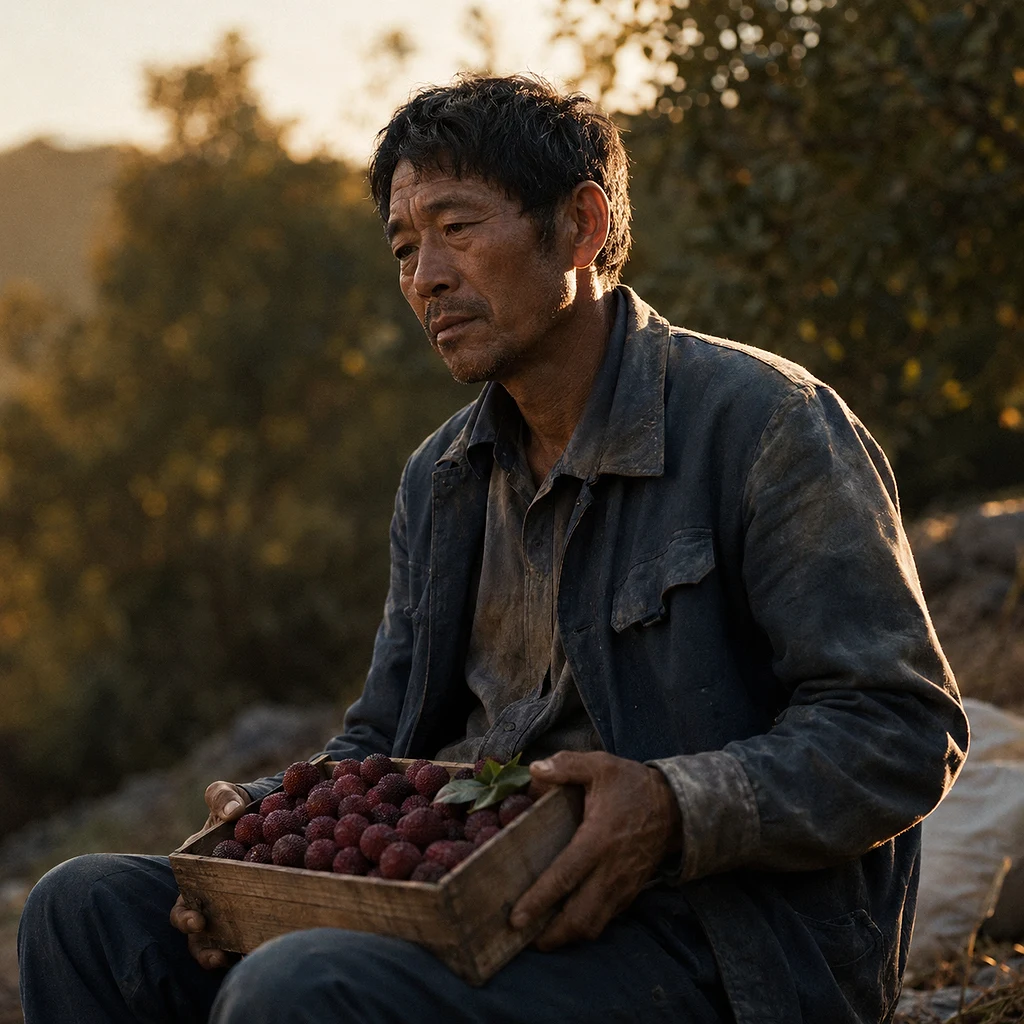
五家收购点,毁了一条产业链——"泡药杨梅"之后
Zhangzhou Bayberry Scandal Hurts Growers
About this story
Zhangzhou Bayberry Scandal Hurts Growers. HSK 5+ Chinese listening practice.
This is an HSK 5+ Chinese listening episode that runs about 7 minutes. The full Mandarin script is shown with tap-for-pinyin and a line-by-line English translation, so you can listen and read at once — comprehensible input in the sense of Stephen Krashen's i+1 theory. It teaches 12 key vocabulary words such as 信任、市场、安全 and walks through 4 grammar patterns, each explained in English with examples. The same news story is retold at 4 difficulty levels — use the level selector above to find the version that is challenging but still understandable for you.
Read at your level
原文Read the complete story in Chinese. Reveal pinyin and English only when you need them.
English transcript reference
In May 2026
something happened in China
that seemed quite small.
Someone used additives that should not be used,
on a small fruit.
It was exposed by the media,
and the authorities handled it quickly too.
Five people were criminally detained,
the case was clear-cut,
and the handling was clean.
On the surface,
this was
a fully wrapped-up food-safety case.
But this matter's
real impact
is not so simple.
Today,
starting from this single bayberry,
we'll talk about something bigger:
trust,
the market,
and why those who play by the rules
also end up
going down with the rest.
Let's first lay out the facts.
The subject of the story
is a fruit called yangmei (bayberry).
Yangmei is a fruit
very characteristic of southern China.
Deep red in color,
sweet-sour in taste.
Each year, only from May to June —
just a few short weeks —
is its best season.
But yangmei has
one deadly trait:
its shelf life
is only two to three days.
After being picked from the tree,
in less than three days
it begins to spoil.
This point,
we'll come back to later.
Around May 15,
CCTV and multiple media outlets
disclosed a story.
It took place in
Longhai District, Zhangzhou City, Fujian Province.
Specifically two towns were involved:
Fugong Town
and Baishui Town.
Several yangmei procurement points there
were found
doing something illegal.
They took the freshly picked yangmei
and soaked it in two things.
The first
was called dehydroacetic acid sodium,
a food preservative.
The second
was a bottle of high-strength sweetener.
The packaging read
"8000x sweetness,"
but it had no production date,
no ingredients list,
and no quality certificate —
a textbook "three-no product."
According to the state's
National Food Safety Standard,
both classes of additives
are clearly forbidden
on fresh fruit.
So what these procurement points did,
legally speaking,
was fully illegal.
On May 20 to 21,
Zhangzhou City issued a notice.
The official investigation found
the procurement points involved
were five in total.
Seized on site
were 225 kg of problem yangmei
and 20.1 kg of illegal additives.
And from the market,
another 540 kg of problem yangmei was recovered.
In the end:
twelve administrative cases were filed,
two criminal cases were filed,
five people were criminally detained.
On the surface,
the matter was handled
quickly
and thoroughly.
But
the real damage
was just beginning.
As soon as the news broke,
the whole yangmei market
crashed rapidly.
In the livestream rooms,
the hosts selling yangmei
were notified —
"illegal selling" —
and had to refund consumers.
Wholesale markets across the country
were being inspected three times a day.
Ordinary consumers,
seeing yangmei, were afraid,
and simply did not buy.
But what hurt the most
was another thing.
Zhejiang
is actually China's most famous yangmei region.
Xianju yangmei,
Yuyao yangmei,
Cixi yangmei —
all are decades-old brands.
This event
had no connection
to Zhejiang at all.
But consumers
could not tell.
You hold up a yangmei to them,
and there's no way they know
whether this one
is from Zhangzhou
or from Xianju.
The result:
Zhejiang fruit farmers
also could not sell.
On May 23,
a Zhangzhou fruit farmer
cried in a livestream room.
He said
his family had grown yangmei for decades
and had never used any 药水.
But this news came out,
and his goods,
none of them could be sold.
This video
spread widely online.
Speaking of this,
we must go back to
the question we started with:
why does this kind of thing happen?
Why do procurement points
take on the risk of prison
to use banned additives?
The answer,
in fact, hides in
yangmei itself —
that two-to-three-day shelf life.
For fruit farmers,
procurement points,
transporters,
and the final sellers,
those two to three days
are
a brutally narrow time window.
Once picked,
it must be sold as fast as possible.
If it doesn't sell,
it can only be thrown away.
And illegal preservatives
can let the yangmei
hold on for a few more days.
Meaning:
goods that would have been thrown out
can now be sold;
goods that couldn't be shipped far
can now travel farther.
For an industry
where money is hard
and pressure is high,
this kind of temptation
is structural.
It's not that
these procurement points are necessarily evil people —
they were, under
a structural pressure,
making a
clearly illegal choice.
This is not defending them.
Illegal is illegal,
and especially treating consumers
as the people who bear the risk —
that is, under any conditions,
unacceptable.
But to solve this problem,
you cannot only rely on "crack down on a few people."
The real cure
is to make the short-shelf-life fruit's
cold chain,
storage,
and processing
truly solid —
so that the law-abiding path
is actually viable.
Speaking of this,
I want to say something
more universal.
The core of this matter
is, in fact, "trust."
A market,
on the surface, exchanges goods.
But one layer deeper,
what it exchanges is trust.
You believe
that what I sell you
is clean.
I believe
that you are willing,
for my labor,
to pay a reasonable price.
This kind of trust
is not written in a contract.
It is, through countless transactions,
slowly accumulated.
Building trust
takes many years;
destroying trust,
sometimes,
takes only one news story.
And when trust
is destroyed by a few people,
the cost is not only
paid by those few.
The cost is the whole industry —
those who play by the rules,
those who did nothing wrong,
also have to bear it together.
This is why
we say
trust is a public good.
It belongs to every
person who works honestly.
And every person who cuts corners
is stealing a little of it away.
Finally,
let me leave you with two questions.
The first:
when an industry
has "a few rotten apples,"
what should we do
to protect those
who really work honestly?
The second,
perhaps harder —
as consumers,
when we see a piece of negative news,
can we
not, with one stroke,
beat the whole industry
to death?
These two questions
have no standard answer.
But they
are worth thinking about slowly.
Okay.
That's all for today.
See you in the next story.
Listen again
Try it without the transcript and notice what sounds clearer.
What vocabulary does this episode teach?
词汇Trust. The episode's core: a market trades not just goods but 信任, and once trust is gone, even honest sellers cannot move their goods.
Market. 整个杨梅市场迅速崩盘 — the whole yangmei market collapsed rapidly once the news broke.
Safe. The episode treats 食品安全 — food safety — as the surface story, while pointing to a deeper structural one.
To fear. 普通消费者,看到杨梅就害怕 — ordinary consumers, seeing yangmei, were afraid, and simply did not buy.
Season. Yangmei's best 季节 is only May to June — a few short weeks that determine an entire industry's year.
Influence, impact. The episode opens by saying the case's true 影响 is bigger than the official handling suggests.
Additive. Beyond HSK4. Two illegal 添加剂 — a preservative and a high-strength sweetener — at the center of the case.
Shelf life. Beyond HSK4. The episode's structural key: yangmei's 2-3 day 保质期 creates the very pressure that breeds the illegal additives.
A long-standing brand or reputation. Beyond HSK4. Xianju, Yuyao and Cixi yangmei are 几十年的招牌 — decades-old brands that collateral damage hurt.
Temptation. Beyond HSK4. The episode argues the temptation to use illegal preservatives is 结构性的 — structural, baked into the trade.
To cut corners; literally 'steal labor, reduce materials.' Beyond HSK4. Every corner-cutter, the episode argues, steals a little from the public good called trust.
Public wealth — a shared, common good. Beyond HSK4. The episode's final framing: 信任 is a 公共财富, owned collectively by every honest worker.
* beyond level超纲词
What grammar patterns appear in this episode?
语法看起来 A,但其实 B
Sets up a contrast between appearance and reality. The episode uses it to say the case looks like a wrapped-up food-safety story but is actually about something much wider.
看起来,这就是一个,完整收尾的食品安全事件。
但是这件事,真正的影响,并没有这么简单。
表面上 A,但更深一层 B
Pushes past the visible to a deeper layer. The episode's analytical move on what a market actually trades.
一个市场,表面上交换的是货物。
但更深一层,它交换的是信任。
不是说 A — 而是 B
Reframes a moral judgment more precisely. The episode uses it to avoid demonising the offenders while still condemning the act.
不是说,这些收购点就一定是坏人——
他们是在,一个结构性的压力下,做了一个明显违法的选择。
X 一旦 Y,Z
一旦 marks an irreversible threshold — once a condition is met, the consequence is locked in. The episode uses it for the fragility of trust.
而且信任一旦没了,所有人都会受伤。
信任一旦被毁掉,建立起来要很多年。
Proper nouns
专有名词Free account
Keep learning from this story
Create a free account to keep saved words and your preferred level together.
- Keep words with their story context
- Remember your preferred level
- Build your vocabulary over time