
A Chinese podcast · Same story, 4 levels
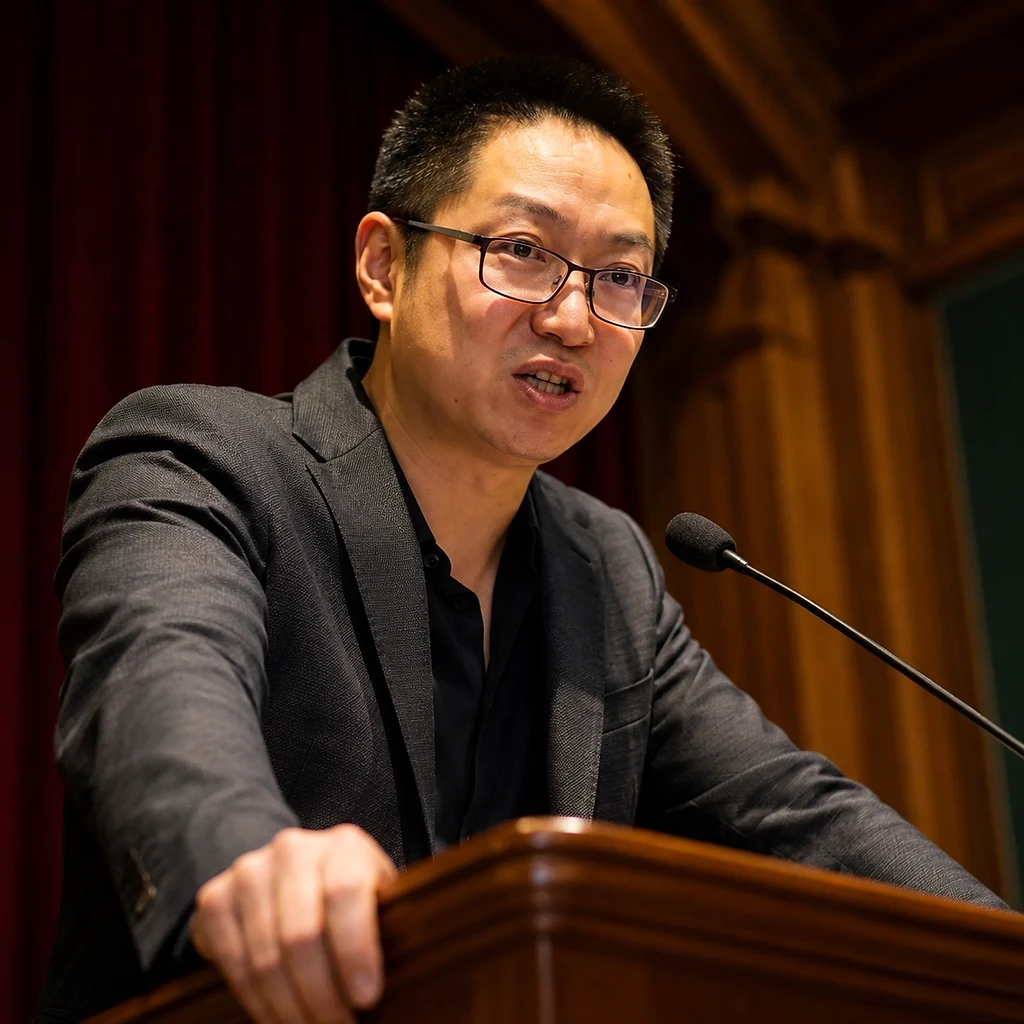
张小龙在人大开骂——粉笔 CEO 的失态与道歉
Fenbi CEO Apologizes After RUC Outburst
About this story
A close look at the Fenbi CEO Zhang Xiaolong incident: the topic switch, the stock-trading advice, the multi-minute profanity, the four ways the story is ironic, and Fenbi's 67% stock drop heading into the controversy. HSK 4 Chinese listening practice.
This is an HSK 4 Chinese listening episode that runs about 8 minutes. The full Mandarin script is shown with tap-for-pinyin and a line-by-line English translation, so you can listen and read at once — comprehensible input in the sense of Stephen Krashen's i+1 theory. It teaches 12 key vocabulary words such as 比如、道歉、选择 and walks through 6 grammar patterns, each explained in English with examples. The same news story is retold at 4 difficulty levels — use the level selector above to find the version that is challenging but still understandable for you.
Read at your level
原文Read the complete story in Chinese. Reveal pinyin and English only when you need them.
English transcript reference
There's a news story recently.
The whole internet is talking about it.
The night of June 3.
At Renmin University of China in Beijing.
A company CEO had gone to give a lecture.
But on stage, he started cursing.
He cursed the students in the room.
He cursed for several minutes.
Then slammed the door and left.
This CEO is named Zhang Xiaolong.
His company is called "Fenbi Technology."
It's China's most famous civil-service-exam prep company.
"Gongkao peixun" (civil service exam training) means teaching students how to take the civil service exam.
Today let's talk about this.
First, a bit of background.
You might wonder: why is this news trending?
Isn't it just a CEO saying the wrong thing?
There are actually several layers behind it.
The first layer.
You might not realize how hot the civil service exam is in China.
Every year, the number of people signing up for the national civil service exam.
Is in the millions.
But only tens of thousands actually pass.
The ratio is extremely low.
For some positions, thousands compete for one spot.
So students need to specifically study, specifically practice.
The civil-service-prep industry is what teaches this.
Fenbi is the biggest player in this industry.
They make apps, they make video courses.
Cheap, convenient.
So many college students use Fenbi.
The company listed on the Hong Kong stock exchange in 2023.
Zhang Xiaolong is the founder and CEO of Fenbi.
He's in his forties.
What's interesting is, he himself studied philosophy in college.
His master's degree at Sun Yat-sen University was also in philosophy.
His high school teacher at the time told him:
If you study philosophy, you won't easily find a job.
But he studied it anyway.
While in grad school.
He worked part-time as a teacher at a civil-service-prep institution.
He taught well, and was popular.
Students all liked him.
Later he gave up on his PhD.
He ran to Beijing to start a business.
In 2013 he started building Fenbi.
Step by step, he built it to today's scale.
Now let's get to June 3.
He went to give a lecture at Renmin University.
The venue for the lecture was the philosophy school.
The lecture's original topic was the civil-service-prep industry.
But just before the lecture started, he changed the topic on short notice.
The new topic was: "Career planning in the AI era."
Meaning: AI is here, how should young people find jobs.
The lecture began.
He first shared some of his own views.
He said the best job in the future is trading stocks.
Best to trade tech stocks.
Even better, trade US stocks.
"And best of all, get the whole family to trade stocks together."
Those were his exact words.
The students listened and had no reaction.
No one laughed, no one asked questions.
They just listened quietly.
This reaction made Zhang Xiaolong unhappy.
He'd probably expected the students to applaud.
Or at least laugh.
But they didn't.
He got more and more agitated on the stage.
Finally he started cursing.
He cursed continuously for several minutes.
The key sentences were these.
He said:
"You have no awareness of the changes new things bring to society."
"You are utterly oblivious."
"So it's only right that you can't find jobs."
He also said:
"Other than getting into the system."
"Working as civil servants, eating and waiting to die."
"You have no abilities at all."
"Hun chi deng si" — "eating and waiting to die" —
You need to pay special attention to those four characters.
It means: a person does nothing.
Just eats their way along.
Waits for death.
It's a very heavy thing to say.
You're standing on a university stage.
Cursing the college students in front of you like this.
And the students you're cursing are philosophy students.
It's a very unusual thing to happen.
The students were shocked at the time.
Some started secretly recording videos.
Zhang Xiaolong finished cursing and left without finishing the lecture.
That night, the videos and audio recordings went online.
All of China was watching.
The comment sections exploded.
What were people saying?
The most common line was:
"Pick up the bowl to eat, put down the bowl to curse mom."
It means: eating someone's food, then cursing the person who cooked it.
Zhang Xiaolong's company makes civil-service-exam prep.
Students buy his courses because they want to take the civil service exam.
The money he earns is the money of these students who want to take the civil service exam.
Then he stands on a stage and curses civil servants as "eating and waiting to die."
This is "pick up the bowl to eat, put down the bowl to curse mom."
There's another even more coincidental thing.
That Renmin University lecture was for the philosophy school.
He himself studied philosophy in college.
His high school teacher at the time said:
"Studying philosophy won't help you find a job."
On the philosophy school's stage, he said to the philosophy students:
"It's only right that you can't find jobs."
What he was cursing was himself from a decade ago.
On the morning of June 4, Fenbi issued an apology letter.
Zhang Xiaolong wrote in the letter:
"The responsibility for this incident is entirely mine."
"I deeply reflect."
"For the negative impact on Renmin University and the philosophy school, I deeply apologize."
"I am willing to take on corresponding responsibility."
The apology was issued.
But the response online wasn't buying it.
Some said: this was written by PR, not from the heart.
Some said: when you were cursing people, no one forced you.
Some said: you're willing to take on "corresponding responsibility" — what responsibility?
Resigning?
Refunding money?
Compensation?
There's still no answer.
And there's something else making things harder for Fenbi.
The company's stock has been falling lately.
From the end of 2025 to now, it's dropped 67%.
On June 3, the stock was at 0.67 Hong Kong dollars.
A big drop from the IPO price.
Will this incident make the stock fall further?
No one knows.
But the company's image has already taken a serious hit.
When I heard this news myself, I had several feelings.
The first is feeling that he's too unprofessional.
You, as a CEO of a publicly listed company.
Standing on a university stage cursing.
This kind of thing shouldn't happen.
Regardless of how the students reacted.
You should control yourself.
Emotional management is a basic skill.
Zhang Xiaolong failed at this.
And he failed very visibly.
The audience didn't applaud, so he started cursing.
That's an extremely fragile reaction.
The second feeling is more complex.
It's that: the phenomenon he was cursing is real.
There really are a lot of young people.
Who treat civil service as the only path.
There really are a lot of people.
Who have no interest in other jobs.
Who only want to get into the system.
Behind this is anxiety.
Fear about the future.
Zhang Xiaolong sees this phenomenon and gets angry.
But his way of being angry is to curse these young people.
Not to ask: why do people choose this?
Actually the problem isn't with the students.
The problem is with this era.
Private companies are unstable.
The economy isn't great.
Working as a civil servant, at least you won't get laid off.
That's the reality students see.
Finally, I want to ask you a question.
The young people around you.
How do they see the future?
Do they feel there are many choices?
Or do they feel there are only one or two paths?
If only one or two, why?
Is it that there really aren't other paths?
Or that other paths look too hard?
What about you?
What's your biggest anxiety these past few years?
Think about it slowly.
Listen again
Try it without the transcript and notice what sounds clearer.
What vocabulary does this episode teach?
词汇HSK 2 connector. Often appears as 比如说 (for example, ...). Used to introduce specific examples.
HSK 3. 公开道歉 = publicly apologize.
HSK 3. Both noun and verb. 别的选择 = other choices.
HSK 3. 负面影响 = negative impact.
HSK 3 noun/verb. 一个新鲜事物给社会带来的改变 = the changes a new thing brings to society.
HSK 3 noun. Implied throughout the discussion of the CEO–customer relationship.
Beyond HSK 1-3. China's largest civil-service-exam prep platform.
Beyond HSK 1-3. 公考 = civil service exam (shortened); 培训 = training. The whole industry Fenbi runs in.
Beyond HSK 1-3. 2023 年在香港上市 = listed in Hong Kong in 2023.
Beyond HSK 1-3. 爆 (burst) + 粗口 (rough words / profanity). 他在讲台上爆粗口 = he started cursing on the podium.
Beyond HSK 1-3. 炒 (stir-fry, but here 'churn') + 股 (stock). What Zhang Xiaolong told students to do.
Beyond HSK 1-3. 一代人的焦虑 = a generation's anxiety. Central concept in the episode's second-layer analysis.
* beyond level超纲词
What grammar patterns appear in this episode?
语法Subject + 让 + Object + Verb
让 = 'to let / cause / make'. Marks causation.
这个反应让张小龙觉得不爽。
这次事件,会不会让股价跌得更厉害?
AI 来了,年轻人怎么找工作。
不是... + 是...
Correction structure: 'it's not X, it's Y'. Used to redirect or clarify.
这不是道德问题。是事实问题。
不是因为他们懒。
其实问题不在学生身上。问题在这个时代。
Verb + 起来 / 起
Verb + 起来 can mark the beginning of an action or introduce a topical sense.
评论区炸了。
他开始爆粗口。
学生当时就被吓到了。
对... + 来说
Topicalizer: 'as for... / from the perspective of...'.
对中国人民大学和哲学院造成的负面影响,我深深致歉。
对学生来说,这是一次伤害。
Subject + 越... + 越...
越 X 越 Y = 'the more X, the more Y'. Implicit progression.
他在讲台上越说越激动。
做生意越来越难。
是不是 + Clause
Used to pose a reflective question about a possibility.
是不是因为别的工作太累、太不稳定?
是不是因为这一代年轻人,对未来感到害怕?
Proper nouns
专有名词Free account
Keep learning from this story
Create a free account to keep saved words and your preferred level together.
- Keep words with their story context
- Remember your preferred level
- Build your vocabulary over time