
A Chinese podcast · Same story, 4 levels
拼豆为什么让所有人上头:一颗塑料珠子背后的中国年轻人
Pindou Pixel Beads Hit 37B Xiaohongshu Views
About this story
China's pindou pixel bead craft explodes to 37B Xiaohongshu views and a projected 1B-yuan market for young adults in 2026. HSK 5-6 Chinese listening practice.
This is an HSK 5-6 Chinese listening episode that runs about 7 minutes. The full Mandarin script is shown with tap-for-pinyin and a line-by-line English translation, so you can listen and read at once — comprehensible input in the sense of Stephen Krashen's i+1 theory. It teaches 20 key vocabulary words such as 现象、刷屏、体量 and walks through 8 grammar patterns, each explained in English with examples. The same news story is retold at 4 difficulty levels — use the level selector above to find the version that is challenging but still understandable for you.
Read at your level
原文Read the complete story in Chinese. Reveal pinyin and English only when you need them.
English transcript reference
Today we're talking about a phenomenon that looks small but has been flooding Chinese young people's social feeds — pindou.
Yes, it's those small plastic beads you played with in elementary school art class.
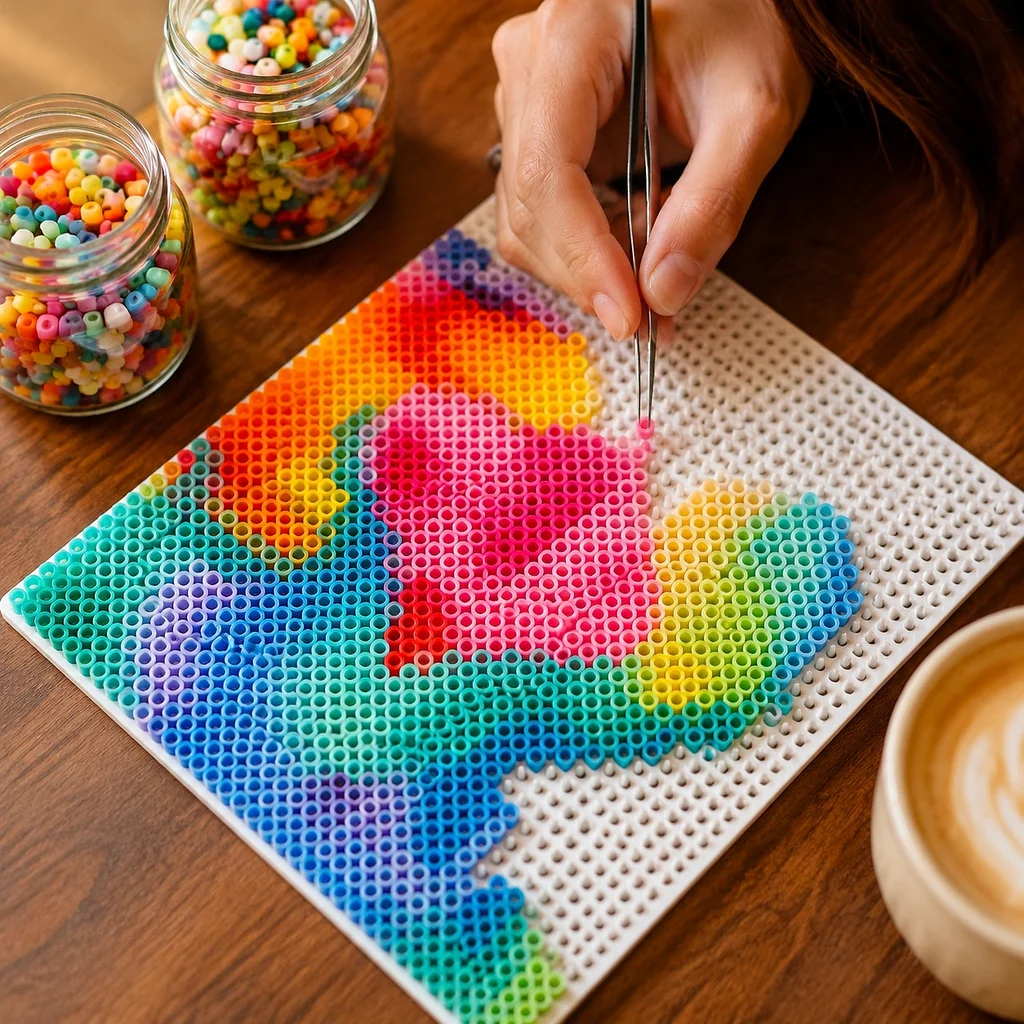
You probably remember it like this — a box of multicolored small pellets, plus a plastic board with holes, and an iron at the end to fuse the beads into a single picture.
Right, it's that thing.
But trust me — pindou in 2026 is not the pindou of your childhood.
Let me give you a few numbers first, and you'll grasp the scale of this.
On Xiaohongshu, the topic "I'm hooked on pindou" has surpassed 37 billion views, with over five million related posts.
On Douyin, total views of pindou-related videos have surpassed 120 billion.
In 2025, pindou's e-commerce sales were nearly nine times the previous year — about a 900% year-on-year increase.
Some firms predict that in 2026, China's pindou market will reach 10 billion RMB.
In December 2025, Taobao listed pindou among its "Top Ten Annual Products," with a very direct rationale: it reflects this generation's mental state.
In plain language: this thing is no longer just a craft — it's an emotion.
So what is it, exactly?
The mechanics are very simple: a box of plastic beads in over a hundred colors, a board with honeycomb holes, plus a small iron.
You follow the picture in your head and place beads into the holes one by one.
When done, you put paper over it, press with the iron, and the beads fuse together into one solid piece.
At the end you get a keychain, a brooch, a fridge magnet, or a small figure to hang on your bag.
The point is: every single bead was chosen by you.
So why is it hot now?
Why this group of young people?
I think there are at least four reasons.
First, it hits the massive "decompression" need.
Today's young people process several times more information per day than ten years ago — work groups, family groups, client messages, push notifications, nonstop from morning to night.
The brain isn't a brain anymore — it's a browser stuffed full of notifications.
What's special about pindou is: it pulls your attention back to one very small, very specific thing — next bead, red or yellow?
Top-left or top-right?
This kind of "controllable micro-decision" is exactly the antidote to the mess inside your head.
Many people, after two hours, say: my brain feels rinsed clean.
Art researchers have even given it an academic frame — "modern Zen practice."
Meaning: the ancients sat and chanted; today's people place beads and iron beads. Different forms, but both are ways of resettling the self.
Second, it hits the "smallest unit of achievement."
What do today's young people lack the most?
Not money, not housing — it's the steady feeling of "I finished one thing today."
Anyone who works gets it: eight hours of work, five meetings, three PPTs, but at home in bed at night, looking back, not one thing actually got "finished."
Pindou's advantage is: it has a very clear beginning and end.
About two hours, and you have a complete, beautiful, hand-touchable little object.
For the brain, that's a long-missed feeling of "solid ground."
Third, it's a match made in heaven with Xiaohongshu.
Pindou is a super "photogenic" activity — overhead shot of a table of colorful beads, a little light, and you've got a built-in high-saturation filter.
The finished pieces also have built-in "anime sweetness" — Labubu, a TV-drama couple's portrait, an internet-meme face, all of it can be made into pindou.
This kind of content is born for Xiaohongshu and Douyin — beautiful in photos, beautiful in process, beautiful when given to a friend.
The reason "I'm hooked on pindou" reached over a hundred billion views is precisely that it's a natural visual content product.
Fourth, celebrities and IP gave it the final push.
At the end of 2024, in the drama Yongye Xinghe, male lead Ding Yuxi made a pindou brooch for the female lead.
The clip exploded online, and countless fans rushed to craft stores asking, "How do I make the Ding Yuxi version?"
In that moment, pindou went overnight from "children's toy" to "young people's romantic token."
After that, Pop Mart's Labubu, various anime characters, and idol merch all migrated onto pindou boards.
Pindou took on the flavor of "fan-support culture" and "gift culture."
The brick-and-mortar stores changed too.
Today's pindou shops feel more like a hybrid of café and workshop — soft lighting, big tables, walls covered with samples.
The "all-day" service is about 80–90 yuan: you sit a whole day, drinks free, beads and boards free.
Some take time off work to come; others come straight from work; some come for a full week to make a complete gift set.
Owners call these customers "resident regulars."
There's also an underestimated fact behind it — pindou is actually a very "low-cost" hobby.
Not as exhausting as running, not as expensive as skiing, not as demanding of inspiration as writing.
80 to 90 yuan, two hours, and a real thing lands.
For a young person hollowed out by work and life, this is an extremely high-value-for-money "small certain happiness."
Of course, every coin has two sides — pindou's heat is starting to face some pushback too.
Some say: as more pindou shops open, teaching quality is uneven, and many beginner pieces aren't actually durable.
Some say: are young people obsessed with "small crafts" because they're avoiding bigger life questions?
Others worry: like Labubu and the anime-merch economy, this trend may pass in two or three years.
Once the next wave of emotional economy comes along, pindou shops may end up like the milk-tea shops and murder-mystery shops of years past — half of them closed.
These criticisms have a point.
But even so, the underlying current behind pindou is impossible to fake.
It shows that today's young people genuinely need something that isn't measured by KPIs, doesn't require grinding, and produces a result when finished.
They aren't unwilling to "win" — they just want, before winning, to be quiet for a moment.
So next time you see a pindou shop on the street, with a few young people inside, heads down picking beads — don't think them childish.
That isn't playing with toys — it's this generation, using one tiny plastic bead at a time, putting back together a day that life had broken apart.
Maybe one day when your mind is a mess, you can also walk into a pindou store, order a milk tea, sit down, and start placing beads.
You'll probably find: turns out, quiet really can be a very concrete thing — right under your fingertips.
Red, yellow, blue, green — one bead at a time.
This is pindou — and it's also the most loved thing of this generation in the past six months: very small, but also very important.
Listen again
Try it without the transcript and notice what sounds clearer.
What vocabulary does this episode teach?
词汇HSK 5. 一个现象 = a phenomenon. Used here to frame pindou's rise as a social trend.
HSK 6+ (internet slang). 刷 (sweep) + 屏 (screen). 在年轻人中刷屏 = flooding young people's social feeds.
HSK 6. 体 (body) + 量 (volume). 这件事的体量 = the scale of this matter.
HSK 5. 情绪经济 = emotion economy. The episode argues pindou is an 情绪 product.
HSK 6. 折 (bend) + 射 (shoot). 它折射的是 ... = what it reflects is ... Used in editorial register.
HSK 5. 一种踏实感 = a sense of being grounded. The emotional payoff of completing a small task.
HSK 5. 性价比极高 = extremely high value. Standard Chinese consumer slang.
Modern slang. Originally 'roll/curl,' now means destructive overwork. 不需要卷 = no need to grind.
HSK 6+. 绩 (achievement) + 效 (effect). 不被绩效衡量 = not measured by KPIs. Corporate jargon.
Beyond. Originally a Korean fan-culture loanword. 应援文化 = fan-support culture.
HSK 6. 熔在一起 = fuse together. The defining physical action of pindou.
Beyond. 蜂 (bee) + 巢 (nest). Used to describe the pegboard's hexagonal hole pattern.
Specialist (UX/psychology). 微 (micro) + 决策 (decision). What pindou offers — small controllable choices.
HSK 6+. 现代禅修 = modern meditation. The episode's analytical frame for pindou.
Internet slang. 出 (produce) + 片 (photo). 超级出片 = extremely photogenic.
Specialist (photo/design). 饱和 (saturated) + 度 (degree). Pindou photos have built-in 高饱和度.
HSK 6+. 信 (faith) + 物 (object). 浪漫信物 = romantic token. The pindou brooch became this overnight.
Modern slang coined for these stores. 驻店 (stationed at the store) + 选手 (player). Affectionate term for super-frequent customers.
Modern slang from Japanese (小確幸). The kind of small, reliable joy pindou provides.
Internet slang. 谷子 transliterates 'goods' (anime/IP merchandise). One of pindou's adjacent economies.
* beyond level超纲词
What grammar patterns appear in this episode?
语法Corrective structure. 'Not X, but rather Y.' Heavy in argumentative prose.
脑子已经不是脑子了,是一个被各种通知撑满的浏览器。
他们不是不想'赢'——他们只是想,在赢之前,先安静一下。
那不是在玩玩具——那是这一代人,在用一颗一颗的塑料珠子,拼回他们自己被生活打散的一天。
X 把 + Object + Verb + Result
Disposal construction with explicit result. Used heavily for HYROX/pindou's 'package' framing.
把珠子一颗一颗放进洞里。
拼豆从'小孩玩具',一夜之间被推到了'年轻人浪漫信物'的位置。
拼回他们自己被生活打散的一天。
Formal causal structure: 'the reason X is Y is because Z.'
'我染上了拼豆'这个话题之所以能涨到上百亿浏览量,靠的就是它在视觉上是天然的内容产品。
Topicalizer: 'For X / from X's perspective.'
对一个被工作和生活掏空的年轻人来说,这是性价比极高的'小确幸'。
对大脑来说,那是一种久违的'踏实'。
Idiomatic transition: 'every coin has two sides.' Used to introduce counter-arguments.
当然,凡事都有两面,拼豆这股热也已经开始受到一些质疑。
Modern marketing idiom: 'hits the spot of Y.' 戳 (poke) and 打 (hit) emphasize precision targeting.
它戳中了'解压'这个超大需求。
它打中了'成就感的最小单位'。
Proper nouns
专有名词Free account
Keep learning from this story
Create a free account to keep saved words and your preferred level together.
- Keep words with their story context
- Remember your preferred level
- Build your vocabulary over time