
A Chinese podcast · Same story, 4 levels
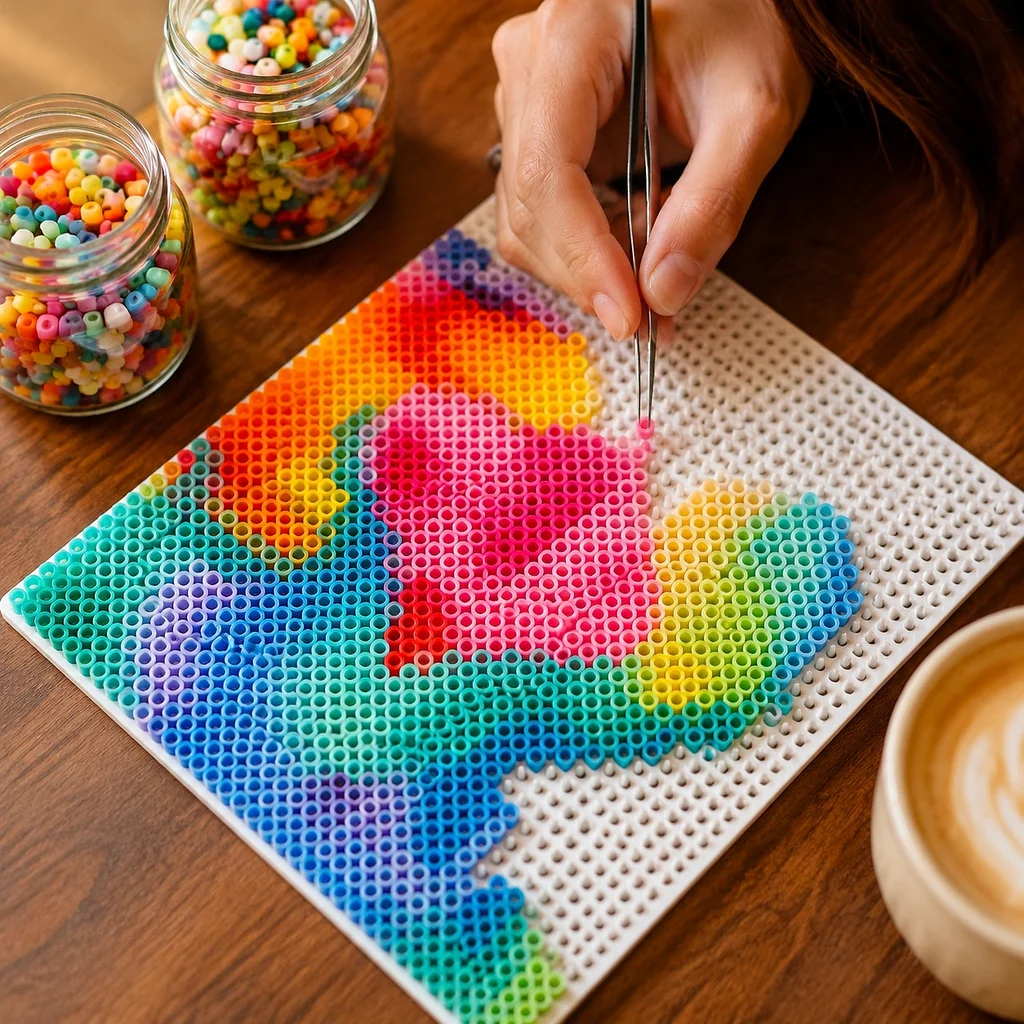
一种用珠子做的小玩具,最近年轻人都在玩
Pindou Pixel Beads Hit 37B Xiaohongshu Views
About this story
Pindou pixel beads — the colorful craft young Chinese adults are doing in Beijing shops and posting on Xiaohongshu. HSK 2 Chinese listening practice.
This is an HSK 2 Chinese listening episode that runs about 6 minutes. The full Mandarin script is shown with tap-for-pinyin and a line-by-line English translation, so you can listen and read at once — comprehensible input in the sense of Stephen Krashen's i+1 theory. It teaches 18 key vocabulary words such as 玩具、颜色、图 and walks through 7 grammar patterns, each explained in English with examples. The same news story is retold at 4 difficulty levels — use the level selector above to find the version that is challenging but still understandable for you.
Read at your level
原文Read the complete story in Chinese. Reveal pinyin and English only when you need them.
English transcript reference
Recently in China there's a small toy that's gone very viral.
Its name is pindou.
What is pindou?
Let me tell you first.
Pindou — basically a bunch of very small plastic beads.
The beads are round.
With a hole in the middle.
There are tons of colors.
Red, yellow, blue, green, and many more.
You take these beads
and place them on a board with small holes.
One hole, one bead.
Whatever color you want, you place that color.
You place them slowly, slowly.
Finally, a picture appears on the board.
It could be a cat.
It could be a flower.
It could also be your favorite cartoon character.
Anything is fine.
After it's done, what next?
You take an iron.
The iron is hot.
You put the iron on top of the beads.
The beads become soft.
Then become hard.
All the beads stick together.
And it becomes one piece.
You can take it away.
You can hang it on a backpack.
Or put it on a desk.
Or give it to a friend.
Pindou was originally for children.
A type of children's toy.
But over the past year,
young people in China have started doing it too.
Not just college students.
Also office workers.
They sit in pindou stores
and make things for an hour or two.
Some people make for a whole day.
They take it very seriously.
Why do young people love it so much?
I think there are three reasons.
The first reason is that it's pretty.
The bead colors are many.
Just looking at them makes you happy.
There's red, yellow, pink, blue, purple.
The colors arranged together look especially good.
You take a photo and post it on Xiaohongshu.
Friends will look and say: wow, so pretty.
The second reason is that it's relaxing.
Today's young people have a lot of stress.
Lots of work.
Lots of things going on.
Their brains are thinking about stuff every day.
But while making pindou,
you only think one thing:
where to put the next bead.
Your brain can rest.
Your heart is very quiet.
So many people say:
pindou helps you "decompress."
"Decompress" means to set down the stress.
The third reason is the sense of achievement.
You make for two hours,
and at the end you have something.
A real thing.
You can touch it.
You can take photos.
You can give it to a friend.
That friend, when they receive it, will be very happy.
They'll say: did you make this?
You'll say: yes, I made it.
And your heart is also happy.
Now some numbers.
This past year,
pindou stores in China have grown more and more.
Many big cities have them.
There's a store in Beijing
that sold twenty-five thousand sets in a year.
In 2025,
pindou online sales
were over eight times the previous year.
That's a lot.
On Xiaohongshu there's a hashtag
called "I'm hooked on pindou."
"Hooked" means: started loving it, can't stop.
This hashtag's view count
is over thirty billion.
That is to say,
hundreds of millions of people have seen it.
And found it interesting.
There's also one thing, quite interesting.
At the end of 2024,
there was a TV drama called Yongye Xinghe.
It had a male lead actor
called Ding Yuxi.
In the show,
he made a pindou brooch.
And gave it to the female lead.
Many people saw it and thought it was great.
They all rushed to ask: how do you make the "Ding Yuxi version"?
So from that point on,
pindou got even hotter.
So this thing pindou —
in the beginning it was a children's toy.
But now,
many adults are doing it.
They do it not because they're childish.
But because:
while making it, it's quiet.
After finishing, there's a real sense of achievement.
And you can take photos,
and give it to friends.
Pindou isn't expensive.
A session is about eighty or ninety yuan.
Not a lot of time, not a lot of money.
So it's very fitting.
Finally, a closing thought.
If you've been stressed lately,
and want to do something small,
you can try pindou.
Find a store,
sit down,
slowly place beads.
You'll find:
oh, so this is what quiet feels like.
"Doing one small thing"
can also make a day really good.
That's today's story.
Pindou is small.
But it's very popular now.
Maybe it tells us:
today's people
don't only want to eat well and play big.
They also want: a moment of quiet.
To make something small.
And feel a little better inside.
Listen again
Try it without the transcript and notice what sounds clearer.
What vocabulary does this episode teach?
词汇HSK 4. 玩 (play) + 具 (tool/instrument). 儿童玩具 = children's toy. The episode argues pindou used to be one.
HSK 2. 颜色非常多 = many colors. Pindou's defining feature.
HSK 4. 一个图 = one picture. What you arrange the beads into.
HSK 3. 送给朋友 = give to a friend. Repeated word — pindou as a gift.
HSK 5. 卡通人物 = cartoon character. Pindou patterns are often 卡通 characters.
HSK 4. 工作压力大 = a lot of work stress. The reason adults seek pindou.
HSK 4. 让你放松 = makes you relax. The episode's central feeling.
HSK 5. 成就 (achievement) + 感 (feeling). Why people feel good after finishing one.
HSK 2. 拼豆店 = pindou store. Where adults go to make pindou.
HSK 1. 不贵 = not expensive. The episode emphasizes pindou is cheap.
Beyond. 拼 (assemble) + 豆 (bean). The whole episode is about it.
HSK 5. 塑料珠子 = plastic beads. The material of pindou.
Beyond. The tool used to fuse beads — the magic step.
HSK 5. 解 (resolve) + 压 (pressure). Glossed inline as 把压力放下. The keyword of pindou's appeal.
HSK 5. 一个话题 = a topic / a trending hashtag on social media.
HSK 5+. 浏览 (browse) + 量 (amount). 浏览量 is the standard metric on Chinese social platforms.
HSK 6. 胸 (chest) + 针 (pin). 拼豆胸针 = pindou brooch. The viral object 丁禹兮 made.
Internet slang. 同 (same) + 款 (style/model). 丁禹兮同款 = 'the Ding Yuxi version' — copying a celebrity's item.
* beyond level超纲词
What grammar patterns appear in this episode?
语法X 是 ...,Y 是 ...
Listing structure: 'X is A, Y is B.' Used to lay out parallel reasons.
第一个原因,是漂亮。
第二个原因,是放松。
第三个原因,是有成就感。
X 就是 Y (definition)
Defines a new word inline using simpler words. Used heavily for 解压, 染上, etc.
"染上"的意思就是:开始喜欢,停不下来。
"解压"就是把压力放下。
拼豆,就是很多很小的塑料珠子。
把 + Object + Verb + Result
Disposal construction. Frontloads the object so the verb can carry a result.
你拿这些珠子,放在一个有小洞的板子上。
你把熨斗放在珠子上面。
把它放在书包上。
X 不只是 ... 也是 ...
'Not only X but also Y.' Adds a parallel point.
做拼豆,不只是手工。
今天的人,不只是想吃好的,玩大的。
比 + Number + 多 + Number
Comparison with explicit difference. The amount comes after the adjective.
比前一年多了八倍多。
也就是说,有几亿个人都看过。
因为 ... 所以 ...
Cause-effect connector. Either half can be omitted.
所以从那时开始,拼豆就更火了。
所以非常合适。
对 X 来说
Topicalizer: 'For X / from X's view.'
对脑子来说,这种感觉特别舒服。
对很多人来说,这是一种新的成就。
Proper nouns
专有名词Free account
Keep learning from this story
Create a free account to keep saved words and your preferred level together.
- Keep words with their story context
- Remember your preferred level
- Build your vocabulary over time