
A Chinese podcast · Same story, 4 levels
AI只是一个很好的计算器
Luc Julia Questions Whether AI Really Thinks
About this story
French author Luc Julia argues AI isn't smart — it's just a powerful calculator, and the smart-machine idea is illusion. HSK 2 Chinese listening practice.
This is an HSK 2 Chinese listening episode that runs about 3 minutes. The full Mandarin script is shown with tap-for-pinyin and a line-by-line English translation, so you can listen and read at once — comprehensible input in the sense of Stephen Krashen's i+1 theory. It teaches 15 key vocabulary words such as 聪明、电影、事情 and walks through 6 grammar patterns, each explained in English with examples. The same news story is retold at 4 difficulty levels — use the level selector above to find the version that is challenging but still understandable for you.
Read at your level
原文Read the complete story in Chinese. Reveal pinyin and English only when you need them.
English transcript reference
Today we are going to talk about artificial intelligence.
Many people think artificial intelligence is very smart.
But is it really smart?
There is a French person named Luc.
He wrote a book.
This book is very interesting.
The book is called "The Illusion of Artificial Intelligence."
He says artificial intelligence is not really smart.
It is just a very good calculator.
A calculator can do math.
It does math very fast and very well.
But a calculator cannot think about things.
Artificial intelligence is the same way.
It can do many things.
For example, write articles.
For example, draw pictures.
For example, answer questions.
But it is not thinking.
It is calculating.
These two things are different.
We humans can think about things.
We can feel happy and feel sad.
We can love a person.
But artificial intelligence cannot.
It has no feelings.
The term "artificial intelligence" is very old.
It was created in 1956.
It has been seventy years until now.
Many people heard this term.
They think machines have intelligence.
But this idea is wrong.
Although artificial intelligence is very powerful, it is not smart.
Because it can only do one thing, it is not like a person.
For example, an AI can play chess.
It plays chess better than people.
But if you ask it what the weather is like today.
It does not know.
If you ask it to go buy things.
It cannot do that either.
It can only do one thing.
People are different.
People can learn anything.
People can learn to cook.
They can also learn to drive.
They can also learn to speak a new language.
Artificial intelligence cannot do that.
Why do we think it is smart?
Because we have watched too many movies.
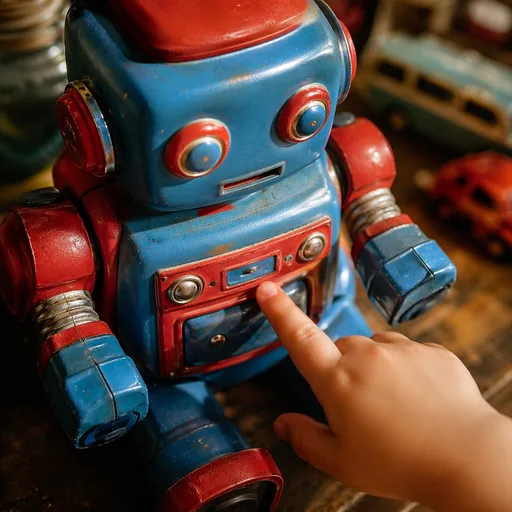
The robots in movies can talk.
They can think about things and have feelings.
But that is just movies.
It is not real.
Real artificial intelligence is very different.
We like to think of machines as people.
Sometimes my phone is very slow.
I will say it is "tired."
But a phone does not get tired.
It is a machine.
Artificial intelligence is also a machine.
Although it is very useful, it is not thinking.
So we should not be too afraid of it.
And we should not trust it too much.
That book is right.
Artificial intelligence is just a tool.
It is made by people.
It helps people do things.
But it is not a person.
This March, a very famous magazine talked about this.
That magazine is called Nature.
Because many people do not understand AI, they trust it too much.
Although AI is very useful, we need to know its problems.
It is just a very good tool, not real intelligence.
Listen again
Try it without the transcript and notice what sounds clearer.
What vocabulary does this episode teach?
词汇A common adjective used to describe someone (or something) intelligent. HSK 2 word.
HSK 2 word. The episode says we think AI is smart because of movies (电影).
HSK 2 word. Used many times: 想事情 (think about things), 做事情 (do things).
HSK 1-2. interesting.
HSK 1-2. why.
HSK 1-2. problem / question.
HSK 1-2. meaning / interest.
HSK 1-2. mobile phone.
人工 means 'man-made' and 智能 means 'intelligence'. Together they form the Chinese term for AI.
计算 means 'to calculate' and 器 means 'device'. A key metaphor in this episode — AI is just a calculator.
错 means 'wrong' and 觉 means 'feeling/perception'. The book title uses this word: 人工智能的错觉.
The episode's main point: AI is just a tool (工具), not a thinking being.
Used throughout the episode. 机器人 (jī qì rén) means 'robot' — literally 'machine person'.
The episode says AI has no 感觉 — no feelings. Can be a noun or verb.
A very common word meaning 'awesome' or 'formidable'. Used here: 虽然人工智能很厉害.
* beyond level超纲词
What grammar patterns appear in this episode?
语法虽然...但是... (suīrán...dànshì...)
Means 'although...but...' Used to express contrast or concession. In Chinese, unlike English, you use BOTH 'although' and 'but' together.
虽然人工智能很厉害,但是它不聪明。(Although AI is impressive, it's not smart.)
虽然它很有用,但是它没有在想。(Although it's useful, it's not thinking.)
虽然人工智能很好用,但是我们要知道它的问题。(Although AI is useful, we need to know its problems.)
因为...所以... (yīnwèi...suǒyǐ...)
Means 'because...therefore...' States a reason and its result. Both parts are used together in Chinese.
因为它只会做一件事情,所以它不像人。(Because it can only do one thing, it's not like a person.)
因为很多人不了解人工智能,所以他们太相信它了。(Because many people don't understand AI, they trust it too much.)
因为我们看了太多电影了。(Because we've watched too many movies.)
比如 (bǐrú)
Means 'for example'. Used to introduce examples in a list or explanation. Very common in spoken Chinese.
比如写文章。(For example, writing articles.)
比如画画。(For example, drawing.)
比如一个人工智能会下棋。(For example, an AI can play chess.)
把...想成... (bǎ...xiǎng chéng...)
The 把 construction is used to indicate doing something to an object. Here 把X想成Y means 'to think of X as Y'.
我们喜欢把机器想成人。(We like to think of machines as people.)
不要太... (bú yào tài...)
Means 'don't be too...' or 'don't...too much'. A gentle warning or advice pattern.
我们不要太怕它。(We shouldn't be too afraid of it.)
也不要太相信它。(And don't trust it too much.)
会 (huì) for ability and possibility
会 can mean 'can/able to' (learned ability) or 'will' (future). In this episode it's used heavily to contrast what humans can do vs. what AI cannot.
我们人会想事情。(We humans can think about things.)
我们会高兴,会难过。(We can feel happy, can feel sad.)
但是人工智能不会。(But AI cannot.)
Proper nouns
专有名词Free account
Keep learning from this story
Create a free account to keep saved words and your preferred level together.
- Keep words with their story context
- Remember your preferred level
- Build your vocabulary over time