
A Chinese podcast · Same story, 4 levels
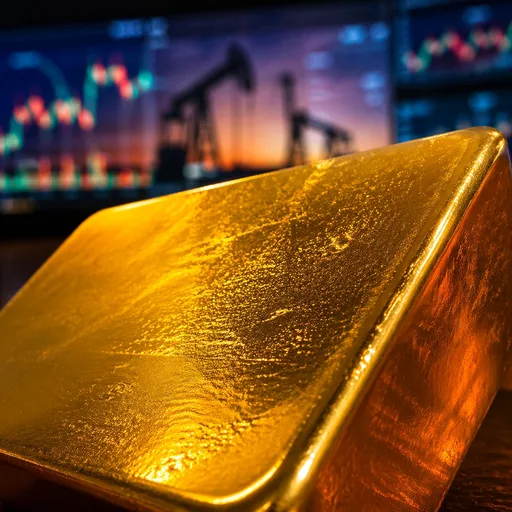
黄金企稳:交易员权衡通胀风险与石油供应冲击
Gold Steadies Amid Oil Shock and Fed Debate
About this story
Gold holds steady as traders weigh CPI inflation, the Fed's FOMC path, and a Brent crude supply shock from the Mideast. HSK 5-6 Chinese listening practice.
This is an HSK 5-6 Chinese listening episode that runs about 8 minutes. The full Mandarin script is shown with tap-for-pinyin and a line-by-line English translation, so you can listen and read at once — comprehensible input in the sense of Stephen Krashen's i+1 theory. It teaches 14 key vocabulary words such as 百分之、经济、政治 and walks through 6 grammar patterns, each explained in English with examples. The same news story is retold at 4 difficulty levels — use the level selector above to find the version that is challenging but still understandable for you.
Read at your level
原文Read the complete story in Chinese. Reveal pinyin and English only when you need them.
English transcript reference
Today we're going to dive deep into the complex logic behind gold price stabilization, and how inflation risks and oil supply shocks intertwine to influence the direction of global financial markets.
Recently, international gold prices have gradually stabilized after a round of dramatic fluctuations, with per-ounce prices oscillating in a narrow range near key psychological levels.
This surface calm actually masks deep-seated battles within the market.
The tug-of-war between bulls and bears has never ceased — traders are carefully weighing two diametrically opposed forces: on one hand, persistently high inflationary pressure, and on the other, expectations that the Federal Reserve might adjust monetary policy.
From the inflation perspective, the latest Consumer Price Index data remains stubbornly elevated.
Although core inflation has pulled back somewhat from its peak, it remains a considerable distance from the Fed's two percent target.
Food prices continue to climb, housing costs remain elevated, and services inflation is particularly sticky.
Each of these data points reminds market participants that the inflation beast is far from fully tamed.
In such a macroeconomic environment, gold's appeal as a traditional anti-inflation asset and safe haven is self-evident.
Historical experience has repeatedly shown that whenever real interest rates decline and currency purchasing power is eroded, gold tends to fulfill its function of preserving and growing value.
However, things are far from that simple.
The Federal Reserve's policy stance constitutes another key thread influencing gold prices.
Minutes from the Federal Open Market Committee's most recent meeting reveal that policymakers are clearly divided on whether to maintain the high interest rate environment.
Some officials lean toward maintaining a hawkish stance, arguing that premature rate cuts could trigger an inflation rebound and undo previous progress; others worry that excessive tightening could cause irreversible damage to the real economy, especially as signs of weakness have already appeared in manufacturing and real estate.
This policy uncertainty hangs over the market like the Sword of Damocles, leaving traders paralyzed with indecision.
Meanwhile, news from the oil market is adding fuel to an already complicated situation.
Recent geopolitical tensions in the Middle East have escalated sharply, with diplomatic maneuvering among major oil-producing nations intensifying.
Certain critical oil shipping routes face potential threats, and market concerns about supply disruptions have quickly heated up.
International crude oil futures prices surged in response, with Brent crude briefly breaking through the important ninety-dollar-per-barrel threshold.
The impact of oil supply shocks on financial markets is multi-dimensional and far-reaching.
First, rising oil prices directly drive up energy costs, which then transmit to transportation, manufacturing, and everyday consumption in all their aspects, creating so-called cost-push inflation.
This differs from demand-pull inflation — the latter at least accompanies economic expansion, while the former can push prices higher even as the economy slows, creating the dreaded stagflation scenario.
Stagflation is arguably the most intractable problem for monetary policymakers.
Raising rates can suppress inflation but further depresses already fragile economic growth; cutting rates can stimulate the economy but risks allowing inflation to continue spreading.
This damned-if-you-do, damned-if-you-don't dilemma is precisely the reality the Federal Reserve currently faces.
For the gold market, a stagflationary environment is often the most favorable.
Looking back at the two oil crises of the 1970s, gold prices experienced an epic surge during that period, soaring from thirty-five dollars per ounce all the way above eight hundred dollars.
Although today's market structure and monetary system are vastly different from half a century ago, history tends to rhyme.
Looking at futures market positioning data, changes in positions held by large speculators and commercial hedgers reveal intriguing signals.
The latest Commitments of Traders report from the U.S. Commodity Futures Trading Commission shows that managed fund net long positions in gold have increased in recent weeks, but the pace of growth has noticeably slowed.
This suggests that while institutional investors are generally optimistic about gold's medium-to-long-term prospects, they remain cautious about chasing prices higher in the short term.
At the same time, commercial hedgers' net short positions have also expanded, which is typically seen as producers actively locking in profits at current price levels.
The offsetting of these two forces neatly explains why gold prices have become stuck in a stalemate at elevated levels.
Technical analysis similarly confirms this bull-bear standoff.
On the gold daily chart, prices are trading above the 200-day moving average, keeping the medium-to-long-term uptrend intact.
However, on shorter timeframe charts, the Relative Strength Index has entered overbought territory, and the MACD indicator shows signs of bearish divergence, suggesting that short-term pullback pressure is building.
The Bollinger Band channel has narrowed significantly, and volatility has dropped to a recent low — this is often a precursor to a trend change, as the market is coiling up, waiting for a catalyst powerful enough to break the equilibrium.
This catalyst could come from multiple directions.
First are the upcoming U.S. non-farm payrolls and inflation data — these key economic indicators will directly influence market expectations about the Fed's next move.
If the labor market continues to show unexpected resilience while inflation data remains elevated, the prospect of "higher for longer" rates will weigh on gold prices.
Conversely, if the labor market shows clear signs of cooling and rate-cut expectations heat up, gold could see a new upward surge.
Second is the evolution of geopolitical risks.
If the Middle East situation deteriorates further and oil supplies suffer substantive disruptions, risk-aversion sentiment will drive massive capital flows into the gold market.
Additionally, the ongoing Russia-Ukraine conflict, intensifying strategic competition in the Asia-Pacific region, and the deepening global de-dollarization trend are all providing solid fundamental support for gold's long-term bull market.
Central banks around the world have been accumulating gold reserves at record pace in recent years — this is no coincidence, but rather a strategic move amid profound changes in the international monetary system.
From a broader perspective, the current stabilization in the gold market actually reflects the global economy standing at a critical crossroads.
The old growth model is no longer sustainable, and a new equilibrium has yet to be established.
The specter of inflation lingers, supply chain restructuring is far from complete, and geopolitical fragmentation is accelerating.
In such an era filled with uncertainty, gold — as the oldest store of value in human civilization — has a role that is not only not obsolete but increasingly prominent.
Traders in the current environment need to maintain a high degree of vigilance and flexibility.
Pure trend-following strategies can easily get whipsawed in this choppy market, while an overly conservative wait-and-see approach risks missing the starting point of a major move.
For ordinary investors, including gold as an important component of their portfolio to hedge against inflation risk and geopolitical uncertainty remains a strategy well worth serious consideration.
The key lies in position management and risk control — it's not about betting on a direction, but about being prepared for various scenarios.
Ultimately, every stabilization in gold prices is not an endpoint but the starting point of the next big move.
The trajectory of inflation, the supply-demand dynamics of the oil market, the Fed's policy path, and the reshaping of the global geopolitical landscape — these variables will continue to ferment in the coming months, collectively determining gold's next direction.
In the calm before the storm, truly smart traders won't be deceived by the surface tranquility — they're actively making thorough preparations for the volatility that's about to arrive.
Listen again
Try it without the transcript and notice what sounds clearer.
What vocabulary does this episode teach?
词汇HSK 1-4. percent.
HSK 1-4. economy.
HSK 1-4. politics.
HSK 1-4. international.
HSK 1-4. policy.
HSK 1-4. institution, organization.
HSK 1-4. market.
A financial term meaning prices stop falling and begin to hold at a level. Composed of 企 (to stand on tiptoe/attempt) and 稳 (stable).
A market term describing price movements that stay within a tight range, neither breaking up nor down significantly.
Originally meaning a board game, now widely used in economics and politics to describe strategic interactions between competing parties.
In economics, refers to prices or wages that are slow to change. Here describes inflation that persists stubbornly.
Used metaphorically here to describe bringing inflation under control, as if taming a wild beast.
Borrowed from English 'hawk', describes officials who favor tighter monetary policy (higher interest rates) to fight inflation.
A portmanteau of 停滞 (stagnation) and 通胀 (inflation). Describes the worst-case economic scenario of slow growth combined with rising prices.
* beyond level超纲词
What grammar patterns appear in this episode?
语法Not only did not... but rather/instead... — Used to express that contrary to expectations, the opposite happened. Stronger than 不但不.
Without exception; every single one... — A double negative construction meaning 'all of them' with emphasis. More literary than 都.
Can be called; deserves to be called — Used to characterize something as a worthy example of a category. Formal register.
Like/as if... causing... — A formal simile structure followed by a causative verb. Used for vivid metaphorical descriptions.
To intensify; to grow more and more fierce — A four-character idiom describing escalation. The 愈...愈... pattern means 'the more... the more...'
In the final analysis; ultimately — A formal transitional phrase used to introduce a concluding summary. Literally 'return to the root and reach the bottom'.
Proper nouns
专有名词Free account
Keep learning from this story
Create a free account to keep saved words and your preferred level together.
- Keep words with their story context
- Remember your preferred level
- Build your vocabulary over time