
A Chinese podcast · Same story, 4 levels
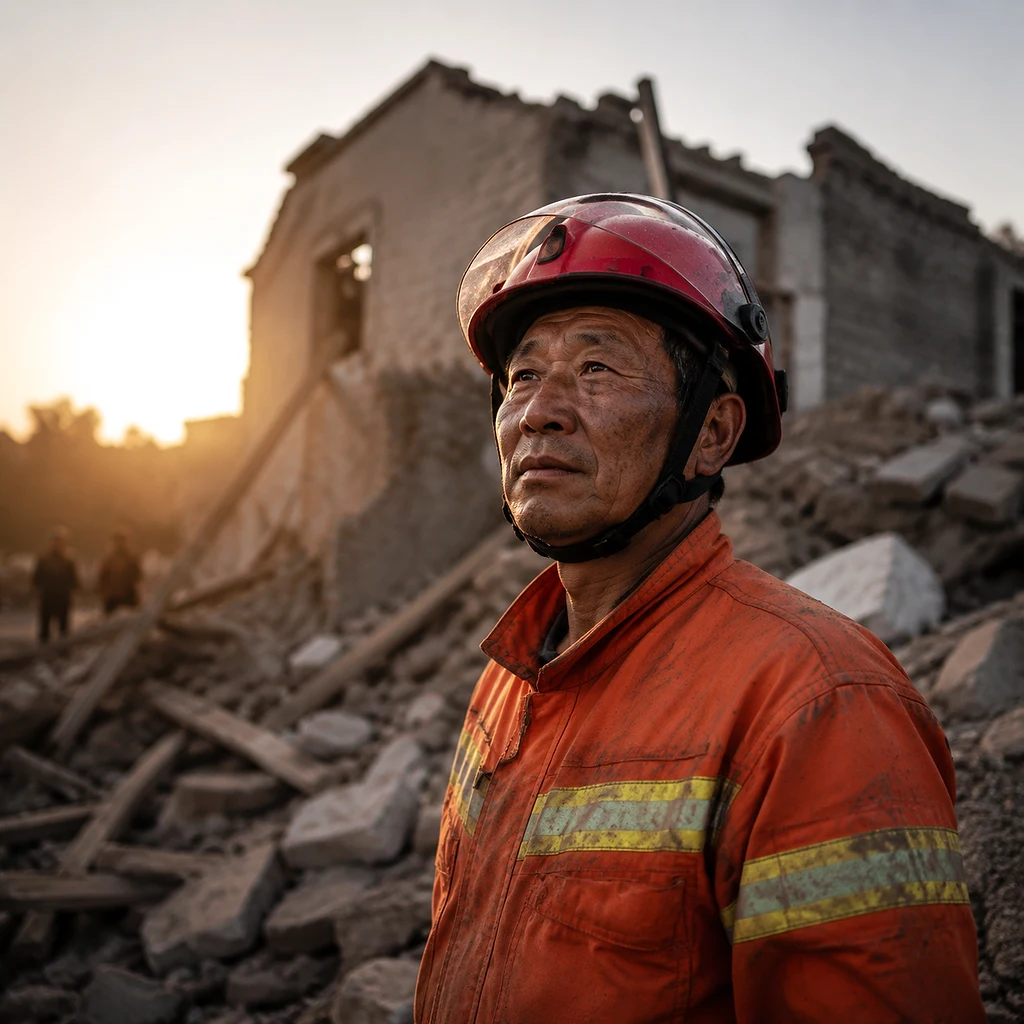
5.2 级:广西柳州凌晨地震
Rare 5.2 Earthquake Hits Guangxi
About this story
Rare 5.2 Earthquake Hits Guangxi. HSK 2 Chinese listening practice.
This is an HSK 2 Chinese listening episode that runs about 4 minutes. The full Mandarin script is shown with tap-for-pinyin and a line-by-line English translation, so you can listen and read at once — comprehensible input in the sense of Stephen Krashen's i+1 theory. It teaches 12 key vocabulary words such as 新闻、找、帮助 and walks through 4 grammar patterns, each explained in English with examples. The same news story is retold at 4 difficulty levels — use the level selector above to find the version that is challenging but still understandable for you.
Read at your level
原文Read the complete story in Chinese. Reveal pinyin and English only when you need them.
English transcript reference
May 18, the early morning.
Something happened in Guangxi.
It was an earthquake.
What is an earthquake?
An earthquake is when the ground moves.
The ground moves,
and the houses move too.
Many people are scared.
Where was the earthquake?
In southern China.
In Guangxi.
Guangxi is a big region in southern China.
Guangxi has many people.
Fifty million.
The center of the earthquake
was Liuzhou.
Liuzhou is a big city in Guangxi.
In Liuzhou,
about four million people live.
The time of the earthquake
was 0:21 in the early morning.
That's a little after midnight.
Everyone was sleeping.
On the evening of May 17,
Liuzhou had actually already shaken three times.
All small.
Magnitude 2.5,
3.0,
3.2.
People felt them,
but nothing happened.
But by the early morning of May 18,
all of a sudden,
the ground shook hard.
Magnitude 5.2.
What does 5.2 mean?
Not big,
not small either.
People can feel it.
Small, old houses
might fall.
Big new buildings
generally don't fall.
This earthquake
woke up everyone in Liuzhou.
Everyone ran outside.
Some cried outside.
Some made phone calls outside.
Some looked for their family outside.
The earthquake wasn't only in Liuzhou.
Nanning shook too,
Guilin shook too.
Hong Kong shook too.
People in many places said:
"I felt it too.
In this earthquake,
13 houses collapsed.
3 people are missing.
4 people are not doing well.
And more than 7,000 people
can't sleep in their own homes tonight.
Right now everyone is helping.
Doctors have come,
rescuers have come.
People from other parts of China have come too.
Why is this earthquake
getting everyone's attention?
First,
Guangxi is not a place with many earthquakes.
The places in China with many earthquakes
are in the west.
Sichuan,
Yunnan,
Xinjiang.
Earthquakes in Guangxi
are rare.
People in southern China
don't usually know what an earthquake feels like.
So this time,
everyone was very scared.
Second,
it was an early-morning earthquake.
Early morning is when everyone is sleeping.
An earthquake when you're sleeping
means people don't know what to do.
There's no time to run.
So it's even scarier.
Third,
Guangxi has many old houses.
New houses are okay,
old houses can fall.
So the ones that fell this time
were all old houses.
Finally,
I want to tell you:
If you've never seen an earthquake before,
you don't know what an earthquake feels like.
You can study a little.
Where you live,
are there earthquakes?
At home,
do you have things you can grab and go?
Like water,
like food.
These are all important.
The people of Guangxi
need everyone's help right now.
We watch the news,
and we can help too.
China has always been like this:
when something happens in one place,
other places come to help.
Okay.
That's all for today.
Talk tomorrow.
Listen again
Try it without the transcript and notice what sounds clearer.
What vocabulary does this episode teach?
词汇News. The framing — 我们看新闻,也可以帮 (we watch the news, and we can also help).
To look for, to seek. After the quake, '有人在外面找家里的人' — people stood outside looking for their family.
To help; help. 'They need everyone's 帮助 right now.' Both noun and verb in Chinese — context decides.
Important. The narrator's call to action: '这些都很重要' — preparing water and food at home is important.
To cry. '有人在外面哭' — some people were crying outside, in the dark, after the shaking stopped.
Time, moment. Used constantly with 的 to mark when something happens: 地震的时候 = 'at the time of the earthquake'. Also 什么时候 = 'when?'
Earthquake. 地 (ground) + 震 (to shake). The episode explains it inline as 地动了.
A city. Liuzhou is described as a 大城市 (big city) with about 4 million people. 城 (city wall) + 市 (market).
The early morning hours (roughly midnight to dawn). The earthquake hit at 凌晨 0 点 21 分 — just after midnight, when everyone was asleep.
To fall over, collapse. 房子倒了 = the house collapsed. Different from 摔倒 (a person falls down).
House, building. The episode contrasts 新房子 (new buildings, generally don't fall) with 老房子 (old buildings, more likely to fall).
To be afraid. 很多人都怕 — many people were scared. Often used as a one-syllable verb; the disyllabic 害怕 is more formal.
* beyond level超纲词
What grammar patterns appear in this episode?
语法可是 + clause (contrast)
可是 = 'but,' the conversational counterpart of the more formal 但是. The episode pivots on it: small foreshocks, 可是 then a 5.2 hit.
可是到了 5 月 18 号的凌晨,一下子,地大动了。
可是这个地震,没有很大。
第一... 第二... 第三...
Numbered enumeration. The narrator breaks 'why is this earthquake notable' into three clean reasons. A pattern any explainer-style Chinese audio uses constantly.
第一,广西不是地震多的地方。
X 的时候 + clause
Standard time-marker. The episode uses it for the disaster moment — 睡的时候地震 (an earthquake when you're asleep), which carries the whole danger of timing in one phrase.
睡的时候地震,人不知道怎么办。
比如 + Noun (example marker)
比如 introduces an example. The narrator uses it in the practical advice section — 比如水,比如吃的东西 — 'like water, like food.' Compact, conversational, useful any time you list examples.
比如水,比如吃的东西。
Proper nouns
专有名词Free account
Keep learning from this story
Create a free account to keep saved words and your preferred level together.
- Keep words with their story context
- Remember your preferred level
- Build your vocabulary over time