Beijing Travel Guide: Forbidden City, Hutongs, Great Wall
Updated
The Forbidden City sells out a week ahead, so book it before you fly. Around it are the hutongs, lanes of grey courtyard houses, and 70 km north is the Great Wall at Mutianyu.
There is a short audio story about Beijing in Mandarin, with English alongside. No Chinese needed for the beginner version. Jump to the storyA short history of Beijing
Kublai Khan, the Mongol emperor of China, made the city his capital in the 1270s. The Ming emperor Yongle rebuilt it from 1406, and his plan is the one you walk today: a walled palace at the centre, a 7.8 km north-south axis through it from the Bell and Drum Towers down to Yongdingmen, and everything else set square to that line. In 2024 UNESCO listed the axis itself as World Heritage.
Twenty-four emperors ruled from the Forbidden City until the last one abdicated in 1912. The palace opened as a museum in 1925. The hutongs around it went on being lived in, which is why Beijing still feels like one city rather than a monument with a modern town attached.
The Forbidden City
故宫 Gùgōng
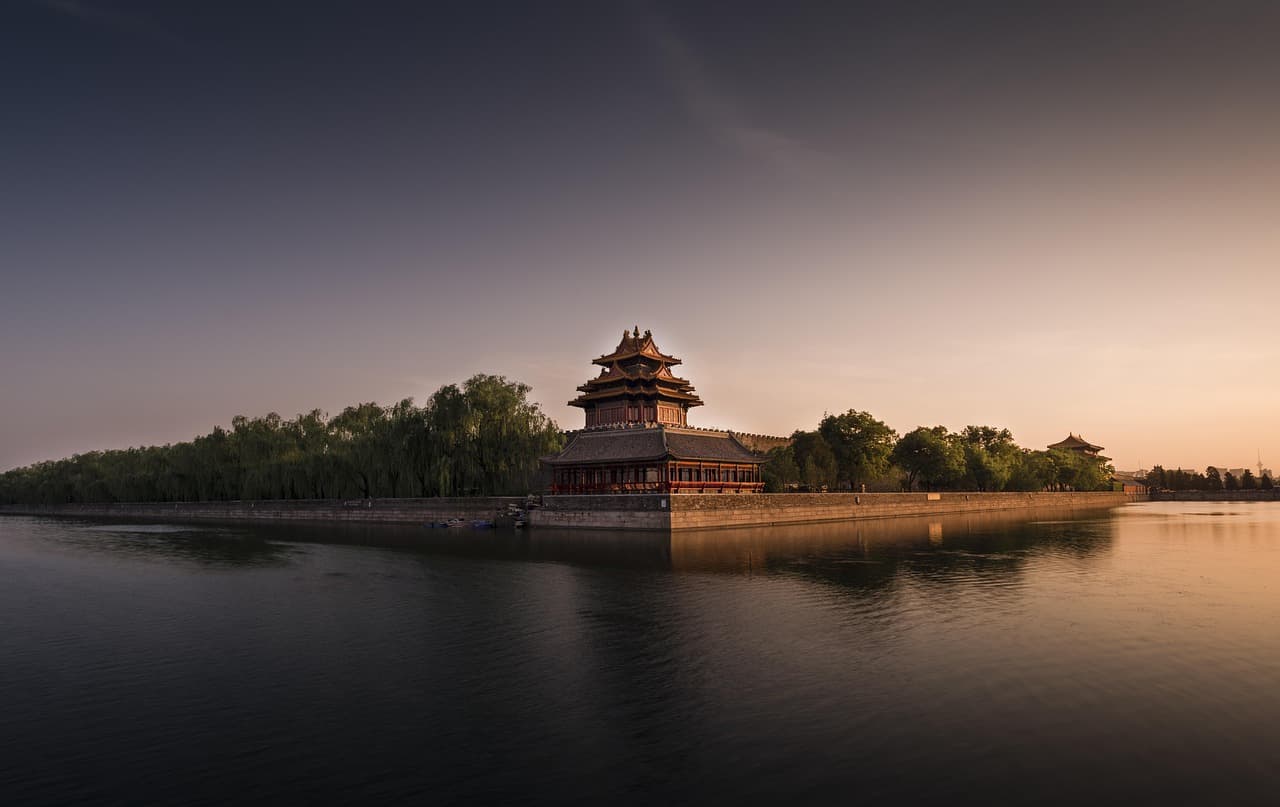
The Forbidden City is the largest palace complex in the world: 72 hectares and 980 surviving buildings, put up between 1406 and 1420. You enter through the Meridian Gate in the south and walk north through courtyards and halls that get smaller and more private as you go. First the outer court, where the state did its business, then the inner court, where the emperor and his family lived.
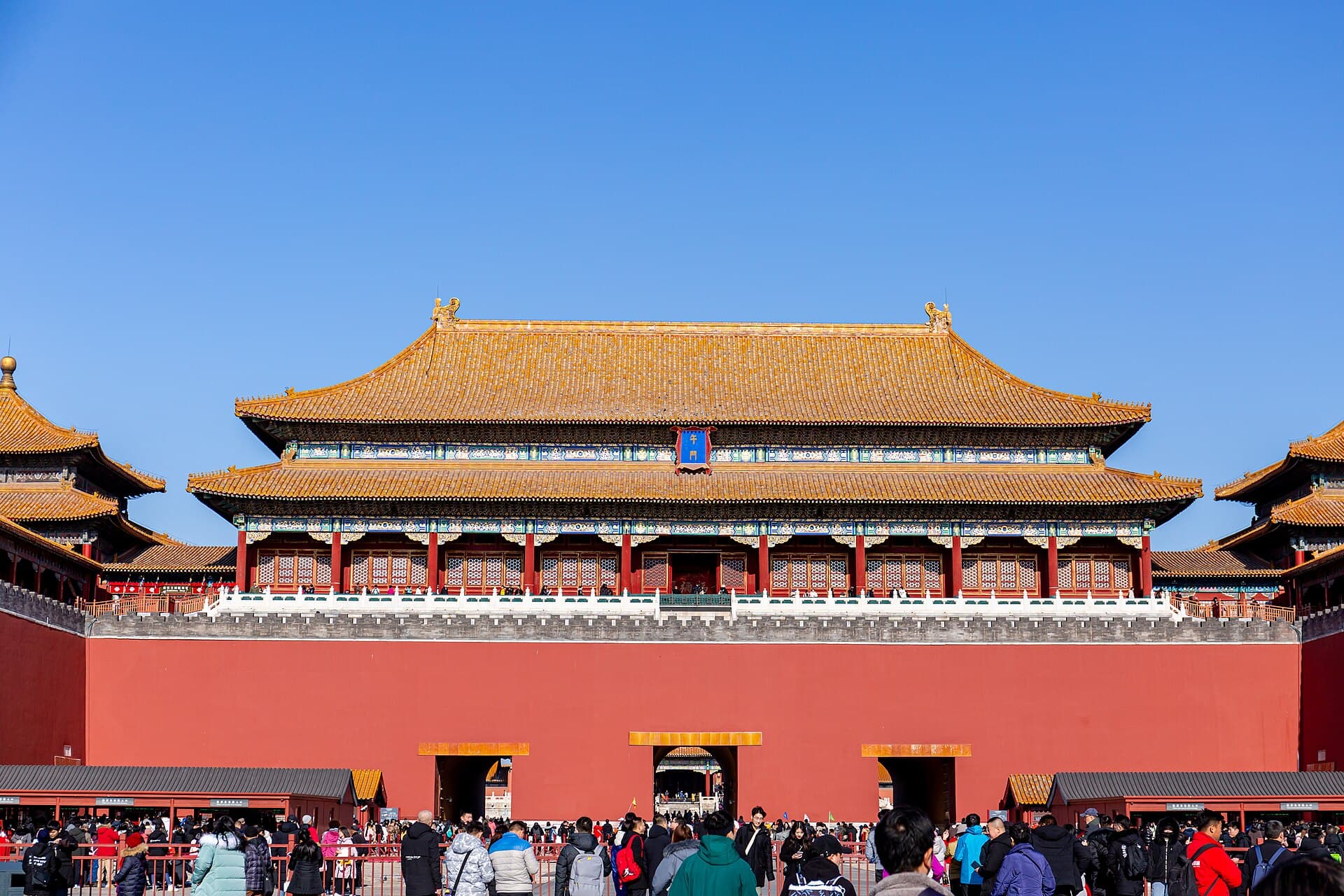
Don’t try to see all of it. The Treasure Gallery and the Clock Gallery on the east side are worth their small extra ticket. Two to three hours is plenty, and the museum’s own audio guide is good.
How to visit the Forbidden City
- 1
Book ahead, by name
Book on the museum’s own site, bookingticket.dpm.org.cn, which has an English version: a passport number and an email are enough. Tickets go on sale at 8 pm Beijing time, seven days ahead, and summer dates go fast. Trip.com and Klook resell them at a mark-up, or ask your hotel. Closed on Mondays.
- 2
Enter from the south
Come in through the Meridian Gate and leave by the north gate; you cannot enter from the north. Tiananmen Square, in front, has its own security check and its own reservation, so allow time if you want both.
- 3
Walk the line, then one side
The central axis takes you through the three great halls. From there choose east, for the Treasure Gallery and the Nine-Dragon Screen, or west, for the quieter palaces. Trying both is how people end up exhausted at hall number twelve.
- 4
Finish on Jingshan
Cross the road from the north gate and climb the hill in Jingshan Park. From the top you look back over every golden roof you just walked under.
Bring the passport you booked with; it is checked at the gate. Water and toilets are inside. There are a few simple cafés, but eat first.
Things to do in Beijing beyond the palace
Jingshan and the hutongs are a walk from the palace. The Temple of Heaven is a metro ride south. The Wall is a day.
Jingshan Park 景山公园
Jǐngshān Gōngyuán
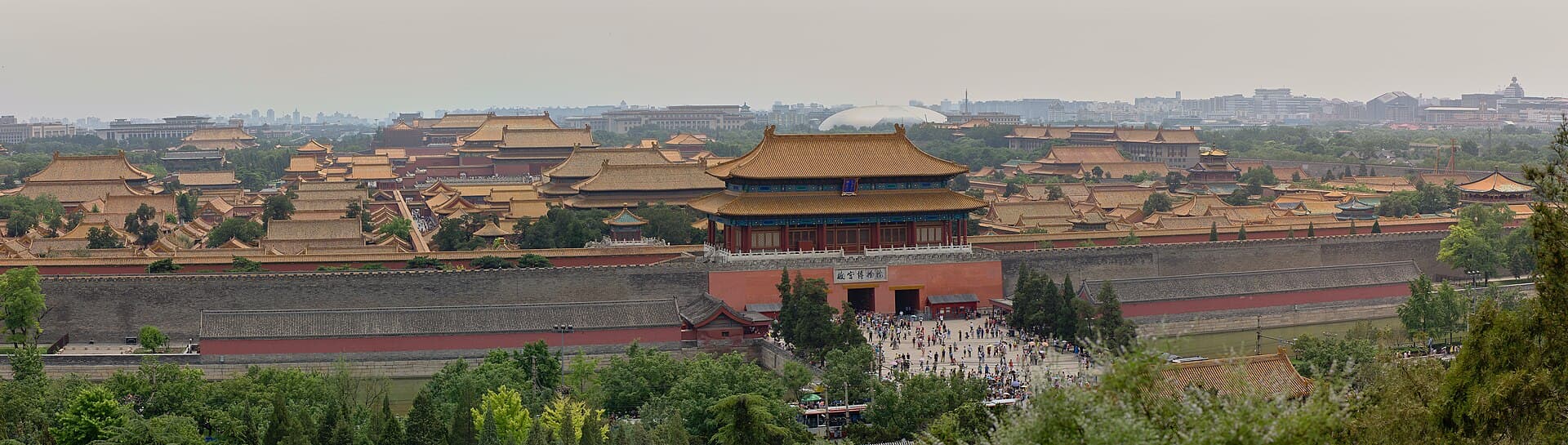
The hill is man-made, piled up in 1420 from the earth dug out for the palace moat. It is 46 metres high and has the best view in the city. Go at sunset. The locals in the park below will be dancing.
The hutongs 胡同
hútòng
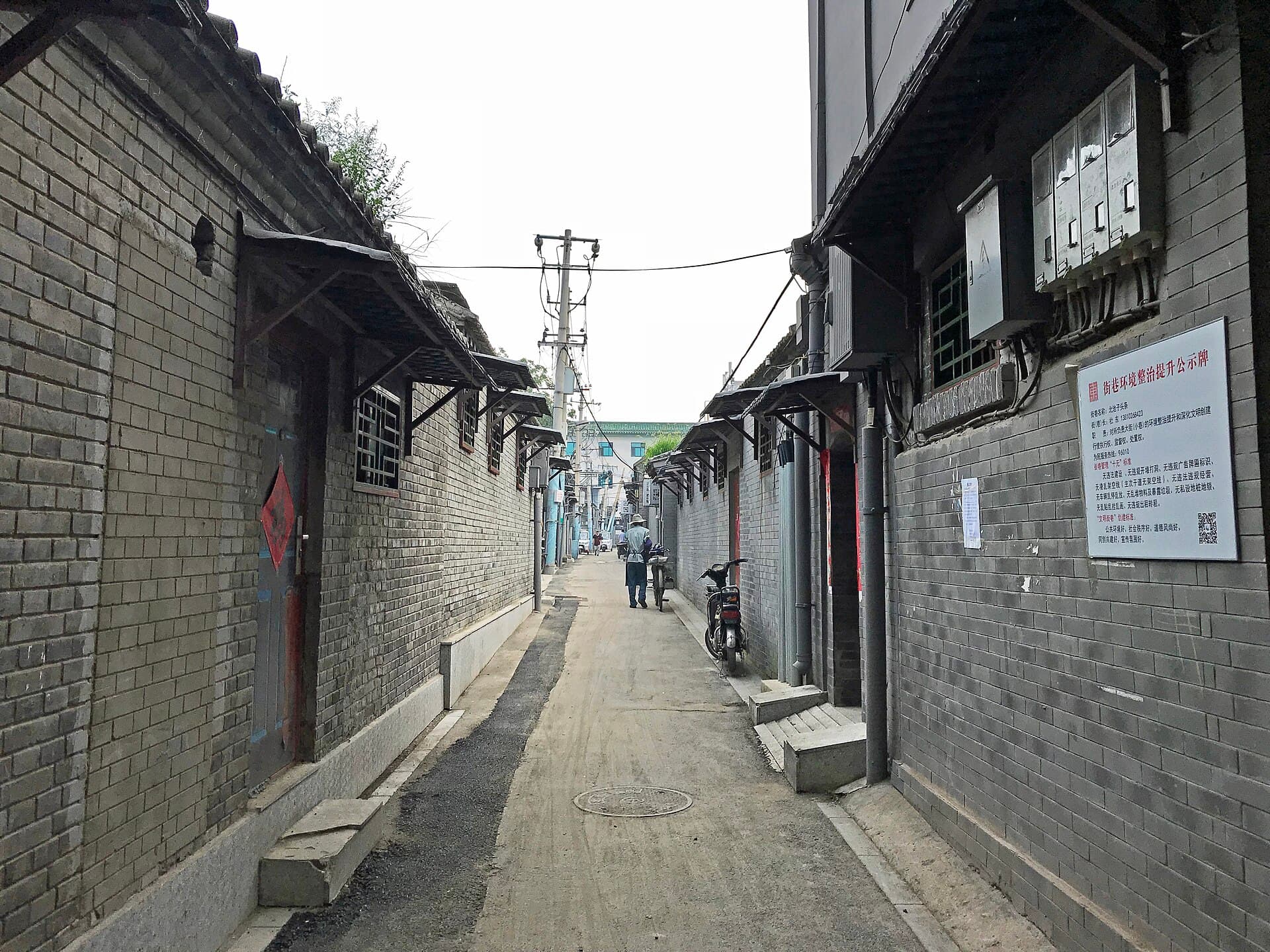
Hutongs are the lanes between courtyard houses. The ones around Shichahai and the Drum Tower are the easiest to walk. Nanluoguxiang is the busy one; the lanes off it are the point. Go early, before the shops open, while it is still a neighbourhood.
The Temple of Heaven 天坛
Tiāntán
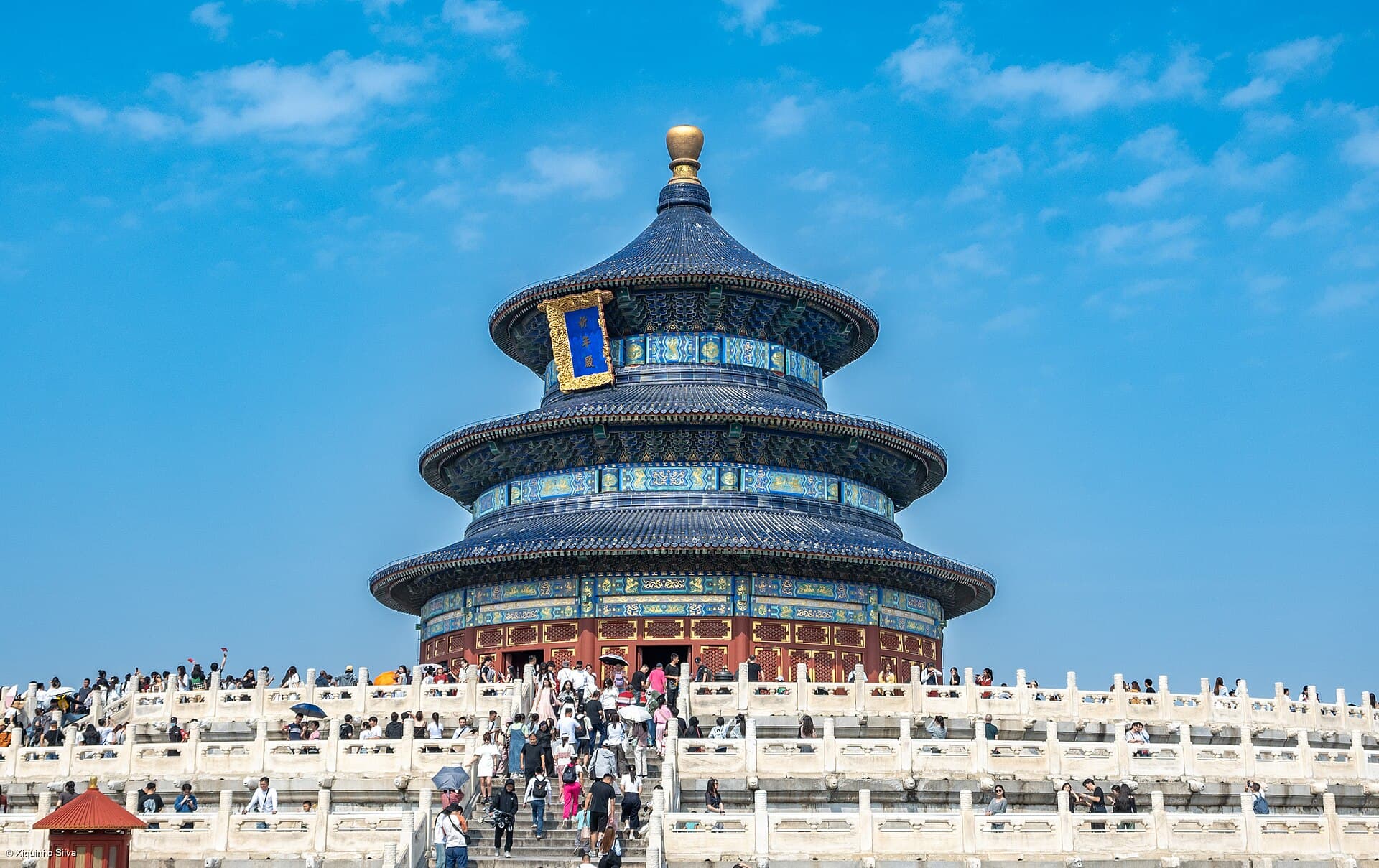
Where the emperor came at the start of each year to pray for a good harvest, built in 1420 and set in a huge park. Come in the morning: the park fills with people doing tai chi, playing cards and singing, and the round blue-roofed hall is at the far end of all that.
The Great Wall at Mutianyu 慕田峪长城
Mùtiányù Chángchéng
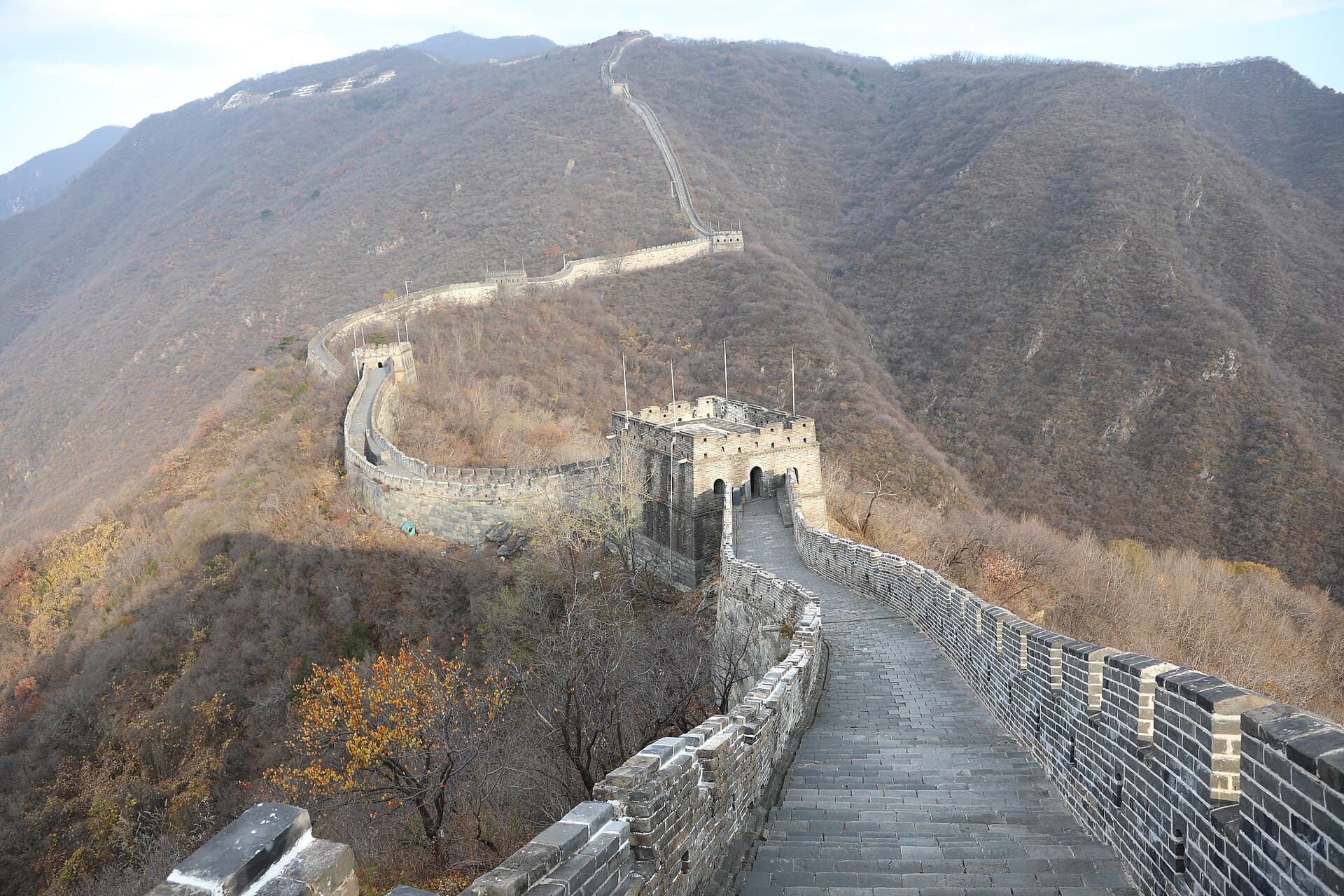
About 70 km northeast of the city: restored, with a cable car up and a toboggan down, less crowded than Badaling and with more wall to walk. Most hotels sell a trip with a driver. On your own, take the 916 Express bus from Dongzhimen to Huairou, an hour or more, then a taxi for the last 20 minutes. Allow the whole day.
What to eat in Beijing
Peking duck 北京烤鸭
Běijīng kǎoyā
Roasted until the skin cracks, carved at the table, wrapped in thin pancakes with cucumber, spring onion and sweet bean sauce. Quanjude is the old name. Locals will send you to Siji Minfu instead.
Zhajiang noodles 炸酱面
zhájiàngmiàn
Thick wheat noodles with a salty fried soybean-paste sauce and a pile of shredded vegetables. The home dish of the city.
Jianbing 煎饼
jiānbing
The breakfast crepe from the street cart: batter, an egg, a crisp cracker, coriander and chilli sauce, folded and gone in a minute.
Plan your trip to Beijing
Best time to visit Beijing
September and October are best: dry, clear and cool. April and May are good too, though spring brings wind and the odd dust storm. July and August are hot and wet, with thunderstorms and school-holiday crowds. January is dry, sunny and well below freezing at night.
Avoid Golden Week, the first week of October, when the whole country travels, and Chinese New Year.
Getting to Beijing
Capital Airport is about 25 km northeast; the Airport Express reaches Dongzhimen, on metro Lines 2 and 13, in 20 to 30 minutes. Daxing Airport is far to the south; its airport train takes 20 minutes to Caoqiao, where you change to the metro. A taxi from either takes about an hour.
Fast trains from Shanghai, about 4½ hours, arrive at Beijing South. Most Xi’an trains use Beijing West, and the fastest Harbin trains Beijing Chaoyang.
Getting around Beijing
The metro reaches almost everything on this page, with station names and announcements in English. Tap a contactless Visa or Mastercard at the gate, or use the Alipay transit code. Bags are X-rayed at every station.
For taxis, use Didi: it works in English, takes foreign cards and shows the driver your address in Chinese. Pay for everything else with Alipay or WeChat Pay. Small restaurants rarely have English menus.
Where to stay in Beijing
Stay in Dongcheng, the old city east of the palace. The hutongs around the Drum Tower and Nanluoguxiang have courtyard guesthouses a walk from Jingshan. Wangfujing, east of the palace on Line 1, has the bigger hotels. Sanlitun, further east, is for bars, not sightseeing.
Beijing in three days
- Day 1. The Forbidden City from opening time, lunch outside, then Jingshan for the view at sunset.
- Day 2. The Temple of Heaven early, while the tai chi is on. The hutongs around Shichahai and the Drum Tower in the afternoon, Peking duck at night.
- Day 3. The Great Wall at Mutianyu. Leave early, walk a long stretch, take the toboggan down.
Questions about visiting Beijing
Do you need to book the Forbidden City in advance?
Yes. There are no ticket windows. Book on bookingticket.dpm.org.cn with your passport number, from 8 pm Beijing time seven days ahead, and bring the same passport.
Which section of the Great Wall is best from Beijing?
Mutianyu for most people: restored, good views, a cable car, and fewer crowds than Badaling. Jinshanling is further out and wilder. Badaling is the closest and the busiest.
Is Beijing easy to get around without Chinese?
Yes. The metro has English signs and announcements. Taxi drivers rarely speak English, so use Didi or have the address in Chinese.
Can you pay with a foreign card in Beijing?
Mostly through your phone. Link your card to Alipay or WeChat Pay before you arrive; both take Visa and Mastercard. Keep a little cash for street stalls.
Beijing or Shanghai?
Beijing for the palace and the Wall; Shanghai for the riverfront and the food. With a week, do both: the fast train takes about 4½ hours.
Chinese you’ll see in Beijing
On the signs, the tickets and the metro map.
The line under each word is pinyin, the Chinese sounds written in our alphabet. The marks over the vowels are tones; people will understand you without them at first.
- 北京Běijīng
- Beijing, "northern capital"
- 故宫Gùgōng
- the Forbidden City, literally "former palace"
- 胡同hútòng
- hutong, a lane
- 长城Chángchéng
- the Great Wall
- 天坛Tiāntán
- the Temple of Heaven
- 门mén
- gate, as in the station names Dongzhimen and Qianmen
- 公园gōngyuán
- park
- 地铁dìtiě
- metro
- 烤鸭kǎoyā
- roast duck
- 出口chūkǒu
- exit
Want more? Browse Chinese vocabulary by level.
Hear Beijing in Mandarin
Our audio story follows one day in Beijing: in through the Meridian Gate, up Jingshan, and out into the hutongs.
The story is Beijing: The Hill Made From the Palace's Own Moat. It is told four ways, one for each level. Every version has a transcript with pinyin and English, so start with Beginner if you have no Chinese yet.